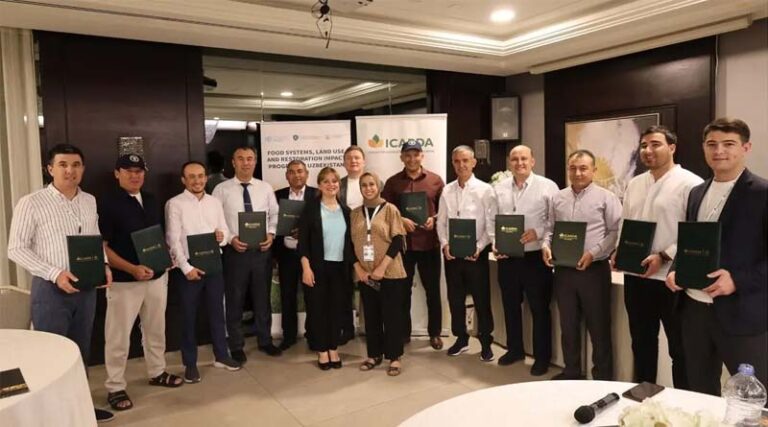
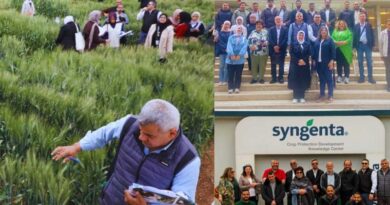
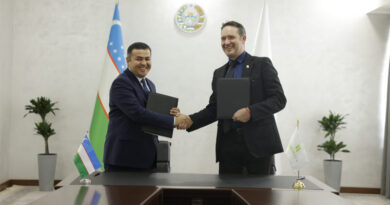
24 August 2026, Jordan: ICARDA, under the Food Systems, Land Use and Restoration Impact Program in Uzbekistan (FOLUR) and the Water Scarcity Initiative (WSI), recently organized, in collaboration with Jordan’s NARC, a Field Academy to strengthen South–South knowledge exchange and showcase science-based approaches to water scarcity, land degradation and Landscape restoration in drylands.
The event, themed “From Rain to Restoration,” brought together participants and technical specialists from Jordan and Uzbekistan to explore how Jordan’s experience could inform approaches adapted to Uzbekistan’s landscapes and local conditions. Over eight days, the participants took part in a diverse program of technical sessions, field demonstrations, hands-on training, institutional exchanges, action planning, and field visits to soil and water conservation and restoration sites across the country.
Field Academy Opens with a Focus on Rainwater Harvesting Types and Principles Consideration for Design
The Field Academy kicked off with a technical day in Amman on 26 July, setting the tone for the sessions that followed and introducing participants to the principles and practical applications of rainwater harvesting in drylands.
Key topics included rainwater-harvesting approaches, technique selection, basic design calculations, landscape restoration, monitoring, site suitability, policy and economic considerations, water-spreading systems in Azraq, Jordan’s historical rainwater-harvesting systems, and nursery management for producing quality seedlings for dryland restoration.
With the principles established, the program moved from discussion to demonstration. Participants visited the WADI NGO nursery to see how quality seedlings are produced for hot, dry conditions, then made a first working visit to the Khanasri Rangeland Research Station to explore soil-moisture monitoring and rainwater-harvesting techniques used to restore rangelands, a site the group would return to two days later for a broader joint opening.
WSI-FOLUR Joint Technical Day at Khansari
On 28 July, participants returned to the Khanasri Rangeland Research Station for a joint technical day, held with the support of the Ministry of Water and Irrigation, where ICARDA, Jordan’s National Agricultural Research Center (NARC), and the Uzbekistan delegations were joined by UN Food and Agriculture Organization (FAO), Mafraq Municipality and Governorate, and local NGO representatives to take stock of progress and lessons from activities implemented in Jordan under the WSI program and FOLUR–Uzbekistan.
“This Field Academy forms a scientific platform for exchanging regional experiences, building technical capacities, and reviewing the latest practical applications in designing rainwater harvesting systems, hydrological monitoring, and tracking rangeland recovery, alongside reviewing successful experiences in treated wastewater reuse and integrated basin management, following the water-energy-food-ecosystems nexus approach.” – Dr. Zakaria Musallam, Acting Director General, NARC
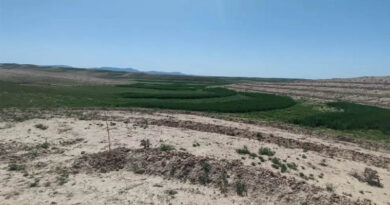
“The nine rainwater-harvesting techniques showcased at Khanasri are designed to restore rangelands by retaining water in the soil, rather than simply collecting it and allowing it to be lost to evaporation or evapotranspiration. This creates opportunities to increase vegetative cover through rangeland shrubs, indigenous trees and crops that can grow under such difficult climatic conditions.” – Dr. Mira Haddad, Research Associate, ICARDA
Dr. Mustafa Shediefat, head of NARC – Mafraq Center : “Today, As part of our work with international organizations such as the International Center for Agricultural Research in the Dry Areas (ICARDA), we are testing and applying new technologies at our Al-Khanafiery site to evaluate their effectiveness. The goal is to help farmers make better use of water. By providing even limited quantities of water efficiently, farmers can improve the rangelands they depend on.”
Water and Restoration Sites Across Jordan
From 28 to 30 July, the program continued across a series of field sites. At the As-Samra Wastewater Treatment Plant and King Talal Dam, they examined treated-wastewater reuse and integrated water management through the Water–Energy–Food–Ecosystem Nexus. A reflection and design session at Ajloun Forest Reserve gave the group time to work through calculations and technique-selection exercises, before visits to the Al-Majidiya community watershed and a Dead Sea permaculture farm showed how Jessour and Marab systems, community governance and multi-layer planting can sustain restoration over the long term.
Towards the Development of Restoration Action Plans for Uzbekistan
Participants’ recommendations included:
Choosing rainwater-harvesting techniques to fit local conditions, rather than applying one solution everywhere.
Starting with small demonstration sites, monitoring how they perform, and adapting the design before any wider scaling.
Pairing physical water-harvesting measures with vegetation restoration, productive land use and nursery development.
Monitoring results across soil moisture, plant survival, vegetation recovery, erosion and agricultural productivity.
Engaging farmers and communities from the planning stage, with clear responsibility for operation and maintenance.
Connecting field implementation with research institutions, government agencies, FAO, FOLUR, WSI, ICARDA and other partners, so evidence from the pilots can inform future scale-up and policy.
Moving forward, ICARDA will continue to strengthen South–South cooperation and work alongside national partners and governments to deliver science-based restoration and water-management solutions for resilient, food-secure communities across the drylands.
Global Agriculture is an independent international media platform covering agri-business, policy, technology, and sustainability. For editorial collaborations, thought leadership, and strategic communications, write to pr@global-agriculture.com