Potassium Nutrition Recalibrated For Non-sandy Soils
06 August 2026, AU: Potassium deficiencies are increasingly prevalent in non-sandy soils across Australia’s grain regions, necessitating targeted research to optimise fertiliser strategies.
Potassium (K) deficiency is increasingly being detected in heavy textured soils and is becoming severe enough to limit yield at sites that previously did not display deficiencies.
Historically a problem for sandy soils, K deficiency in other soil types is now the target of a GRDC investment via a project led by Professor Mike Bell at the University of Queensland.
Professor Bell explains that Australia has a negative K balance of about 400 kt per year. This amounts to K removal from the system at 3 times the rate it is applied across agricultural areas. The greatest deficits are where whole crop removal has occurred for hay, mulch or bioenergy crops.
“The continuous deficit over time has increased the area of cropping considered marginal or deficient for K,” he says.
“Growers have raised K management and the impacts of running a negative K balance at National Grower Network (NGN) forums across all GRDC regions.”
In the past, growers reported that they were seeing K responses in paddocks where testing, using industry critical values, showed they should not have been deficient. However, these values were developed on Western Australian sandy soils.
A previous project (UOA2201-002RTX), which originated from the NGN in South Australia, led to the identification of heavier-textured, potassium-responsive soils. This work has helped pave the way for re-establishing critical values for different soil types.
“This new project will explore K response dynamics in a spectrum of non-sandy soil types with the explicit goal of providing growers and agronomists with the answers they are seeking.”
The response will take the form of knowledge and tools to identify when a K deficiency is likely. It will also provide all regions with knowledge to improve fertiliser K application strategies to maximise use efficiency and the return on investment.
New calibrations
The previous research was conducted by a University of Adelaide team led by Dr Nigel Wilhelm. It included Sam Trengove of Trengove Consulting, who helped establish a key insight: K recommendations generated for sandy soil are unlikely to transfer over to heavier soils.
Now working within the new project, Mr Trengove says that a key industry standard will need to be recalibrated for heavier soils – the ‘K deficiency threshold’.
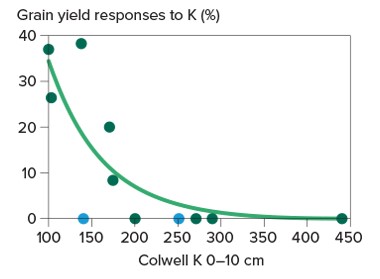
Figure 1: The relationship between soil Colwell K status (at 0 to 10 cm) and grain yield response (%) to applied K fertiliser
Source: Trengove Consulting
This threshold is measured as the ‘critical Colwell K value’, the soil test concentration (in mg/kg) of available K. This value indicates whether a fertiliser response is likely.
“Predicting crop response is especially difficult on heavier soils, as current critical Colwell K values are largely based on Western Australian sandy soils,” Mr Trengove says.
For example, levels below 50 mg/kg are typically considered deficient in Western Australia sandy soils. Values of 50 to 70 mg/kg are considered moderate. Above 70 mg/kg and K concentrations are labelled sufficient.
In sharp contrast, Mr Trengove has detected a yield response in wheat (but also barley and lentils) at Colwell K ranging from 98 to 175 mg/kg on Yorke Peninsula soils (see Figure 1).
“This indicates that the critical K threshold is higher for heavier soils than the current industry standard of 45 mg/kg,” Mr Trengove says.
There is an additional point of difference that matters greatly – the location of K in the soil profile relative to where the soil moisture is located. Research is finding that the optimal K application method will vary depending on how rainfall impacts the location of K in the soil and where crop roots are active.
That’s why understanding K dynamics (the movement and behaviour of K within the soil and plant) is central to the research project’s design.
Crop uptake dynamics
Professor Bell explains that K can wash to the bottom of the soil profile in sands during wet years. As such, there is no benefit to applying more K than is needed by the crop.
In contrast, it is possible to bank K in other soil types and building these reserves can amount to an optimal strategy to capitalise on good seasons.
“Sandy soil lacks the means to hold on to K, but clay soil can,” Professor Bell says.
“The challenge we face is that K dynamics are affected by rainfall patterns that differ dramatically in northern and southern regions.”
In the south, yields are dependent on in-crop rainfall. As such, if the top layers of soil are enriched for K, then the crop usually can make use of it since K will move down the soil profile with the water and become available where roots are active. That means shallow K fertiliser placement (broadcast or preferably drilled into the top 10 cm of the profile) is a viable option.
In the north, water from fallow rainfall is stored in the soil for use in the next crop season. That ‘bucket of water’ within the soil profile is relied on by crops, as in-season rainfall can be highly variable and sporadic.
As such, the topsoil can dry out, which renders K in those dry soil layers unavailable to the crop. In these cases, options such as deep banding (into subsoil layers that are slower to dry out) may be necessary.
“The strategy that works in the south will not work in most years in the north,” Professor Bell says.
“Context is going to matter and that meant setting up a network of research sites across parts of Australia with different seasonal conditions and soil K dynamics.”
As such, the project aims to provide all regions with knowledge to improve K fertiliser use efficiency strategies specific for their soils.
The new project
To gain the required insights, studies are being conducted in field trials, laboratories and glasshouses across varying soil types and environments. These are assessing the crop responsiveness and quantifying the recovery of applied K fertiliser.
Crop types under investigation for K nutrient response will primarily focus on winter cereals (wheat and barley) and legumes and oilseeds grown in rotation with them (lentils, faba beans, chickpeas, canola). However, seasonal water availability may result in some summer sorghum being grown in northern sites.
The project was launched in March 2025 and will run until 2029, with recommendations developed and extended to growers as part of the project.
Testing will assess a wide range of sites in Queensland, New South Wales, South Australia and Victoria. The project has adopted a ‘hub and spoke’ model, in which a hub of intense research activities feeds information to a larger series of grower groups and paddock trials (the spokes).
Outputs
The project will explore 3 main questions.
What is the best methodology for testing soils in ways that are predictive for K response?
This will entail studying K and soil moisture levels in different soil layers at a wide range of sites. The aim is to understand the relationship between K availability, seasonal water fluctuations and crop response.
What is the most effective K application strategy?
The aim is to achieve recommendations specific to soil type and climate, based on predictive critical K threshold values for the soil. This will mean establishing how much K a crop needs, where K is present in the soil and how available it is. This understanding will guide comparisons of application strategies, with the project ultimately putting the validated approaches through an economic analysis.
How much of applied K is recruited into the plant over time?
Trials using a trackable K isotope will study what happens to applied K, how much makes it into the plant and what variation occurs with different application strategies. As K isotopes are expensive, the project will also investigate alternative techniques for tracing K uptake. Adelaide University is working with the University of Queensland on this.
They are also testing a technique that looks to measure the changes in soil K supply in response to fluctuations in soil water content over a growing season. This aspect of the project will help clarify the observations of variation in K response at a site across seasons.
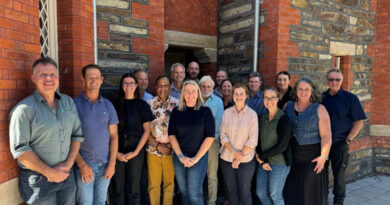
“What excites me about this project is the participation of growers, since the hub-and-spoke model means we are working in people’s paddocks,” Professor Bell says.
It also means growers, grower groups and agronomists will have a front-row seat to the results and watch as we take crop productivity to another level.
Extension efforts will include field days and walk-throughs that get underway for the first time in 2026. Recent GRDC Grains Research Update papers are also available from both Professor Bell and Mr Trengove.
The key collaborators include:
- Mike Bell, School of Agriculture and Food Science, Gatton campus, University of Queensland
- Chris Guppy and Richard Flavell, Agronomy and Soil Science, University of New England, Armidale
- David Lester, Department of Primary Industries, Leslie Research Centre, Toowoomba
- Doug Sands, Department of Primary Industries, Leslie Research Centre, Emerald
- Nigel Wilhelm, Farming Systems, South Australian Research and Development Institute, Waite Research Precinct, Adelaide
- Shihab Uddin, Department of Primary Industries and Regional Development, Wagga Wagga.
Also Read: FMC to Launch New Herbicide Keenali for Paddy Weed Control in India
Global Agriculture is an independent international media platform covering agri-business, policy, technology, and sustainability. For editorial collaborations, thought leadership, and strategic communications, write to pr@global-agriculture.com