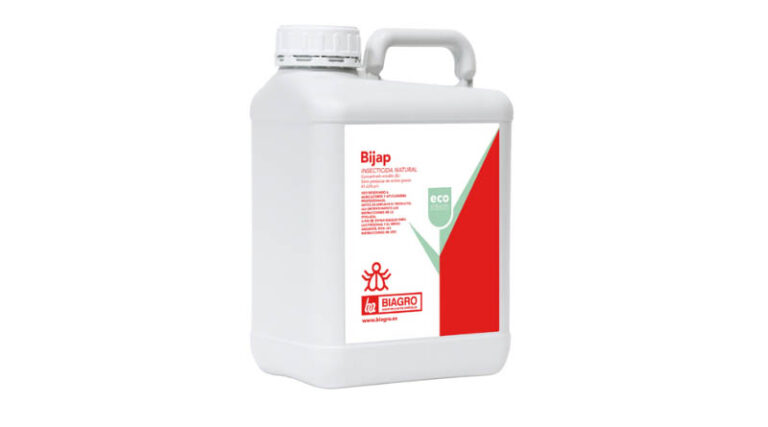
Biagro Bijap: Bioinsecticidal Potassium Soap for Pest Control
04 August 2026, Valencia: Potassium soap-based bioinsecticides represent one of the longest-standing and most well-understood tools in natural pest management, valued for their straightforward physical mode of action, favorable environmental and safety profile, and low risk of contributing to resistance development in target pest populations. Bijap is formulated specifically as a bioinsecticide built around soluble potassium soap, offering growers a dedicated natural pest control tool designed to target soft-bodied insect pests common across a wide range of crops.
The mode of action underlying potassium soap-based insecticides like Bijap centers on physical disruption rather than biochemical toxicity. When applied to soft-bodied pests — aphids, whiteflies, mealybugs, spider mites, and similar species that lack the more robust protective cuticle characteristic of many hard-bodied insects — the potassium soap dissolves and disrupts the waxy protective layer covering the pest’s body. This disruption compromises the pest’s ability to regulate water loss through its cuticle, ultimately leading to desiccation and death. Because this mechanism operates through direct physical contact and disruption rather than targeting a specific biochemical pathway within the pest, it carries a fundamentally lower risk of resistance development compared to many synthetic insecticides that rely on more specific biochemical targets that pest populations can potentially evolve around over repeated exposure.
This physical mode of action also contributes to potassium soap’s generally favorable environmental and non-target organism safety profile. Because the mechanism depends on the specific cuticle characteristics of soft-bodied pests, beneficial insects with more robust cuticle structures — many predatory and pollinator species among them — tend to show considerably greater tolerance to potassium soap exposure compared to the target soft-bodied pests, making products like Bijap generally more compatible with integrated pest management programs that rely on beneficial insect populations for broader pest suppression than many broad-spectrum synthetic insecticide alternatives.
The “soluble” characteristic of the potassium soap formulation in Bijap matters for practical application purposes, ensuring the product mixes readily into spray solutions and achieves the thorough coverage necessary for the contact-based mode of action to be effective. Because potassium soap works through direct physical contact with the target pest, thorough spray coverage reaching the undersides of leaves and other areas where soft-bodied pests commonly congregate is particularly important for achieving reliable control results — a practical application consideration that distinguishes contact-based products like this from systemic alternatives that can achieve some degree of control even with less than perfectly comprehensive coverage.
Given the contact-dependent mode of action and the relatively short residual activity typical of potassium soap products compared to some synthetic insecticide alternatives, application timing and frequency often require more careful attention to actual pest population monitoring, with growers typically applying Bijap in response to observed pest pressure reaching action thresholds, potentially requiring repeated applications through periods of sustained pest pressure to maintain adequate control given the product’s more limited residual activity window.
Bijap’s compatibility with organic and reduced-synthetic-input production systems represents another significant practical consideration, since potassium soap-based bioinsecticides generally qualify for use within organic-certified production frameworks, subject to the specific certification standards applicable in a given region and crop, making products like this a relevant tool for growers operating under these more restrictive input frameworks where many conventional synthetic insecticide options aren’t available.
Practically, Bijap’s liquid, soluble formulation supports standard foliar spray application, integrating into broader pest management programs either as a standalone treatment for light to moderate soft-bodied pest pressure or as one component within a more comprehensive integrated pest management strategy.
For growers seeking a natural, contact-based insecticide option for managing soft-bodied pest pressure — particularly valuable for organic production systems or integrated pest management programs prioritizing beneficial insect compatibility — Bijap offers a well-established potassium soap bioinsecticide designed around this favorable and time-tested mode of action.
Also Read: Western Sydney International Airport Strengthens Australia’s Trade And Biosecurity Future
Global Agriculture is an independent international media platform covering agri-business, policy, technology, and sustainability. For editorial collaborations, thought leadership, and strategic communications, write to pr@global-agriculture.com