A Career Rooted in Purpose: Prof. K.C. Bansal Receives Lifetime Achievement Award at Biotech Innovations 2026
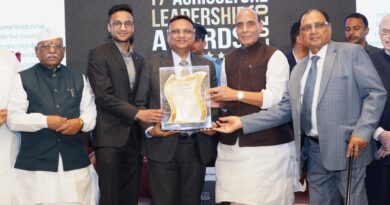
10 April 2026, New Delhi: At the International Conference on “Biotech Innovations 2026: From Discovery to Translation”, held in Jaipur from 26–28 March 2026, one name stood out not just for a career’s worth of discoveries but for decades of quietly shaping the trajectory of plant biotechnology in India and beyond. Prof. Kailash Chander Bansal was honoured with the Lifetime Achievement Award, a recognition that speaks as much to the breadth of his influence as to the depth of his science.
The conference, co-sponsored by the Department of Biotechnology (DBT), Govt. of India and the Department of Science and Technology (DST), Government of Rajasthan, and hosted by Suresh Gyan Vihar University, was inaugurated by Padma Shri Dr. Yogesh Kumar Chawla, Former Director of the Post Graduate Institute of Medical Education and Research (PGI), Chandigarh.
Science at the Scale of Global Hunger
Prof. Bansal’s research career has been anchored in one of agriculture’s most enduring challenges: how to grow enough food, of sufficient nutritional quality, in the face of a rapidly changing climate. His approach in bringing together functional genomics, genetic engineering, and genome editing has produced outcomes with tangible implications for food security at the global scale.
His work on the large-scale evaluation of plant genetic resources has identified trait-specific reference sets for climate resilience in wheat and chickpea — two crops that feed billions of people across South Asia, Sub-Saharan Africa, and the Middle East. These reference sets have become foundational tools for breeding programmes seeking to develop varieties capable of withstanding drought, heat, and salinity, and resistance to diseases.
Beyond identifying resilient traits, Prof. Bansal has advanced the discovery and cloning of stress-tolerance genes, enabling the development of transgenic crops engineered to perform under abiotic stress conditions. One striking example: a transgenic rubber crop incorporating the osmotin gene, developed through collaborative work at the Rubber Research Institute of India in Kerala, is currently undergoing field trials, a direct downstream result of gene constructs shared from Prof. Bansal’s laboratory.
Building the Infrastructure of Innovation
Individual discoveries, however significant, rarely transform agricultural systems on their own. Recognising this, Prof. Bansal devoted much of his career to creating the institutional architecture through which science can travel from laboratory to field.
His central role in establishing and leading ICAR’s National Transgenic Crop Network is emblematic of this approach. Through the network, his laboratory systematically developed and shared gene constructs with ICAR institutes, CSIR laboratories, a DRDO institute, and numerous universities across India. The result was a multiplier effect: improved transgenic crops developed across diverse agricultural systems, by teams that might never have accessed the necessary genetic tools independently.
As Director of the ICAR’s National Bureau of Plant Genetic Resources (NBPGR) from 2010 to 2016, he oversaw one of the world’s major repositories of plant germplasm, a role that positioned him at the intersection of conservation and innovation. During this period, he also served as Vice-Chair for Asia on the 15th Regular Session of the UN Commission on Genetic Resources for Food and Agriculture (2013–2015), bringing India’s scientific perspectives to global policy debates on genetic resource governance.
Shaping Policy, Enabling Progress
Science does not automatically translate into societal benefit, it requires regulatory frameworks that are both rigorous and forward-looking. Prof. Bansal has been a consistent force in pushing India’s agri-biotech regulatory environment in that direction.
His contributions to progressive biosafety regulation include, notably, advocacy for the exemption of specific categories of genome-edited plants from the more stringent biosafety requirements historically applied to transgenic crops. He also helped develop standard operating procedures to facilitate the commercialisation of genome-edited varieties — a practical bridge between laboratory innovation and farmer adoption that many countries are still struggling to construct.
As Chairman of the ICAR-NASF Technical Advisory Committee of the CRISPR Crop Network on Genome Editing in Plants, he has guided India’s national research agenda on one of the most consequential biotechnological platforms of the current era.
Training the Next Generation
A scientist’s legacy is measured not only in papers and patents but in the researchers they train and the institutions they strengthen. Prof. Bansal played a visionary role in formulating India’s World Bank-funded National Agricultural Higher Education Project (NAHEP), now implemented across 75 agricultural universities. The project is directly reshaping the quality and relevance of agricultural science education across the country.
Beyond formal education, he has been a committed communicator of science, engaging policymakers, farmers, civil society, and the general public in balanced and evidence-based conversations about GM crops and genome editing. In an era when public trust in agricultural biotechnology is both essential and contested, this kind of bridge-building carries real weight.
Also Read: Skymet Forecasts Below-Normal Monsoon for India in 2026 at 94% of LPA
Global Agriculture is an independent international media platform covering agri-business, policy, technology, and sustainability. For editorial collaborations, thought leadership, and strategic communications, write to pr@global-agriculture.com