Between the Wide Rows: What a Sugarcane Field in India Taught Us About the Future of Farming In South Asia
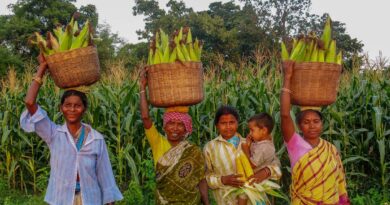
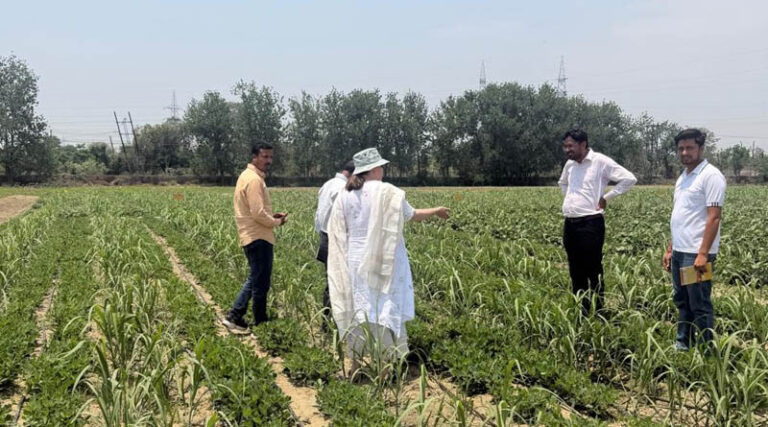
03 June 2026, New Delhi: There is something quietly extraordinary about standing in a sugarcane field in Meerut, India, watching a farmer kneel between the tall green stalks to check on his groundnut plants. Just two years ago, this farmer had never considered growing groundnut at the same time as sugarcane. Groundnut was something that came from a different corner of Uttar Pradesh’s agricultural belt, not from here. And yet here he is pulling up a healthy plant, holding it up to the light, and assessing the plump pods which will bring him a good second income this season.
This is what effective agricultural transformation looks like — not loud, not sudden, but steady, confident, and visible in the farmer’s own hands. In this way, CIMMYT is transforming our strategy and vision into tangible change in the field, creating sustainable pathways for ongoing agronomic productivity and smallholder profitability.
What Is Additive Intercropping and Why Does It Matter?
Sugarcane is planted in wide rows, has high fertilizer and water inputs, and is a long-duration crop. Being also a high-income-generating and relatively low-labor crop, sugarcane has, for decades, dominated western Uttar Pradesh in a rotation of plant crop, ratoon, and wheat. While this is profitable in the short term, it has been slowly depleting the soil of nutrients and increasing farmers’ climate risk.
Additive intercropping changes the agronomic balance without asking farmers to give anything up. The key insight is simple: in larger crops like maize and sugarcane it is necessary to plant the crops at relatively wide spacing (60+ cm rows) to ensure there is sufficient room for the mature crop. This means that early in the season there is room to add a smaller, short-duration crop into the cropping system without reducing the yield of the main crop. In sugarcane, groundnut fills the interrow space beautifully. It grows low, suppressing weeds and acting as a living mulch to conserve soil moisture, fixing nitrogen from the air into the soil, and is ready for harvest well before the sugarcane canopy closes.
In on-farm trials led by CIMMYT-BISA and the Indian Council of Agricultural Research-Indian Institute of Farming Systems Research (ICAR-IIFSR) in western Uttar Pradesh in India, farmers achieve up to 10% higher sugarcane yields due to the living mulch and nitrogen enrichment effects from the intercrop.
On-station experiments additionally quantify the value of growing wide-row crops in paired rows to maximize the space available for intercultural operations and top dressing, and demonstrate that when paired with surface and sub-surface irrigation systems, water-use efficiency increases by 75-80%.
When the CIMMYT-BISA-ICAR team first introduced groundnut to this belt, farmers had questions. These farmers knew sugarcane like the back of their hands. But groundnut? “What would we do with it?” “How do we grow it, harvest it, store it, and sell it?”
Now, three years later, those same questions have become expertise. Farmer after farmer spoke about their intercropped groundnut with the quiet pride of someone who has mastered something new. They spoke about the differences in their soil and plant health. They noticed that their sugarcane juice quality had improved too, an effect of the green manuring and mulching that additive intercropping brings. The numbers tell a remarkable story of adoption. Word travels fast when something works.
The groundnut oil is of excellent quality. And the oil cake left after extraction is a highly nutritious, concentrated feed for livestock, which is another unexpected bonus that farmers are beginning to factor into their household economies.
One thing stood out from every conversation we had: additive intercropping is particularly meaningful for those who struggle most at the margins of agriculture. For tenant farmers, the additional income from the groundnut harvest has the potential to substantially offset land lease and input costs, meaning the income from the sugarcane and/or maize grown alongside the intercrop becomes profit. For someone farming on hired land, this changes the entire calculus of risk.
And then there are the young people. Across rural UP, young men and women have been moving towards urban areas in search of a more secure and more rewarding future. Several field experts we spoke with noted that the dual-income, lower-input-risk nature of additive intercropping is beginning to attract young farmers back. When farming offers variety, innovation, and a visible improvement in returns, it becomes interesting again. It becomes something to stay for.
The Bigger Picture: Soil Health, Water, and a Country’s Cooking Oil
India currently imports approximately 60% of its edible oil requirement. This is a vulnerability that has only grown sharper in recent times with global supply chains under strain. Dr. M.L. Jat, Secretary, DARE, and Director General of ICAR, recently visited the project sugarcane fields in western UP and made this point with clarity: a science-led, sustainable increase in oilseed cultivation is essential to achieve India’s goal of self-sufficiency in edible oils.
The scale of opportunity is enormous. Uttar Pradesh alone has nearly three million hectares under sugarcane cultivation. Even a modest fraction of that land under additive intercropping with oilseeds would meaningfully improve national self-sufficiency.
A Policy Window That Must Not Be Missed
The timing of this work could not be better aligned with policy momentum. Earlier this year, the Uttar Pradesh Chief Minister convened a high-level meeting and declared sugarcane-based additive intercropping “the new model for the agricultural future of Uttar Pradesh,” directing its implementation in mission mode from 2026–27 to 2030–31. Dr. M.L. Jat has set an ambitious target of one million hectares of sugarcane intercropped with groundnut within a year — a challenge that CIMMYT-BISA is proud to support ICAR to achieve.
Targets like these also reinforce why considered investments in agricultural research matter. For the project funder, the Australian Centre for International Agricultural Research (ACIAR), whose mission is to build more productive and sustainable agricultural systems in low- and middle-income countries, research outcomes like these are both a validation and a motivation. ACIAR’s strategy for India specifically prioritises sustainable intensification, cropping system diversification, and groundwater management — and this project speaks directly to all three.
Translating this momentum into impact, however, also requires institutions to work together. Research findings need to reach farmers as capacity building and scale-appropriate innovations. Policy intent needs to materialise in practical ways to enable widespread uptake and access to new markets and value chains. In Uttar Pradesh, interested farmers new to groundnut need practical support — the right varieties, appropriate knowledge to harvest, process, and store their new crop, and reliable buyers. This is the work that CIMMYT-BISA and ICAR are now engaged in.
Back in the Field
As we walked out of the farm that afternoon, one of the older farmers — a man who has grown sugarcane his entire life — said something that resonated. “I used to think more crops meant more confusion. Now I know – more crops mean more life in the soil,” he said, simply.
He didn’t mean it metaphorically. He was talking about the soil; about the way it feels under his feet now compared to a few years ago. But the metaphor holds as well. Something is indeed breathing better here — the farming system, the income prospects, the connection between young people and the land, the hope for a more self-reliant country.
These practices are the future of farming — doing more with the same land at a lower cost while keeping the soil healthy for generations to come. This sustainable intensification sits at the heart of CIMMYT’s evolving vision — and the science is very encouraging. Water-efficient, soil-enriching, and climate-resilient, additive intercropping in wide-row crops like maize and sugarcane is exactly the shift that sustainable farming demands.
Additive intercropping will not solve everything. But it is a technique available to many farmers growing maize, sugarcane and other wide-row crops; quietly powerful proof that we can ask more of our land without taking more from it. That is a lesson worth carrying out of every sugarcane field in Meerut.
Also Read: India Approves Two Rice Varieties To Secure Yields In Direct-seeded Rice Farming
Global Agriculture is an independent international media platform covering agri-business, policy, technology, and sustainability. For editorial collaborations, thought leadership, and strategic communications, write to pr@global-agriculture.com