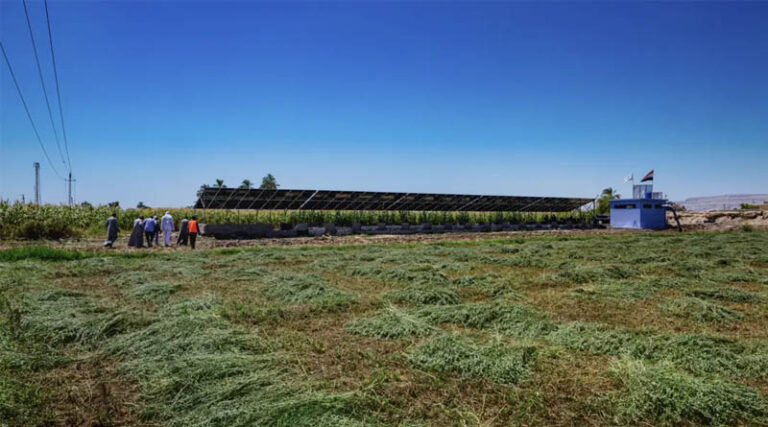
Harnessing Solar Energy for Efficient, Collective, and Farmer-Led Irrigation in Egypt
24 August 2026, Egypt: ICARDA and Egypt’s Ministry of Water Resources and Irrigation, with funding from the Government of Japan, are demonstrating a collective irrigation model that combines solar-powered pumping with water-saving infrastructure and equips farmers to manage the system themselves.
In Egypt, ICARDA and the Ministry of Water Resources and Irrigation (MWRI) are combining solar energy, improved irrigation infrastructure, and farmer-led water management to use limited water resources more efficiently.
The model replaces individual diesel-powered pumps with a centralized solar pumping system and traditional open Mesqa and field ditches with buried pipes and valves to improve both water conveyance and field application efficiencies. These improvements can save 30% of irrigation water and increase the irrigated agricultural area by 3%, while reducing reliance on fuel and lowering pumping costs.
ICARDA is also working with local Water Users’ Associations (WUAs) to build the capacity they need to operate, maintain, and manage the systems themselves, including coordinating irrigation schedules among farmers.
The approach is being demonstrated at Mesqa Abu Al Foutouh in Minya Governorate, covering 53 feddans (about 22 hectares), and Mesqa Alashraf Alsharkia in Qena Governorate, covering 27 feddans (about 11 hectares).
“This model demonstrates how renewable energy, practical, efficient, and easy-to-use irrigation systems, and farmer-led water management are key pillars for improving water-use efficiency, reducing farmers’ dependence on diesel, strengthening local ownership of irrigation systems, and improving beneficiary farmers’ livelihoods.” – Dr. Mohie Omar, Associate Scientist and Country Coordinator – Egypt, ICARDA
From individual pumps to a shared system
In many farming communities in Egypt, irrigation depends on individual pumps and conventional energy sources to move water to fields, making irrigation costly and inefficient and leaving farmers to manage water use largely on their own.
ICARDA and MWRI’s model introduces a centralized solar pumping system that provides water for a group of farmers, replacing individual diesel-powered pumps. The water is then distributed through an improved irrigation network using buried pipes and valves.
The system is designed to use water and energy more efficiently, while bringing farmers together around a shared irrigation system.
The people managing the system matter just as much
A new irrigation system can only deliver lasting benefits if the people using it have the knowledge and capacity to keep it working. ICARDA has worked with local WUAs to build their capacities to operate, maintain, and manage the system, including organizing irrigation schedules and coordinating water use among farmers. The collective system helps reduce competition over water, particularly during the high-demand summer months. Through WUAs, farmers agree on irrigation schedules and coordinate water distribution, while valves enable more controlled and predictable delivery. This combination of shared infrastructure, transparent scheduling, and farmer-led management can help prevent disputes and promote more equitable access to water.
In August 2026, ICARDA and MWRI formally handed over the solar-powered collective irrigation system to the local WUA in Qena, marking the transition from project implementation to local management.
Making the most out of every drop
With increasing pressure on Egypt’s water resources, improving how irrigation water is delivered and used is becoming ever more important. The collective solar irrigation model brings several benefits together rather than treating them separately:
- Improved buried-pipe irrigation can reduce water losses in delivery to fields.
- Covered field mesqas and field ditches can increase irrigated agricultural areas.
- Solar pumping provides an alternative to individual fuel-powered pumps.
- Coordinated irrigation scheduling also allows farmers to organize water use collectively.
From demonstration to a model that can grow
The systems in Minya and Qena are demonstrations, but their potential extends beyond these sites.
The experience is already attracting interest in how similar approaches could be expanded. During a February 2026 visit to the Qena site, Qena Governor Dr. Khaled Abdelhalim expressed interest in expanding the solar-powered improved irrigation system from the 28 feddans (around 11.8 hectares) covered by the project, to 28,000 feddans (around 11,760 hectares) in Qena governorate in the coming years.
Scaling the model will also depend on technical support, financing, appropriate institutional arrangements, and empowered local organizations that can manage collective irrigation systems.
“The model aligns closely with Egypt’s priorities by bringing together improved irrigation efficiency, renewable energy, and participatory water management. One of the key lessons for wider uptake is that the potential scalable approaches for improving sustainability of irrigation systems in Egypt require a combination of technology, institutions, and local ownership.” – Mr. Abdellatif Al Dawwi, Director of Upper Egypt Irrigation Development, MWRI.
A system farmers can take forward
The handover marks the beginning of a new phase. The infrastructure is in place, the solar system is operating, and the WUA has the capacity to manage and maintain it. The next step is for farmers to take on that responsibility.
The model could offer a practical approach to bringing together three priorities: using water more efficiently, reducing irrigation costs, and giving farmers greater control over the systems they depend on.
Also Read: ASSOCHAM to Host 4th Agritech Summit 2026 in New Delhi on October 26
Global Agriculture is an independent international media platform covering agri-business, policy, technology, and sustainability. For editorial collaborations, thought leadership, and strategic communications, write to pr@global-agriculture.com