By Clementino Lara Grajales and Juan Felipe Peña Mojica
24 November 2026, Colombia, RSA: A mixture can meet a target carbon-to-nitrogen ratio and still leave a farmer with important questions about the compost it will produce. What happens during decomposition? How variable is the finished material? What information is needed before deciding how it should be used? Research on 36 plantain and banana farms in Quindío, Colombia, follows those questions from formulation through field observation to laboratory analysis.
The project, led by Universidad La Gran Colombia’s Armenia campus, has established 72 compost piles across two production cycles. Its findings show why the formulation, the monitored process and the finished compost need to be examined separately. Each offers evidence about a different stage, and none alone establishes the response of a crop.
A calculation meets a supply of materials
The ingredients available in the participating farms include plantain and banana residues such as pseudostems, leaves and fruit-bunch stalks. Access to other materials varies. Some farms can use coffee pulp and livestock residues, while others rely more heavily on crop residues and leaf litter.
The first stage produced 36 formulations, one per farm, combining between four and twelve materials. Their initial carbon-to-nitrogen ratios were estimated from the quantities entered and technical information about the materials. These calculations supported decisions about a mixture before construction; they were not direct chemical measurements of each batch.
Twenty-seven formulations fell within the project’s reference interval of 25:1 to 35:1. Nine were outside it because the types or quantities of available residues were limited. Reporting that result as a compost-quality success rate would confuse an estimated property of the starting mixture with the characteristics of the product obtained later.
For applied research, the nine formulations are particularly informative. They identify cases in which a technical target met a constraint in the supply of ingredients. The next question is whether an adjustment is feasible in that farm’s circumstances, and what the subsequent process reveals about the mixture actually prepared.
Reading a process rather than a single temperature
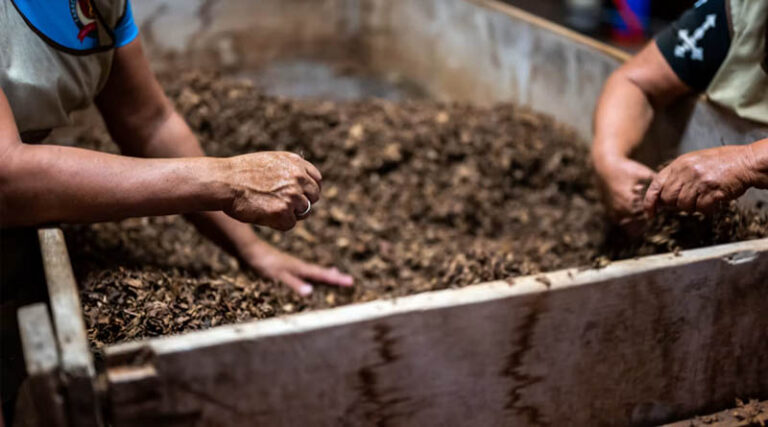
The materials were weighed and prepared for the piles, with perforated pipes placed at the base to support air circulation. By October 2026, field monitoring had produced 932 temperature readings. Temperatures ranged from 20.4°C to 75°C, with an overall mean of 38.2°C.
That range describes observations collected during monitoring. It does not establish that every pile reached the same temperature or followed the same pattern over time. For that reason, the overall mean cannot serve as proof that an individual compost batch completed a particular treatment.
Of the 935 moisture observations, 90.9 per cent were classified as adequate. The remaining observations recorded dry or saturated material. The records flag when moisture, aeration or handling needs attention.
The finished material has to be characterised
Initial laboratory results from 19 mature compost samples revealed a broad range of properties. Measured pH values ran from 7.78 to 9.40, while electrical conductivity ranged from 3.58 to 22.40 dS/m. Electrical conductivity indicates the presence of soluble salts and is relevant when considering agricultural applications.
The variation is consequential because the products cannot be assumed to have identical characteristics simply because they were made within the same project. A crop-nutrition recommendation needs to consider what the compost contains as well as the soil that will receive it. Where conductivity is high, application quantities, soil conditions and plant sensitivity require particular attention.
These results provide grounds for examining use, not a universal application rate. They also leave other aspects of characterisation open: microbiological analyses form part of the evaluation planned for mature compost. The findings reported here should not be read as microbiological clearance or evidence of a measured improvement in plant performance.
Putting the samples back on the farm map
The broader research helps locate those measurements within working farms. Participatory mapping documented 525 land-use areas covering approximately 424 hectares, together with more than 1,300 qualitative records. Farmers contributed observations about land uses and management difficulties, which were considered alongside geographic information.
Approximately 51 per cent of the mapped area was classified as overutilised in the land-use assessment. This is a diagnostic classification, not a direct measurement of soil degradation. Its value lies in identifying questions and priorities for land management that can be examined with the producers.
The project has also established an environmental, economic and social sustainability baseline across the 36 farms. More than half were in the lower category of that assessment. Follow-up evaluation is needed to examine change; the baseline cannot demonstrate an effect of compost use or an increase in farm income.
For now, the research offers a sequence of decisions that can be inspected: choose a formulation from available resources, follow its development, characterise the compost and consider its intended application in a particular soil. Keeping the evidence attached to each decision makes the next research task clearer. A result about a mixture, a compost sample or a mapped area can then guide further work without being mistaken for a result about the harvest.
About the authors
Clementino Lara Grajales works in communications for the Regenerative Agriculture project led by Universidad La Gran Colombia’s Armenia campus in Quindío, Colombia. He develops stories and audiovisual materials about collaboration between farmers, researchers and field teams.
Juan Felipe Peña Mojica is a co-researcher in the technical and scientific component of the Regenerative Agriculture project at Universidad La Gran Colombia’s Armenia campus. His contribution brings together project findings on participatory mapping, composting, soils and farm sustainability.
Global Agriculture is an independent international media platform covering agri-business, policy, technology, and sustainability. For editorial collaborations, thought leadership, and strategic communications, write to pr@global-agriculture.com