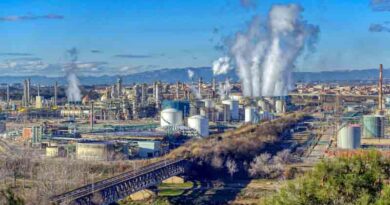
23 November 2026, Taquari, BR: Adama is closing its active ingredient manufacturing plant in Taquari, in the southern Brazilian state of Rio Grande do Sul, as the country’s crop protection industry splits over a proposal to raise tariffs on imported pesticides. The company, one of the world’s largest crop protection manufacturers, said the plant had struggled to remain competitive against imported products and that the closure follows a review of its economic viability.
The Taquari plant opened four years ago after an investment of about 300 million reais, roughly 55 million dollars. It produced the fungicide picoxystrobin and the herbicide trifluralin, both of which will now be imported rather than manufactured domestically. Adama described the closure as part of a global review of its manufacturing assets and active ingredient production network, saying it reflects changing market conditions and the need to align output with long term demand. The company did not disclose job losses or production volumes tied to the closure.
A tariff fight divides the industry
The closure comes as Sindiveg, the Brazilian crop protection industry association whose members include UPL, Sumitomo Chemical and Adama itself, pushes for import tariffs of up to 35 percent on four categories of formulated, finished pesticide products from China. The association has asked Camex, Brazil’s foreign trade authority, to act, arguing that cheaper Chinese generic products have undermined the competitiveness of domestic manufacturing. Sindiveg says imports covered by its tariff request rose 129 percent between 2022 and 2025, climbing from 166,700 metric tons to 381,600 metric tons, and that domestic producers have operated under unfavorable tariff conditions for nearly two decades.
The proposal has fractured Sindiveg’s own membership. Tecnomyl and Alta Defensivos announced they were leaving the association on a Friday, saying they had not been consulted before the tariff request was filed. SLM Brasil followed with its own exit the following Monday, also citing a lack of consultation, and warned that higher tariffs would raise the cost of food production. One departing member argued that growth in domestic manufacturing should rest on investment, innovation and efficiency rather than on tariff protection.
Daniel Dias, chairman and co-founder of Agriconnection, a Brazilian pesticide importer and distributor, said raising tariffs on imported formulated products would not by itself remove the country’s dependence on foreign chemical inputs. He argued that Brazil lacks enough domestic capacity to supply its full agrochemical demand, and that any tariff policy should first establish which products the country can realistically manufacture at scale before duties are raised on imports.
A structural supply question
Industry figures familiar with the sector describe Brazil’s reliance on imported active ingredients and intermediate chemicals as a structural vulnerability for domestic formulators, since many companies that blend and package finished products in Brazil still depend on imported technical grade material. Adama’s own decision illustrates the point directly, since picoxystrobin and trifluralin, the two products made at Taquari, are not among those covered by Sindiveg’s current tariff request, leaving a gap between the industry’s public push for tariff protection on some products and individual companies’ manufacturing decisions on others.
Brazil’s agriculture ministry recorded 912 pesticide and bio-input product registrations in 2025, including 323 technical grade products, with the ministry noting that a significant share followed court orders tied to missed regulatory deadlines under the country’s 2023 pesticide law. Camex has not set a timetable for deciding on Sindiveg’s tariff request, and Adama has not said whether the Taquari closure is linked to the outcome of that decision.
People familiar with the industry say the dependence cuts both ways. Brazilian formulators that rely on imported technical grade material would face higher input costs if tariffs rise on finished products without a parallel plan to expand domestic active ingredient capacity, while manufacturers that already produce locally, including Sindiveg’s own members, continue in some cases to shift production offshore for individual products when economics favor importing over manufacturing. Sindiveg has said its position is not intended as blanket protectionism, and that it is responding to nearly two decades of tariff conditions it considers unfavorable to domestic producers, even as three of its own member companies have now left the association over how the tariff proposal was handled.
Global Agriculture is an independent international media platform covering agri-business, policy, technology, and sustainability. For editorial collaborations, thought leadership, and strategic communications, write to pr@global-agriculture.com