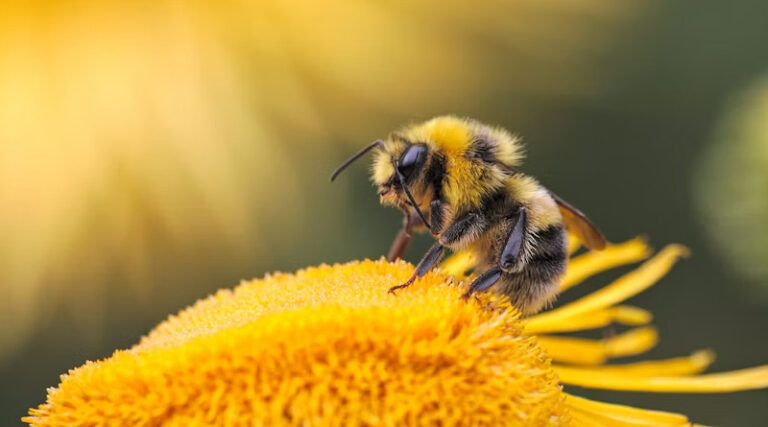
28 September 2026, California, USA: Researchers at the University of California, Riverside have used a machine learning model to sift through tens of millions of candidate chemicals and identify a small set that reliably repel honeybees, a finding that could let farmers keep bees away from crops during pesticide spraying without harming the insects. The study, led by professors Anandasankar Ray in the department of molecular, cell and systems biology and Boris Baer in the department of entomology, was published in the journal eLife on September 23, 2026.
Honeybee losses tied to pesticide exposure remain a persistent problem for growers of pollinator dependent crops such as almonds, apples and a wide range of vegetables and oilseeds, since bees can absorb or carry back insecticide residue picked up while foraging on treated flowers. One proposed fix, adding a repellent to pesticide formulations so foraging bees simply avoid treated plants during and shortly after application, has been explored for years, but progress has been slow because testing repellent candidates one at a time in the field is expensive and slow, and there are hundreds of thousands of known odorant compounds to sort through.
How the Screening Worked
To speed up that search, the UC Riverside team built a machine learning model trained on the three dimensional chemical structures and physical properties of compounds already known to attract or repel honeybees and, in earlier related work, fruit flies. The model learned to predict how a novel compound’s molecular shape and chemistry would likely affect bee behavior without needing to test it directly first. In its first pass, the model screened a virtual library of more than 50 million compounds and flagged around 130 with strong predicted repellent activity. In computational validation the model performed strongly, correctly distinguishing repellents from non repellents at a rate researchers described using an accuracy measure of 0.88 out of a possible 1.0, comparable to a solid diagnostic test.
The researchers then ran a second, refined round of screening against a roughly 10 million compound library, using data gathered from testing the first batch of candidates on real bees in the lab to sharpen the model’s predictions. From the combined rounds of screening, seven top performing compounds were selected for field testing with freely foraging honeybee colonies, rather than bees confined in a lab enclosure, a tougher and more realistic test since foraging bees can simply choose to feed elsewhere. Using a statistical test called the Kruskal-Wallis test, which checks whether differences between groups are larger than would be expected by chance, the team found significantly fewer bees landing on wax honeycomb surfaces treated with the candidate repellents compared with untreated surfaces, with the effect holding up consistently across all seven compounds. Laboratory observations of individual bee behavior lined up with what the computer model had predicted, giving the researchers confidence that the underlying approach, not just these specific seven molecules, is sound.
The practical idea is straightforward: a repellent compound identified through this process could eventually be blended directly into insecticide formulations, so that the same spray application that controls a target pest also carries a signal that tells foraging bees to stay away for the period when residue is most toxic. Ray, one of the study’s senior authors, noted that beyond crop protection, the same class of compounds could have secondary uses, such as discouraging bees from nesting in unwanted locations near buildings or public spaces. The researchers stressed that none of the seven candidate compounds harmed the bees that encountered them, an important distinction from older repellent chemistries that sometimes carried their own toxicity concerns.
The work is still at an early commercial stage. The published study demonstrates that the compounds repel bees under field conditions, but it does not yet include data on how the repellents perform when actually co-formulated and applied together with a working insecticide, how long the repellent effect lasts under real spraying conditions, or what regulatory pathway such an additive would need to follow before it could be sold as part of a commercial pesticide product.
Global Agriculture is an independent international media platform covering agri-business, policy, technology, and sustainability. For editorial collaborations, thought leadership, and strategic communications, write to pr@global-agriculture.com