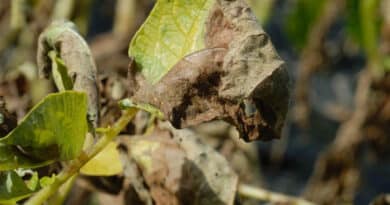
23 November 2026, Rehovot, IL: AgPlenus, an Israeli crop protection research company, said on November 17 that two of its early stage fungicide discovery programs have produced small molecules able to inhibit previously untapped proteins in fungal pathogens, including strains of Septoria tritici blotch that have already developed resistance to existing fungicides.
The company, based in Rehovot and a subsidiary of Evogene Ltd, said selected compounds from the two programs reduced disease severity by 75 percent in plant tissue assays. Orli Even Or, AgPlenus’s vice president of research and development, said the growing challenge of fungicide resistance highlights the need for new modes of action in crop protection, and that the results demonstrate the potential of the company’s artificial intelligence driven discovery platform.
Septoria tritici blotch, caused by the fungus Zymoseptoria tritici, is one of the most damaging wheat diseases in Europe. AgPlenus cited outside research estimating that more than 70 percent of fungicide use on European wheat is directed at controlling the disease, representing a market opportunity of roughly 1.2 billion euros. Resistance to several widely used fungicide classes, including succinate dehydrogenase inhibitors, has already spread through Septoria populations in parts of Europe, reducing the effectiveness of some standard treatments and adding pressure on chemical companies to find new chemistries before existing options lose their usefulness in the field. AgPlenus attributed the wheat fungicide usage and market figures to a 2018 study published in the journal Plant Pathology, and cited a separate 2026 paper in the European Journal of Plant Pathology to support its characterization of how far resistance to existing fungicide classes has already spread in the region.
Early stage discovery work
AgPlenus did not disclose the identity of the specific proteins its candidate molecules target, describing them only as proteins essential to fungal survival that had not previously been exploited by commercial fungicides. The company said the biological findings behind the announcement were independently corroborated by an outside research organization, though it did not name that organization or describe the scope of the corroborating work. AgPlenus said the next steps for both programs include further molecular optimization and a broader round of biological evaluation, with the stated goal of developing differentiated fungicide candidates suitable for further development.
The announcement describes laboratory and plant tissue assay results rather than field trial data, indicating the programs remain at an early stage well before any commercial product would reach the market. AgPlenus gave no timeline for when, or whether, the candidate molecules might advance to field trials or seek regulatory registration in any market, and it did not disclose how many compounds remain under active evaluation from the original screening pool that produced the molecules described in the release.
The discovery work rests on ChemPass AI for Ag, a platform AgPlenus licenses from its parent company Evogene, which trades on both the Nasdaq and the Tel Aviv Stock Exchange under the ticker EVGN. Evogene has built a cluster of subsidiaries, including AgPlenus, around applying computational biology and machine learning to different parts of agriculture, spanning crop protection chemistry, microbiome based products and other biological technologies. AgPlenus has said its approach aims to shorten the time it takes to move from identifying a biological target to a validated chemical candidate, a method the company has compared to drug discovery practices more commonly associated with the pharmaceutical industry than with agricultural chemistry.
Fungicide resistance has become a growing concern for wheat growing regions beyond Europe as well, as the same modes of action used against Septoria are often deployed against other cereal diseases. A genuinely new mode of action, if it eventually reaches commercialization, would give growers and advisers another tool to rotate into resistance management programs alongside existing chemistries, though AgPlenus’s announcement stops well short of claiming the current candidates are ready for that stage.
Global Agriculture is an independent international media platform covering agri-business, policy, technology, and sustainability. For editorial collaborations, thought leadership, and strategic communications, write to pr@global-agriculture.com