Workshops Spur Innovation In Grain Storage
17 November 2026, AU: Collaborative workshops and other activities run by the GRDC Grain Storage Extension team are upskilling growers and driving on-farm innovations to reduce pest pressure in stored grain.
A new development from the GRDC Grain Storage Extension team, inspired by feedback from growers, shows diatomaceous earth (DE) can be effectively applied in sheds using leaf blowers.
The finding builds on 2025 research from the team that found leaf blowers could distribute an even coverage of DE in cone and flat-bottomed silos to control storage pests.
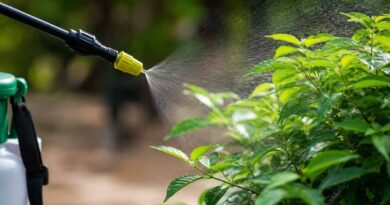
DE is fossilised algae dust that dehydrates and kills insects without residue issues. It is a handy tool to clean up empty on-farm storage units before harvest but has traditionally been applied in sheds as a slurry.
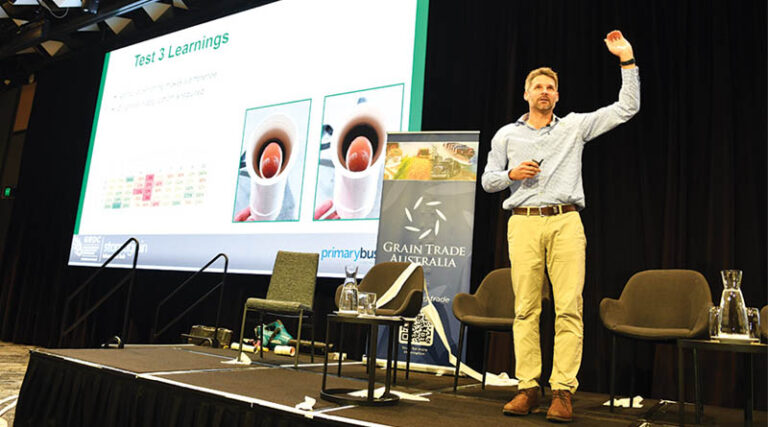
Chris Warrick, who leads the extension team, told the 2026 Australian Grain Storage and Protection Conference that slurry application was not favoured because it was slow, uneven and wore out water pumps.
After Stored Grain Extension workshops showcased findings of the successful trials using leaf blowers to apply DE in silos, growers suggested the method also be trialled in sheds. “So we thought we’d go and test it,” Mr Warrick said.
This is just one example of how the two-way dialogue encouraged at the workshops helps to shape research and development that is relevant to the needs on the ground. “The work is driven by the questions we get at workshops,” he said. “Growers are innovative, they ask questions, we test theories.”
Even coverage
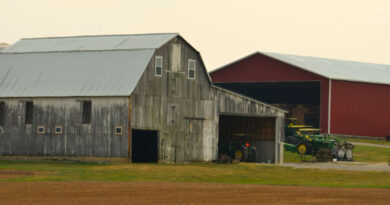
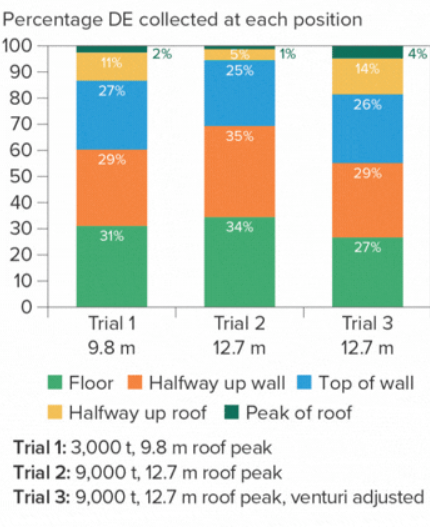
The latest DE trial tested dust distribution using a 36-volt leaf blower fitted with a homemade venturi, which draws the DE dust into the airstream. Trials were conducted in 3,000 t and 6,000 t sheds with ceiling height peaks of 9.8 m and 12.7 m respectively.
In the first 2 trials, the researchers observed inconsistent DE dust coverage in both shed sizes, with very little reaching the ceiling peak.
But coverage was more even right up to the ceiling in a third trial, when the venturi was adjusted to protrude less into the airstream, providing more airflow and less suction.
“The positioning of the venturi made a huge difference in how far it was throwing the dust,” Mr Warrick said.
“And the other thing we learnt was the importance of diligence when traversing the shed as we were applying the DE to get a really even coating.”
Help on the ground
This work is part of the Grain Storage Extension team’s larger research and extension agenda.
Now operating across all Australian states and territories, the team has a broad role that includes:
- improving grain storage quality through on-farm management
- improving value and lowering costs around storage
- enhancing safety.
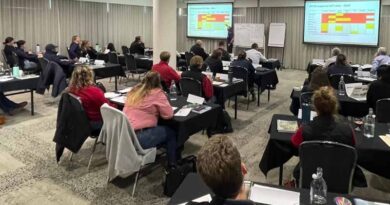
The team conducts development and extension across these themes and holds practical workshops to share findings and build knowledge around best practice. They also produce videos, podcasts and articles, and maintain the Stored Grain website.
Current and recent development projects include performance testing silos, the economic analysis of on-farm storage, aeration ducting in cone-bottomed silos, pressure testing temporary storages, aeration back pressure of various grains, and a deep dive into PPE (personal protective equipment).
The team also works with industry to ensure equipment is meeting standards, and with other stakeholders across the supply chain to ensure storage practice aligns with market requirements.
“There’s no point in us helping growers understand how they need to manage storage if they can’t access equipment that they need to do it,” Mr Warrick said.
“So, we’re a conduit between the scientific research and the grower, getting questions back to the researchers and also working across industry and the supply chain.”
An agronomist’s assessment
A key component in this ‘whole-of-industry’ approach is a close working relationship with agronomists and advisers, Mr Warrick said.
“Obviously farmers go to them for advice on all things agronomy and business management, and grain storage might be one little part of that,” he said. “So if we can upskill advisers, that helps build our capacity as well.”
Elmore-based Nutrien agronomist Chris Dunn organised 2 grain storage workshops for more than 40 growers in north central Victoria in 2025. The benefits were many, he said, including the immediate upskilling of growers with varying experience in grain storage.
“Chris gave lots of practical, easy solutions that the growers really took on board, and because he has such in-depth knowledge, he was able to talk at a high level to people with extensive grain storage facilities, but also upskill the guys who had only just dipped their toe in the water,” Mr Dunn said.
“Everyone walked away feeling that they were going to be able to do something better.”
The issue of DE is a case in point, he said. Before the Elmore workshops, most participants generally didn’t know much about the product or how best to apply it.
“A couple of guys had tried doing it as a slurry and said ‘never again’. But since the workshops it’s become an easy, normal part of their pre-harvest hygiene process.”
Advice at hand
Mr Dunn said another benefit of the workshops was the relationships it built between the grain storage team and the grower and agronomist participants.
“It gave them a contact,” he said. “People have called Chris when they’ve been looking at purchasing silos, and I’ve contacted him when we’ve had some unexpected live storage pests.”
Mr Warrick said that one of the strengths of the team’s structure was the various avenues it provided for people seeking information and having different needs met.
Workshops, for example, tend to skew towards proactive, strategic questions. Recent exit surveys show aeration and prevention have been high on the agenda of participants.
While long-term management topics are a popular focus at workshops, the team also offers advice for more immediate issues through its hotline service, 1800 WEEVIL.
Information is also always available on the dedicated online Stored Grain Information Hub, which provides video tutorials, a collection of continually updated research and a workshop calendar.
Also Read: ADM Opens New Destination Marketing Office in Nairobi, Strengthening Presence Across East Africa
Global Agriculture is an independent international media platform covering agri-business, policy, technology, and sustainability. For editorial collaborations, thought leadership, and strategic communications, write to pr@global-agriculture.com