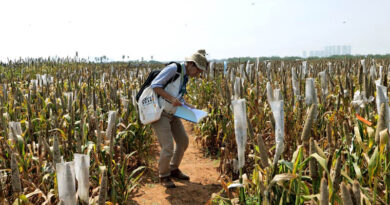
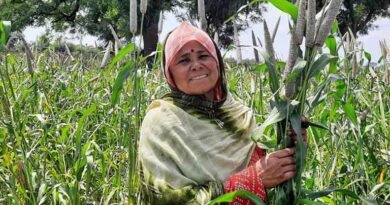
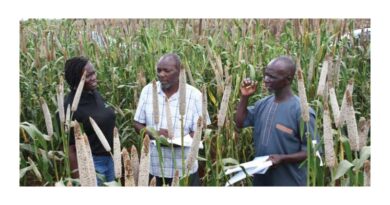
16 November 2026, Beijing, CN: Chinese researchers have built the first working haploid-induction system in Pennisetum alopecuroides, an ornamental and forage grass commonly called fountaingrass that belongs to the same genus as pearl millet, a staple cereal grown across more than 30 million hectares, mostly in India and semi-arid Africa. The work, led by scientists at Beijing Forestry University’s School of Grassland Science and the Beijing Academy of Agriculture and Forestry Sciences’ (BAAFS) Institute of Grassland, Flowers and Ecology, was published online on November 10, 2026, in the Plant Biotechnology Journal, with contributing researchers from the University of Cambridge, Hebei North University and North Dakota State University.
Haploid induction is a technique breeders use to speed up developing new crop varieties. Normally, a plant’s offspring carry one set of chromosomes from each parent. A haploid-inducing gene, when disabled, causes some offspring to inherit chromosomes from only one parent instead. Breeders can then chemically double those single chromosome sets to create a fully uniform, true-breeding plant line in roughly one generation, a process called doubled-haploid breeding that can cut years off conventional crossing and selection. The approach already works in major crops like maize, but the broader Pennisetum genus, which includes pearl millet, had resisted this kind of genetic manipulation until now.
The team, with corresponding authors Zhihui Chang at Beijing Forestry University and Ke Teng at BAAFS, and first author Yidi Guo, focused on a gene family called DMP, which in several other crops controls a protein found in the membrane of sperm cells and triggers haploid formation when switched off. Using a reference genome from a fountaingrass variety named ‘Liqiu’, they identified the Pennisetum version of this gene, named PaDMP8, and found it was active mainly in mature anthers, the pollen-producing part of the flower.
To confirm the gene actually works the way they expected, the researchers first tested it in a different plant species, Arabidopsis, in a line that had been engineered to lack its own two related DMP genes and, as a result, produced poor seed set. Adding the fountaingrass PaDMP8 gene back into that Arabidopsis line restored seed set to between 68.6 and 76.6 percent, compared with 41.7 percent in the mutant without it, evidence that the gene performs a similar function across two very different plant species.
With that confirmed, the team used the gene-editing tool CRISPR, which lets scientists cut and disable a specific, targeted gene, paired with Agrobacterium-based transformation, a standard method of delivering new genetic material into plant cells, to knock out PaDMP8 directly in fountaingrass. Of 63 regenerated plants, 15, or 23.8 percent, carried the intended edit.
Confirming true haploids, not just smaller plants
The researchers then self-pollinated and cross-pollinated the edited plants and screened their offspring for haploid seedlings, those carrying chromosomes from only the mother plant. They confirmed haploid status through three independent methods: flow cytometry, which measures the amount of DNA in a cell; direct chromosome counting under a microscope; and whole-genome sequencing, which showed none of the genetic markers expected from a pollen-parent contribution. Two independently edited lines produced haploids at rates of 0.46 percent and 0.39 percent among their self-pollinated seeds, and 0.34 percent among cross-pollinated seeds, while unedited control plants produced none. Those rates are in a similar range to DMP-gene-based haploid-induction systems already reported in maize and the legume Medicago, which run between 0.1 and 0.82 percent.
The haploid plants that resulted were visibly different from normal fountaingrass, standing roughly 42 percent shorter, with narrower and shorter leaves, malformed flower clusters, and were almost completely unable to produce functional pollen, a pattern consistent with how haploid plants typically appear once isolated in other species.
The authors describe the induction rates achieved so far, under half of one percent, as still too low for routine breeding programs, and outline next steps aimed at raising efficiency: combining the PaDMP8 knockout with other haploid-inducing genes already used elsewhere, known as MTL, NLD or ZmPLA-type factors, or pairing it with modified expression of a gene called PARTHENOGENESIS in the egg cell. Either approach, if successful, would be aimed at eventually supporting practical doubled-haploid breeding programs in pearl millet itself and in related forage and bioenergy grasses. The work was funded by the National Natural Science Foundation of China, BAAFS’s own scientific research funds, and a High-End Foreign Experts program that supported the international collaboration.
Global Agriculture is an independent international media platform covering agri-business, policy, technology, and sustainability. For editorial collaborations, thought leadership, and strategic communications, write to pr@global-agriculture.com