Farmers Need Shared Risk Support to Accelerate Regenerative Agriculture Transition
05 June 2026, New Delhi: India’s agricultural transformation is no longer a distant ambition but an ongoing reality. However, farmers cannot be expected to bear the risks and costs of adopting regenerative and climate-resilient agricultural practices alone. This was the key message emerging from a national conference on “India’s Transition to Regenerative Agriculture: Policy, Partnerships, and Pathways,” where policymakers, farmers, agribusiness leaders, financial institutions, researchers, and civil society organisations came together to discuss the future of sustainable agriculture in India.
A strong consensus emerged during the two-day conference that the next phase of India’s agricultural development will require far more than isolated pilot projects and fragmented interventions. Participants emphasized the need for integrated, systems-level solutions that align public policy, market incentives, financial mechanisms, technological innovation, and effective last-mile delivery systems to support farmers through the transition.
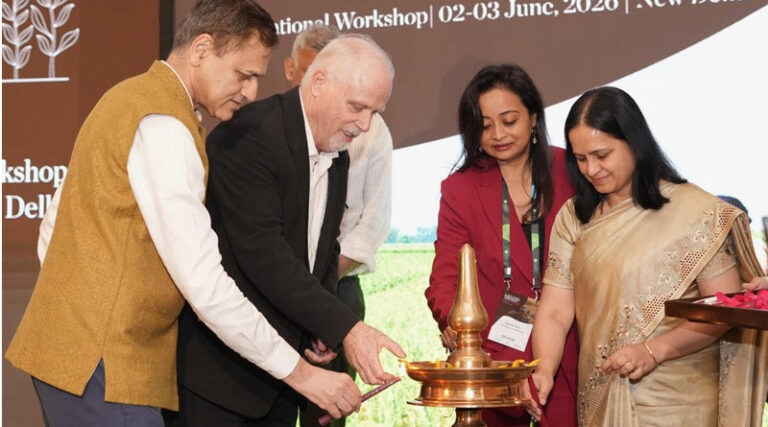
The conference was organised by The Nature Conservancy (TNC) in collaboration with the Confederation of Indian Industry’s Food and Agriculture Centre of Excellence (CII FACE) and was held in New Delhi on June 2–3. The discussions drew extensively on insights from PRANA (Promoting Regenerative and No-burn Agriculture), TNC’s flagship programme operating across 18 districts and 6,826 villages in Punjab, which aims to encourage the adoption of regenerative agricultural practices at scale.
Speaking at the event, Saswati Bora, Global Director, Regenerative Food Systems, The Nature Conservancy, said that transforming food systems requires science, market incentives, and long-term financing to work together.
“Transforming food systems demands the integration of science and knowledge, market incentives, and sustained financing working in concert. TNC’s foodscapes strategy brings these elements together to scale regenerative models that restore nature while strengthening livelihoods, and PRANA stands as its most advanced proof point,” Bora said. She added that PRANA’s outcomes demonstrate the importance of placing food production at the centre of climate and biodiversity solutions.
Since its launch in 2021, PRANA has worked extensively to reduce crop residue burning in Punjab while promoting regenerative farming practices. The programme has encouraged the adoption of water-efficient rice cultivation techniques such as Alternate Wetting and Drying (AWD) and Direct Seeding of Rice (DSR), helping conserve groundwater and reduce methane emissions. It has also supported crop diversification and introduced innovative incentive-based models, including a Pay-for-Results mechanism that rewards machinery service providers for delivering crop residue management and DSR services to farmers who do not own specialised equipment.
According to programme data presented during the conference, PRANA has so far supported approximately 370,000 farmers in adopting no-burn agricultural practices across 850,000 hectares. The initiative has contributed to the conservation of nearly 400 billion litres of water and helped avoid more than 3.8 million tonnes of carbon dioxide equivalent emissions. Organisers also highlighted the critical role of behavioural change interventions in driving adoption. Women, despite owning only a small proportion of agricultural land, have played an influential role in decision-making processes. The programme has further engaged Gurudwara preachers, village sarpanches, women’s groups, street theatre teams, and rural youth as local champions to encourage sustainable farming practices.
Addressing the conference, Marc De Sousa Shields, Country Director, International Fund for Agricultural Development (IFAD), stressed that trust is a fundamental requirement for scaling regenerative agriculture.
“At scale, regenerative agriculture depends on three pillars of trust that farmers need. They need to trust markets to reward change. They need to trust that institutions will support them. They need to trust that supporting infrastructure and technology will evolve and be affordable and accessible,” he said. Shields added that India has a unique opportunity to demonstrate how agricultural transformation can strengthen resilience while empowering farmers to become active participants in change rather than passive recipients.
Also Read: India Approves Two Rice Varieties To Secure Yields In Direct-seeded Rice Farming
Global Agriculture is an independent international media platform covering agri-business, policy, technology, and sustainability. For editorial collaborations, thought leadership, and strategic communications, write