From Monoculture to Opportunity: Rethinking Sugarcane Farming in Uttar Pradesh
18 August 2026, Uttar Pradesh: What if India could produce significantly more edible oil in line with government priorities, improve farmer incomes, restore soil health, and strengthen climate resilience—without bringing a single additional hectare under cultivation?
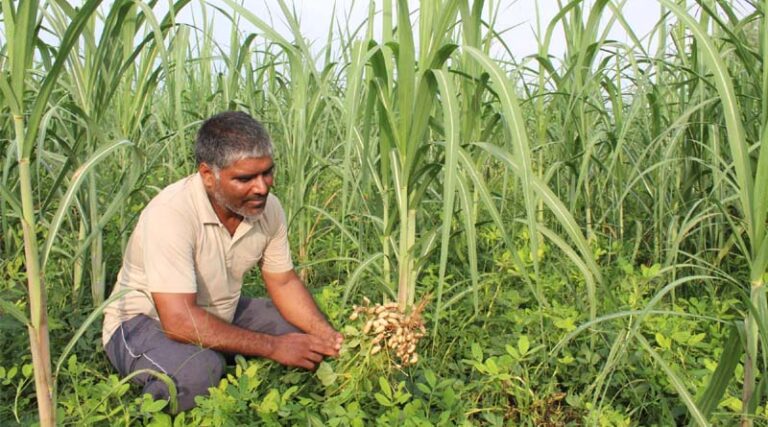
CIMMYT and Indian Council of Agriculture Research Indian Institute of Farming Systems Research (ICAR-IIFSR) are demonstrating an innovative approach in Uttar Pradesh, where farmers grow short-duration groundnut between paired rows of sugarcane. Rather than replacing sugarcane, additive intercropping makes more productive use of the space and growing period within the existing crop cycle.
The result is a more diversified and resilient production system. Farmers continue to grow sugarcane as their primary cash crop while harvesting an additional oilseed crop, improving soil health, enhancing water-use efficiency, and creating new income opportunities—all without expanding cultivated land.
A National Opportunity
At the national level, India imports around 60% of its edible oil requirements, spending more on these imports than on its national health budget. While increased domestic oilseed production is a strategic government priority, farmers prefer to grow high value cash crops such as sugarcane. Sugarcane + groundnut (or other legume) additive intercropping is a viable solution to this paradox.
Uttar Pradesh in north India cultivates approximately 2.7 million hectares of sugarcane; incorporating sugarcane + groundnut additive intercropping in 20% of this sugarcane would result in an additional 652,800 tonnes of additional groundnut annually, generating approximately INR 4,907 crore in extra farmer income while strengthening India’s edible oil self-sufficiency.
The vision as proposed by Dr ML Jat, Secretary, Department of Agricultural Research and Education (DARE) and Director General, ICAR is to scale this approach across one million hectares through coordinated research, extension, seed systems, mechanization, and policy support.
This innovative approach led by CIMMYT and ICAR-IIFSR and supported by the Australian Centre for International Agricultural Research (ACIAR is emerging as an attractive option for farmers to sustainably increase their system yields, production efficiencies, and profitability while contributing to the Government of India’s priorities to achieve atmanirbhar (self-sufficiency) in oilseeds.
The future of agriculture depends on supporting farmers to use existing land more intelligently to achieve national food security goals while sustainably improving rural livelihoods.
Also Read: Paraquat and the Future of Pesticide Regulation in India
Global Agriculture is an independent international media platform covering agri-business, policy, technology, and sustainability. For editorial collaborations, thought leadership, and strategic communications, write to pr@global-agriculture.com