IRRI, Partners Advance Thailand’s Unified Rice-sector Emissions Monitoring System
03 July 2026, Bangkok: Thailand is eyeing for a more unified and credible greenhouse gas (GHG) monitoring, reporting, and verification (MRV) system as government agencies and research partners work to better align its national climate commitments with sustainable rice production.
While rice is central to Thailand’s food security, rural livelihoods, and agricultural economy, it is also a significant contributor of the country’s climate challenge, releasing methane, a powerful greenhouse gas, under continuously flooded conditions. To meet the country’s climate commitments, stronger data systems are needed to show where emissions can be reduced, track progress, and support farmers in adopting low-emission practices.
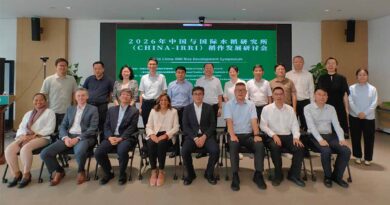
To support this effort, the International Rice Research Institute (IRRI) together with national partners, convened a consultation workshop focused on one core question: how can Thailand build a rice-sector MRV system that is credible enough for climate reporting, practical enough for national use, and useful enough to support action in the field?
Building a credible national MRV system
A central theme throughout the workshop was the need for stronger coordination among institutions working across rice production, agricultural economics, climate reporting, land development, geospatial information, and extension services.
Discussions highlighted that developing an MRV system will require harmonized data, common standards, and clearly defined institutional roles, as no single organization can build and manage such complex system alone.
“We need MRV systems that follows internationally recognized standards to produce credible data for both national and international reporting,” said Mr. Sommai Lertna, Director of the Rice Research and Development Division at Thailand’s Rice Department during the workshop’s opening session.
He also highlighted the importance of better rice crop management, lower-emission practices, and stronger cooperation across agencies as climate change becomes more volatile and felt in rice production.
Reliable field data also emerged as a critical foundation for national climate reporting. During the workshop, Mr. Kanoknop Klinlaor, Agriculturalist at the Rice Department, explained how how field-level data collected by the Rice department feeds into national reporting channels, including onward reporting to the Department of Climate Change and Environment. This data forms an essential part of the greenhouse gas inventory preparation under the Paris Agreement and the Biennial Transparency Report.
Consultations also identified strengthening data quality as a priority. Ms. Chanathip Boonchalee, Economist at the Office of Agricultural Economics, also emphasized that credible data depends recognized standards, clear methods, and consistent definitions.
A fundamental step identified towards improving the credibility and consistency of national rice-sector emission reporting to align activity data with international guidance, including the Intergovernmental Panel on Climate Change (IPCC) guidelines.
Supporting farmers through better data
Creating value beyond climate reporting, discussions also emphasized that an effective MRV system should also benefit farmers by providing information that can supports more sustainable rice production.
Rather than promoting a single solution, the consultation highlighted that farmers should have a range of mitigation options suited to different faming conditions. This flexible approach will enable farmers to choose low-emission practices, such as alternate wetting and drying or improved straw management, while adapting recommendations to their local conditions.
Additionally, participants discussed that expanding low-emission rice production should go hand in hand with market opportunities while ensuring that farmers will feel supported rather than burdened to comply with MRV’s new data requirements.
Strengthening data systems for long-term implementation
Dr. Bjoern Ole Sander, IRRI Country Representative for Thailand, presented digital innovations that can strengthen future MRV system. This includes as RiceMoRe, an IRRI-developed data entry and management system.
Discussions also highlighted the long-term goal of moving from Tier 2 to Tier 3 greenhouse gas estimation approaches, showing Thailand’s capacity to produce more accurate and country-specific emissions estimates through stronger data systems.
A centralized farm-data database to support data collection, verification, and information sharing was also explored, with the Rice Department as a potential central verifier of rice-sector data, given its mandate and role in the sector. Common definitions, shared metadata, and standardized data formats will also be essential for improving data sharing across agencies and laying the foundation for a national rice-sector MRV system.
Water management, straw management, fertilizer application, and soil organic carbon were identified as priority data areas for the system to further understand how rice cultivation practices influence GHG emissions.
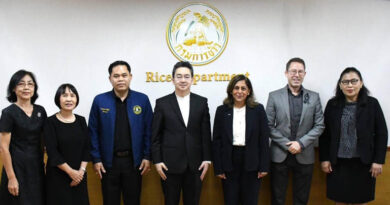
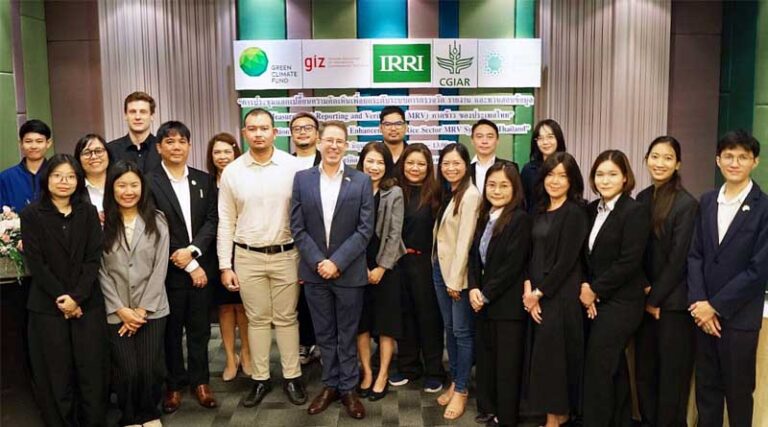
The workshop brought together representatives from IRRI, the Rice Department, GIZ, JGSEE at King Mongkut’s University of Technology Thonburi, the Department of Climate Change and Environment, the Office of Agricultural Economics, the Department of Agricultural Extension, the Geo-Informatics and Space Technology Development Agency, and the Land Development Department.
By bringing these institutions together, the consultation marked an important step toward a more coordinated and practical MRV system for Thailand’s rice sector. It reinforced that no single agency could build an effective rice-sector MRV system alone and helped clarify priority data needs, institutional roles, and technical requirements to guide its further development.
IRRI will continue working with Thai partners to support the development of a context-appropriate MRV system that strengthens climate reporting, informs policy, and helps farmers adopt low-emission and environmentally sustainable rice practices.
Also Read: Bayer Group to Consolidate U.S. Glyphosate Business Into Distinct Entity Operating As Ruveon
Global Agriculture is an independent international media platform covering agri-business, policy, technology, and sustainability. For editorial collaborations, thought leadership, and strategic communications, write to pr@global-agriculture.com