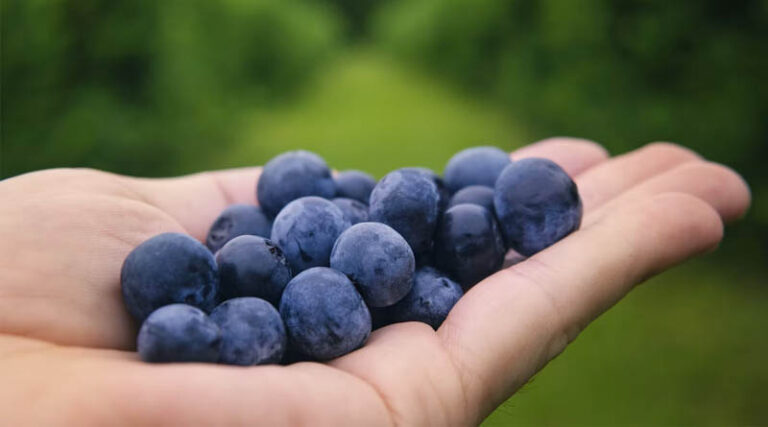
Soft Robotic Gripper Harvests Blueberry Clusters With 92% Success in Field Trials
07 October 2026, Atlanta: Engineers at the Georgia Institute of Technology, working with researchers at the University of Georgia and the University of Florida, have built and field-tested a robot that harvests whole clusters of fresh-market blueberries at once, rather than picking one berry at a time, achieving a 92% successful-grasp rate across real outdoor trials.
The team described the system, called CLASP, in a paper posted September 16 to the preprint repository arXiv. The paper has not yet completed peer review, so its findings should be read as early but field-tested results rather than a fully vetted, published study. The lead and corresponding author is Yue Chen of Georgia Tech’s Institute for Robotics and Intelligent Machines, with co-authors from Georgia Tech’s mechanical engineering department, the University of Georgia’s crop and soil sciences and horticulture departments, and the University of Florida’s agricultural engineering program. The work was supported in part by a robotics grant from USDA’s National Institute of Food and Agriculture.
Fresh-market blueberries, the kind sold whole in supermarket clamshells rather than processed into juice or baked goods, must be picked gently and selectively, since bruised or underripe fruit cannot be sold at full price. That requirement has kept most mechanical harvesting, which typically shakes a bush and catches whatever falls, limited to lower-value processing fruit. Fresh-market blueberries remain almost entirely hand-picked, an increasingly costly and labor-scarce proposition for growers as farm labor supply tightens in major berry-growing regions.
A gripper built around clusters, not single berries
Most earlier fruit-picking robots have tried to identify and grasp individual berries one at a time, a hard problem given how small blueberries are and how densely they grow in tight clusters hidden among leaves. The Georgia Tech team took a different approach. Their gripper, called the Soft Active Rolling-Band Gripper, uses two independently powered silicone bands that wrap around an entire cluster of berries and rotate, applying a steady pulling force to the whole group at once rather than targeting single fruit.
The engineering insight that makes this work is a measurable difference in how hard a berry needs to be pulled before it detaches from the stem depending on its ripeness. The team found that ripe berries separate from the plant under an average force of 0.66 newtons, while unripe, immature berries require 2.47 newtons, roughly four times as much force. By tuning the rolling bands to apply a pulling force that falls between those two thresholds, the gripper harvests ripe fruit while green berries stay attached to the plant to keep maturing, without needing a dedicated force sensor. Instead, the system estimates the force being applied from the electrical current drawn by its motors, a simpler and cheaper approach than adding separate sensing hardware.
The gripper sits on a six-jointed robotic arm that reaches into the bush, guided by two cameras working together: a wider-angle camera mounted away from the arm first spots candidate clusters, and a second camera built into the gripper itself provides close-up positioning as the arm moves in. A machine-vision model, trained on images collected across four growing seasons from 2023 through 2026, classifies clusters as mature or immature to decide where to aim.
In field trials, the system achieved a 92% successful grasp rate across 25 attempted clusters. The researchers are careful to note this is a feasibility demonstration rather than a statistically robust reliability figure, given the small sample size, and that both failed attempts were caused by the robotic arm failing to position the gripper correctly on the cluster, a camera and positioning problem, rather than any failure of the gripping mechanism itself. Measured separately from the navigation and positioning steps, the gripper harvested at a rate of 32 berries per minute, compared with roughly 55 berries per minute for an experienced human picker, putting it at about 58% of manual speed. The team also found that mechanically harvested fruit measured slightly softer than hand-picked fruit in a firmness proxy test, a 15% difference the authors say could partly reflect their small sample rather than genuine damage from the gripper.
One further challenge the paper documents in detail: when the team analyzed how many blueberry clusters were actually visible to the robot’s wide-angle camera from a single fixed position, only 40% of clusters in the test canopy were in view, with the rest hidden behind leaves and stems, a reminder that dense natural canopies remain a harder problem for robotic vision than the gripping mechanism itself.
Berry and specialty fruit acreage is expanding into new regions worldwide, including trial blueberry plantings in parts of India such as Himachal Pradesh and Jammu and Kashmir, alongside growing export-oriented berry sectors in Latin America and parts of Africa. All of these regions face the same underlying pressure driving this research: hand-harvest labor for delicate, fresh-market fruit is becoming scarcer and more expensive everywhere. A commercial version of a gripper like this one is likely still years away, but agri-equipment suppliers and automation companies serving these emerging berry markets have reason to track this research line, since a cluster-level harvesting approach, if it matures, could eventually extend beyond blueberry to other small, clustered soft fruits.
Global Agriculture is an independent international media platform covering agri-business, policy, technology, and sustainability. For editorial collaborations, thought leadership, and strategic communications, write to pr@global-agriculture.com