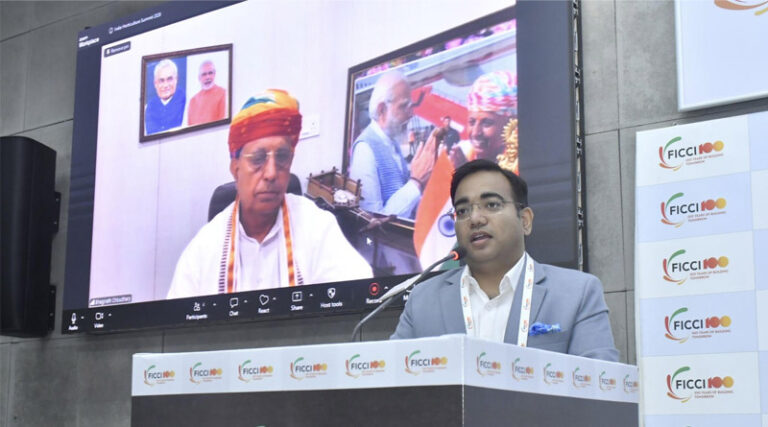
11 April 2026, New Delhi: At the FICCI India Horticulture Summit 2026, Shri Bhagirath Choudhary, Minister of State for Agriculture and Farmers Welfare, highlighted horticulture as a key driver of India’s agricultural transformation, contributing nearly one-third of the agricultural Gross Value Added (GVA). He noted that the sector is increasingly shaping the future of Indian agriculture by creating value, enhancing resilience, and opening new income opportunities for farmers.
In his keynote address, the Minister emphasized that Indian agriculture is steadily transitioning from a quantity-led approach to a value-driven growth model, with a stronger focus on high-value crops, quality production, and improved market access. This shift is expected to play a crucial role in strengthening rural livelihoods and ensuring long-term food and nutrition security.
A major highlight of the summit was the release of the report, “Vision 2030: Focusing on High-Value Horticulture for Atmanirbhar Bharat” by FICCI in collaboration with Grant Thornton Bharat LLP. The report outlines strategic pathways to unlock the full potential of India’s horticulture sector, focusing on productivity, value addition, and global competitiveness.
Throughout the summit, speakers from government, industry, and research institutions stressed the importance of improving quality planting material, strengthening processing ecosystems, and enhancing import-export linkages to boost farmer incomes. The role of innovation, climate-resilient practices, and integrated crop solutions was also highlighted as critical to building a future-ready horticulture sector.
Panel discussions at the summit covered a wide range of themes central to the growth of high-value horticulture. Sessions focused on driving growth in high-value horticulture, where experts emphasized agri-diversification, technology adoption, and the need for climate-resilient production systems. Another key discussion on unlocking value in horticulture highlighted the importance of integrating sustainability with value creation, strengthening processing infrastructure, and aligning ESG priorities with business strategies.
Deliberations also explored value chain challenges and market linkages, stressing the need for efficient supply chains, better price discovery, and stronger policy support. Stakeholders discussed the role of Farmer Producer Organizations (FPOs), contract farming, and digital platforms in improving aggregation, market access, and farmer incomes. Additionally, sessions addressed export readiness and global competitiveness, focusing on aligning Indian produce with international standards and leveraging global partnerships for technology transfer and market expansion.
Industry leaders further highlighted the growing importance of sustainable and nutrition-focused agriculture, with horticulture playing a key role in shifting from food security to nutrition security. Investments in cold-chain infrastructure, private sector participation, and hyper-local production models were identified as essential for improving efficiency and reducing post-harvest losses.
The summit concluded with a strong consensus that through collaborative efforts between government, industry, and farmers, high-value horticulture can significantly enhance farmer incomes, drive rural prosperity, and position India as a leading global player in the horticulture sector over the next decade.
Global Agriculture is an independent international media platform covering agri-business, policy, technology, and sustainability. For editorial collaborations, thought leadership, and strategic communications, write to pr@global-agriculture.com