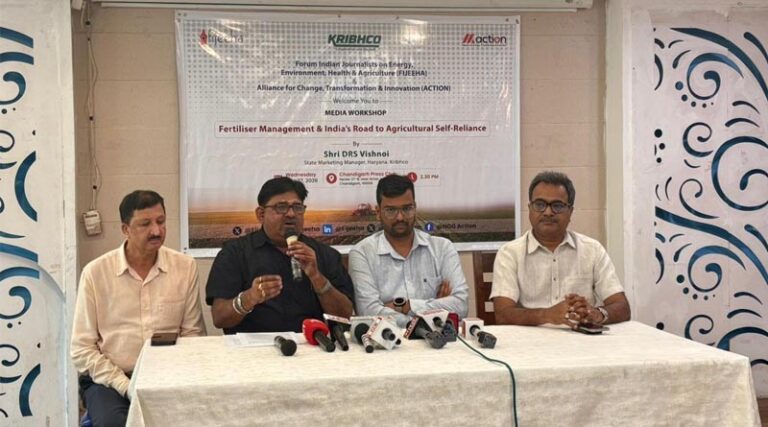
KRIBHCO Assures Adequate Fertilizer Availability for Haryana’s Kharif 2026 Season
02 June 2026, Chandigarh: Haryana farmers can expect uninterrupted fertilizer supplies during the upcoming Kharif 2026 season despite global supply chain uncertainties linked to ongoing geopolitical tensions in West Asia, according to KRIBHCO.
Speaking at a media workshop organized by the Forum for Indian Journalists on Education, Environment, Health & Agriculture (FIJEEHA) in collaboration with Alliance for Change, Transformation & Innovation (ACTION), Desh Raj Singh Vishnoi, State Marketing Manager, KRIBHCO Haryana, said the state has made sufficient arrangements to meet fertilizer demand during the critical sowing period.
Haryana’s total fertilizer requirement for the Kharif 2026 season is estimated at approximately 16.20 lakh metric tonnes, with urea accounting for nearly 11 lakh metric tonnes, reflecting the state’s heavy dependence on nitrogen-based fertilizers, particularly for paddy cultivation.
The projected demand also includes 2.80 lakh metric tonnes of DAP (Di-Ammonium Phosphate), 0.95 lakh metric tonnes of SSP (Single Super Phosphate), 0.70 lakh metric tonnes of MOP (Muriate of Potash), 0.60 lakh metric tonnes of complex fertilizers, and 0.15 lakh metric tonnes of city compost.
“Despite global challenges and disruptions in supply chains, all stakeholders are working in close coordination to ensure the timely availability of fertilizers to farmers across Haryana during the crucial Kharif season,” Vishnoi said.
He emphasized that uninterrupted fertilizer availability and balanced nutrient management remain essential for sustaining agricultural productivity in Haryana, where nutrient-intensive crops such as paddy continue to dominate the cropping pattern.
According to Vishnoi, the Haryana government, cooperative institutions, and fertilizer companies are jointly undertaking measures to maintain smooth fertilizer distribution, encourage balanced fertilizer application, and protect long-term soil health. Alongside conventional fertilizers, farmers are also being encouraged to adopt nano fertilizers, bio-fertilizers, and other sustainable farming practices that can improve nutrient-use efficiency while reducing environmental impact.
The workshop also highlighted KRIBHCO’s broader efforts to support climate-resilient and sustainable agriculture. The cooperative is conducting awareness campaigns and farmer training programmes focused on soil testing, soil health management, and crop-specific nutrient planning. These initiatives aim to reduce excessive dependence on chemical fertilizers and promote more efficient nutrient management practices.
KRIBHCO is also actively promoting the adoption of nano fertilizers and bio-fertilizers. The use of products such as nano urea is expected to enhance nutrient-use efficiency, minimize fertilizer losses, lower environmental pollution, and contribute to the long-term sustainability of agricultural production systems.
Addressing the gathering, Dr. Navneet Anand, President of FIJEEHA, praised KRIBHCO’s contribution to Indian agriculture, stating that the cooperative has played a significant role in ensuring reliable fertilizer availability for farmers while strengthening the rural agricultural ecosystem through a cooperative-led development model.
Pragya Lal Ranjan of ACTION noted that the Kharif season remains central to Haryana’s agricultural economy and that timely access to quality fertilizers is vital for ensuring food security, sustaining crop productivity, and improving farm incomes.
Global Agriculture is an independent international media platform covering agri-business, policy, technology, and sustainability. For editorial collaborations, thought leadership, and strategic communications, write to pr@global-agriculture.com