Making Women’s Empowerment Status Visible
18 November 2026, Africa: What gets measured gets managed, they say. Or, if you prefer the negative version: What doesn’t get measured doesn’t get managed. Or acted on. Or moved. Or improved. But some of the most important issues in research-for-agricultural-development work, such as community resilience, or institutional change, or system sustainability, are famously hard to measure, and therefore hard to track, manage, or enhance.
Consider women’s empowerment. CGIAR researchers have made great progress in recent years in measuring progress in women’s empowerment in agricultural development projects through use of tools such as:
- WEAI: the Women’s Empowerment in Agriculture Index, launched in 2012 by the International Food Policy Research Institute (IFPRI), the former United States Agency for International Development (USAID), and the Oxford Poverty and Human Development Initiative (OPHI)
- WELI: the Women’s Empowerment in Livestock Index, launched in 2015 by the International Livestock Research Institute (ILRI) and Emory University
- WEFI: the Women’s Empowerment in Fisheries and Aquaculture Index, launched in 2022 by WorldFish and the KIT Royal Tropical Institute
For research methods, problem diagnoses, and project evaluation, these tools have proved invaluable (and are being continually refined). But measures of empowerment, of “agency”, are largely hidden; they cannot be determined by, say, counting the number of hectares planted or cattle owned or determining the levels of household income or education.
To collect the most salient data on levels of empowerment therefore has to date been time-consuming, requiring interviewing more people (women as well as men), conducting longer interviews and distributing longer questionnaires, providing greater enumerator training, and doing more complicated sampling and analyses. For the overloaded and under-resourced national statistical offices and ministries of agriculture in the Global South, these comprehensive tools are a bridge too far.
What’s been missing is a streamlined way to measure empowerment—simple and short enough to fit inside existing national surveys and rigorous enough to be trusted. The Women’s Empowerment Metric for National Statistics Systems (WEMNS) is that measure.
First released in early 2024, this survey module takes less than 15 minutes to administer and can be folded into the routine household surveys that national statistical teams already conduct.
WEMNS measures agency across four domains—intrinsic (“power within”), instrumental (“power to”), collective (“power with”), and the material, human, and social resources that enable agency in the first place. Crucially, WEMNS also shows which specific constraints are driving disempowerment.
WEMNS was co-developed by IFPRI with the World Bank’s Living Standards Measurement Study, Emory and Oxford universities, and country partners in Bangladesh, Guatemala, Malawi, and Nepal. The metric was first fielded nationally in Liberia, Sierra Leone, and Tanzania with the Food and Agriculture Organization of the United Nations (FAO) through the 50×2030 Initiative to Close the Agricultural Data Gap.
Added value from the Scaling Fund
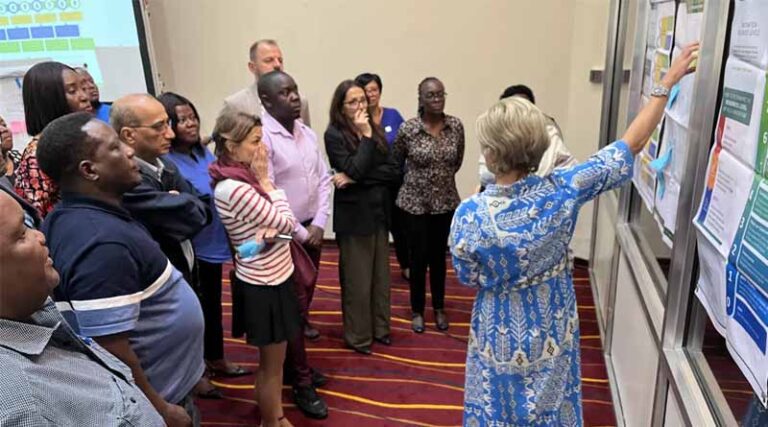
In 2025, WEMNS was one of eight innovations that won support from CGIAR’s annual competitive Scaling Fund. This Fund—delivered through CGIAR’s Scaling for Impact program and led by the International Livestock Research Institute (ILRI)—provided modest financial and hands-on technical support for scaling WEMNS to additional countries. The scaling tools used included convening an “Innovation Packaging and Scaling Readiness (IPSR)” workshop in Nairobi with stakeholders from FAO, national statistical offices and gender ministries, CGIAR researchers, and other organizations.
As IFPRI’s Hazel Malapit put it, the Fund’s “catalytic dollars” enabled the WEMNS team “to widen the room at the precise moment the partnership needed to align”.
The Nairobi workshop catalyzed a chain of follow-up activity: a webinar with twenty donors and strategic partners (including large-survey actors such as the Demographic and Health Surveys Program) and a follow-on consultation to embed WEMNS within the 50×2030 “data-use” partnership rather than approaching countries piecemeal.
The Nairobi workshop and related work also instigated a follow-on consultation with representatives from Liberia, Sierra Leone, and Tanzania to identify the next WEMNS scaling steps in those countries. The innovation team has validated a monitoring-and-evaluation framework and a clear scaling action plan, developed jointly with FAO and the 50×2030 Initiative.
Finally, the Scaling Fund’s process pushed the WEMNS partners to set explicit targets for the first time in the metric’s history—an exercise the innovators described as “eye-opening.” Already active in 6 countries, the WEMNS team now aims by 2030 to have the women’s empowerment metric tool adopted by 8 countries and used in 16–24 million household surveys and to partner with countries beyond the 50×2030 partner initiative that are using other multi-topic national surveys.
“Why is measuring women’s empowerment so critical? Change starts with data. Numbers tell us the stories of gaps and guide us toward policies that are not just well-intentioned, but laser-focused on solving real problems.”—Theresa Tenneh Dick, deputy minister at the Sierra Leone Ministry of Agriculture and Food Security
This tool has now been implemented in Liberia, Sierra Leone, and Tanzania, which have integrated WEMNS into their national agricultural surveys through the 50×2030 Initiative, and has been embedded in CGIAR’s GENDER accelerator, a program that integrates work on gender equality across CGIAR’s research portfolio.
The future
A short, credible survey module now exists to make women’s empowerment visible. The task now is to help many more countries pick it up and further refine it. Widespread uptake of WEMNS will allow countries to generate the meaningful and comparable data that will enable them to better target their investments in women’s empowerment.
Also Read: Mahindra Launches 50 HP Compact Harvester Harvest Yuva for Small Farms
Global Agriculture is an independent international media platform covering agri-business, policy, technology, and sustainability. For editorial collaborations, thought leadership, and strategic communications, write to pr@global-agriculture.com