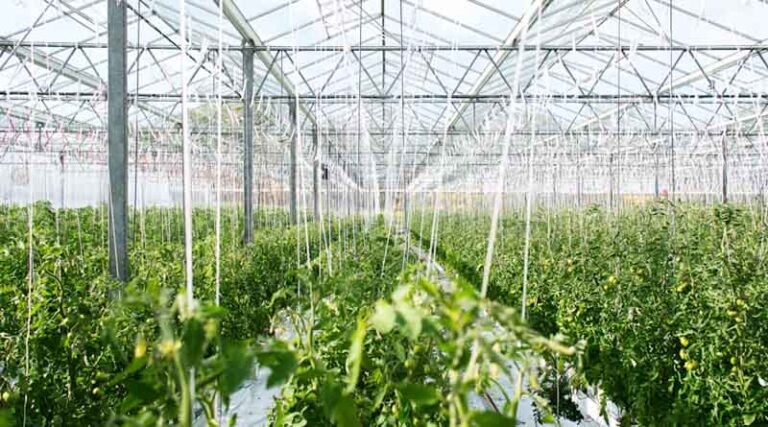
24 November 2026, Uggiate Trevano, IT: Arrigoni, an Italian manufacturer of agricultural netting and greenhouse covering materials, has published field trial results showing that a pair of its thermo-reflective shading screens can cut the amount of irrigation water lost to evaporation by as much as 50 percent compared with uncovered crops, data the company presented publicly at the EIMA International farm machinery show in Bologna this November.
The company’s research and development team tested 25 different fabric types during summer conditions, with maximum temperatures above 31 degrees Celsius, comparing covered plots against an uncovered control area. To measure water loss consistently, the trials used reference evapotranspiration, a standard method set out by the United Nations Food and Agriculture Organization and calculated with the Penman-Monteith formula, which estimates how much water a well-watered reference crop loses to the atmosphere under given weather conditions. That approach allowed Arrigoni to compare different screen types on equal footing rather than relying on anecdotal water-use reports from individual growers. The company said an earlier, independently run trial by the French technical institute ACSE in 2023 produced supporting results, though it did not publish details of that study alongside the new data.
Two products anchor the results: Prisma and Robuxta, both described as thermo-reflective screens, meaning they are designed to reflect a portion of incoming solar radiation rather than simply blocking it, which keeps the covered space cooler without cutting off all light to the crop underneath. Each comes in different shading strengths, described by the company using density codes. A lighter version that blocks about 30 percent of light cut evaporative water loss by 40 percent in the trials, while a denser version blocking 49 percent of light cut water loss by 46 percent. A full covering that blocks essentially all light to the crop cut water loss by 75 percent, though Arrigoni noted that level of shading is impractical for most crops because it starves the plant of light needed for growth. Robuxta also uses a reinforced, monofilament-based structure intended to give the screen added mechanical strength, useful in regions with strong wind or heavy handling during installation and removal.
A growing water problem
Patrizia Giuliani, Arrigoni’s sales director, said the trial data would feature in the company’s newly updated product catalogue of nets and films, framing the screens as part of a broader push toward water-efficient greenhouse and tunnel growing. The company’s own figures, drawn from Food and Agriculture Organization estimates, note that agriculture already accounts for roughly 70 percent of freshwater withdrawn globally, and that irrigated crop production needs to grow by more than 50 percent by 2050 to keep pace with demand, even as available water supplies are projected to rise by no more than 10 percent over the same period. That gap between water demand and water supply is the backdrop against which greenhouse and tunnel growers, particularly those producing berries, vegetables and other high-value horticultural crops in warm or increasingly erratic climates, are under pressure to cut irrigation use without sacrificing yield or quality.
For protected-crop growers, thermo-reflective screening sits alongside other climate-control tools such as fogging, pad-and-fan cooling and ventilation management, but has the advantage of being a largely passive technology once installed, requiring no energy input to run. By reducing the temperature inside a covered structure and slowing the rate at which irrigation water evaporates from soil and plant surfaces before it can be taken up by roots, a well-chosen shading screen can reduce how often and how much a grower needs to irrigate during the hottest parts of the season, when water demand and water stress on crops are both at their peak.
The company has not published independent third-party verification of the summer 2026 trial figures beyond its own reporting and the earlier French institute study, and growers evaluating the screens for their own operations would likely want to see performance data under their specific crop, climate and covering-structure combination before committing to a changeover. Even so, the scale of the claimed water savings, in the range of 40 to 50 percent for the two commercial products tested, is large enough that it is likely to draw attention from growers in water-stressed regions weighing covering upgrades ahead of next season.
Global Agriculture is an independent international media platform covering agri-business, policy, technology, and sustainability. For editorial collaborations, thought leadership, and strategic communications, write to pr@global-agriculture.com