Bipartisan Majorities in U.S. Favor Glyphosate Ban, Annenberg Survey Finds
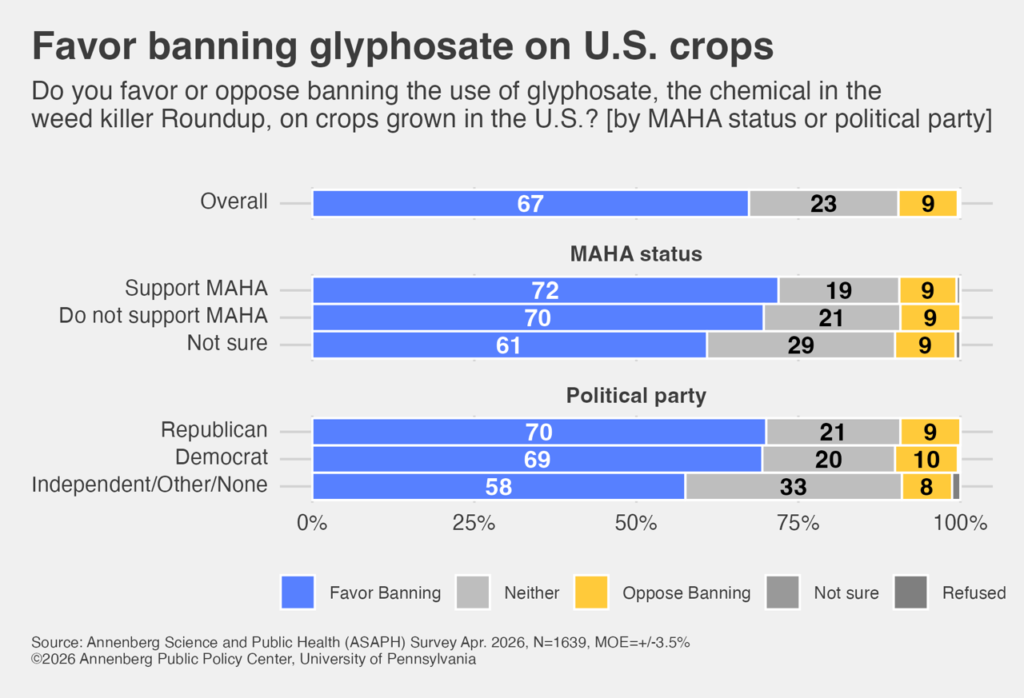
24 August 2026, Philadelphia: Two-thirds of Americans support banning the use of glyphosate on crops grown in the United States, with majorities of both Republicans and Democrats backing a ban, according to a nationally representative survey by the Annenberg Public Policy Center (APPC) of the University of Pennsylvania.
The survey found that 70% of self-identified Republicans and 69% of Democrats favor banning glyphosate, the active ingredient in widely used herbicide formulations including Roundup. Support was also high among people who identify with the Make America Healthy Again (MAHA) movement, at 72%, compared with 70% among those who do not support MAHA.
The findings come as glyphosate remains at the center of debate in the United States over pesticide safety, agricultural productivity and potential health risks. At the same time, the survey indicates that public understanding of the herbicide remains limited.
Limited public awareness despite strong support for a ban
The Annenberg Science and Public Health (ASAPH) survey, conducted April 14–28, 2026, among 1,639 U.S. adults, found that 83% of respondents had heard either nothing at all or only a little about glyphosate in the months preceding the survey.
Fifty-four percent said they had heard nothing at all, while another 29% said they had heard only a little. Just 16% reported hearing a moderate amount or more about glyphosate.
Awareness was similarly limited among MAHA supporters. Seventy-six percent said they had heard nothing or only a little about glyphosate, while 24% said they had heard a moderate amount or more.
“Americans express strong support for banning glyphosate even though most acknowledge hearing relatively little about the herbicide in recent months,” said Ken Winneg, APPC’s managing director of survey research.
Public views on glyphosate and cancer remain uncertain
The survey also found that Americans remain divided or uncertain about the potential health effects of glyphosate.
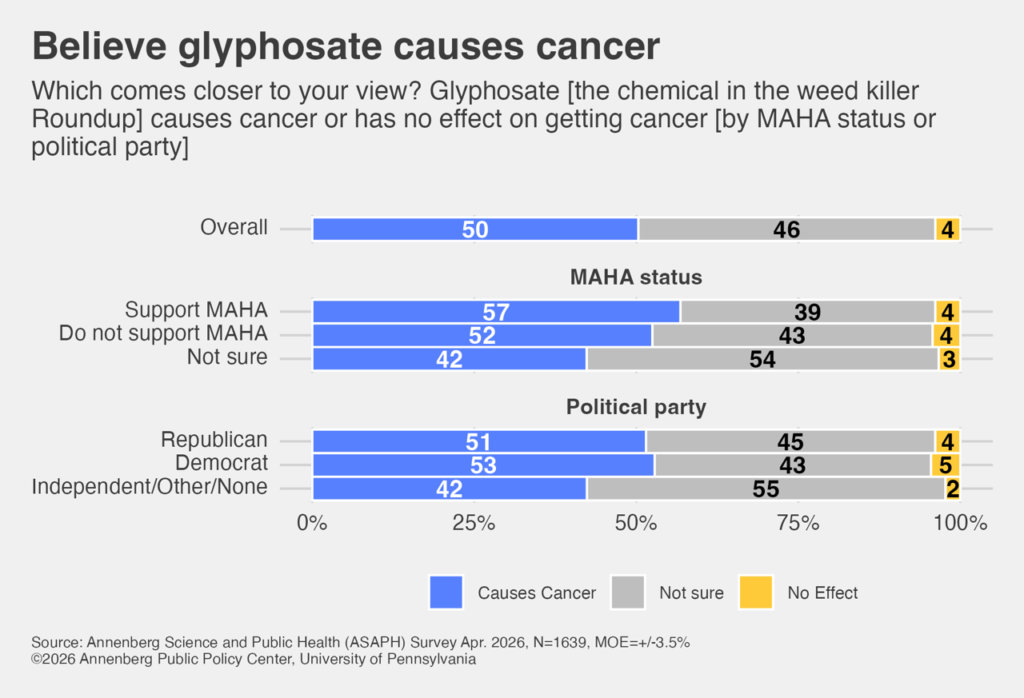
Half of U.S. adults, or 50%, said they believe exposure to glyphosate causes cancer, while 46% were unsure. Only 4% said glyphosate has no effect on cancer risk.
Views were broadly similar across the two major political parties. Fifty-one percent of Republicans and 53% of Democrats said they believe glyphosate causes cancer. Among independents, 42% held that view, while 55% said they were unsure.
Patrick E. Jamieson, director of APPC’s Annenberg Health and Risk Communication Institute, said public concern about potential cancer risks and support for restricting glyphosate use both extend across political lines.
The scientific and regulatory assessments of glyphosate, however, have not been uniform. The International Agency for Research on Cancer classified glyphosate as “probably carcinogenic to humans” in 2015, based on its assessment of the available evidence. The U.S. Environmental Protection Agency has reached a different conclusion, stating in its 2017 review that glyphosate is “not likely to be carcinogenic to humans” when used according to label directions.
Glyphosate debate intensifies in U.S. politics
Glyphosate has become increasingly prominent in the U.S. political debate, particularly within the MAHA movement, which has advocated tighter controls or a phase-out of certain agricultural chemicals.
The issue has also created tensions within the Trump administration. In February 2026, President Donald Trump signed an executive order invoking the Defense Production Act to support domestic production of elemental phosphorus and glyphosate-based herbicides, describing the products as important to national security and U.S. agricultural strength.
The decision drew criticism from some MAHA supporters. Health and Human Services Secretary Robert F. Kennedy Jr., who has previously raised concerns about glyphosate, subsequently defended the administration’s position while acknowledging the potential disruption that an immediate ban could cause to U.S. agriculture.
The debate also comes amid continuing litigation surrounding glyphosate-based products. In June 2026, the U.S. Supreme Court overturned a $____ jury award in a case involving a plaintiff who alleged that exposure to glyphosate in Roundup caused non-Hodgkin’s lymphoma and that Monsanto should have included a cancer warning on the product label.
Americans uncertain about glyphosate’s role in food production
The survey suggests that uncertainty extends beyond health concerns to the role glyphosate plays in agriculture.
When asked which statement best described glyphosate’s effect on the U.S. food supply, only 33% said the most accurate view was that glyphosate helps increase food production by enabling farmers to control weeds.
Nearly half of respondents, or 48%, said they were unsure. Another 12% said glyphosate has no effect on food production, while 6% believed its use decreases the food supply.
The results highlight a gap between strong public support for banning glyphosate and relatively limited public awareness of its role in crop production.
Glyphosate has been used in the United States since the 1970s and remains an important herbicide for weed management across major agricultural crops. Any broad restriction would therefore have implications for farmers, input markets and crop production systems.
The APPC survey indicates that the political debate over glyphosate is no longer confined to one ideological group. Support for a ban has emerged among substantial majorities of both Republicans and Democrats, despite widespread uncertainty among Americans about the herbicide’s health effects and contribution to food production.
Also Read: UPL’s Advanta to Acquire Egyptian Seed Company Hytech Egypt for $110 Million
Global Agriculture is an independent international media platform covering agri-business, policy, technology, and sustainability. For editorial collaborations, thought leadership, and strategic communications, write to pr@global-agriculture.com