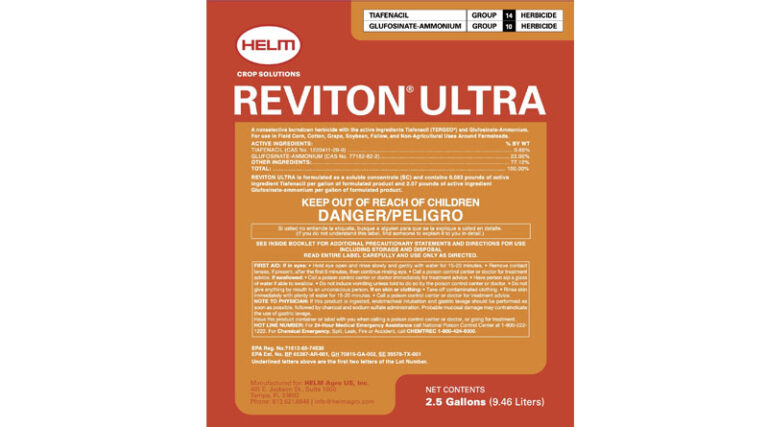
28 November 2026, Tampa, US: HELM Crop Solutions announced the commercial launch of Reviton Ultra, a new premix herbicide combining tiafenacil and glufosinate, giving US row crop growers a broader-spectrum burndown option ahead of the 2027 planting season. The company said regulatory approval for the product is secured and that manufacturing is increasing to meet expected demand.
Reviton Ultra pairs tiafenacil, a Group 14 PPO inhibitor that is the active ingredient in HELM’s original Reviton herbicide, with glufosinate, a Group 10 glutamine synthetase inhibitor. The combination is designed to control or suppress more than 100 broadleaf and grass weed species, according to the company, including difficult populations such as marestail, waterhemp and kochia in areas without PPO-resistant biotypes, as well as volunteer corn. Brock Waggoner, product development lead at HELM Crop Solutions, described the product as building on the burndown performance growers have come to expect from tiafenacil while extending the number of weed species it controls.
Building on Tiafenacil’s Burndown Record
The original Reviton herbicide, labeled at 1 to 3 fluid ounces per acre for burndown, established tiafenacil as a fast-acting option for growers looking to clear fields ahead of planting. Reviton Ultra is labeled at a higher rate of 24 to 48 fluid ounces per acre, reflecting the addition of glufosinate to the formulation, and the company recommends tank-mixing it with a methylated seed oil adjuvant plus ammonium sulfate at 3 pounds per acre for best results.
The product is labeled as a burndown herbicide for fallow and non-crop acres, with preplant and preemergence uses in field corn and preplant burndown uses in cotton and soybeans. HELM said the product carries a zero-day plant-back interval for field corn, cotton and soybeans, depending on the rate used and soil type, giving growers flexibility on timing between application and planting. Reviton Ultra is also labeled for shielded-sprayer application in grape vineyards, extending its use beyond row crops into specialty production.
The launch comes as growers across the US Corn Belt and Mid-South continue to manage weed populations that have developed resistance to multiple herbicide groups, particularly glyphosate and ALS-inhibiting chemistries. Pairing a PPO inhibitor with a glutamine synthetase inhibitor gives growers two distinct modes of action in a single premix, a formulation approach that has become more common industry-wide as companies look to slow the spread of herbicide-resistant weed biotypes without requiring growers to manage multiple separate tank-mix partners themselves.
HELM positioned Reviton Ultra as a companion product to the original Reviton rather than a replacement, giving growers a choice between the lower labeled rate of the original product for straightforward burndown situations and the higher rate, broader-spectrum Reviton Ultra where resistant or harder-to-control weed populations are present. The company said it expects supply to be available in time for spring 2027 field applications, with manufacturing capacity increasing following the securing of regulatory approval.
Global Agriculture is an independent international media platform covering agri-business, policy, technology, and sustainability. For editorial collaborations, thought leadership, and strategic communications, write to pr@global-agriculture.com