27 November 2026, Cambridge, US: Engineers at the Massachusetts Institute of Technology have flown an insect size flapping wing robot that carries its own sensors and onboard computer for the first time, removing its need for the external camera systems that have constrained this class of robot in the lab, the university said on November 18. The work, led by associate professor Kevin Chen and professor Jonathan How at MIT along with assistant professor Elizabeth Farrell Helbling at Cornell University, is published in the journal Science Robotics.
The robot is roughly the size and shape of a microcassette tape and weighs less than a paperclip. Four wings, each driven by soft, muscle like actuators rather than a conventional motor, flap rapidly to generate lift. Earlier versions of this robot, built by the same MIT lab, could already fly with speed and agility comparable to a real insect, but only inside a room fitted with an external motion capture system, a rig of cameras that tracks reflective markers on the robot to work out where it is in space. That dependency has limited such robots to controlled lab settings and ruled out any real world use.
How it navigates itself
The new version instead carries a miniature onboard package weighing just 244 milligrams that combines an inertial measurement unit to sense orientation, an optical flow sensor to estimate how fast and in which direction it is moving sideways, a time of flight sensor to measure its height, and a microcontroller to process all of it in real time. Because flapping wing robots are inherently unstable in flight, the onboard computer has to estimate the robot’s position and correct its course many times each second, a computation that would overwhelm many small embedded processors. The team’s main contribution is a simplified estimation method that trades some precision for speed, which the researchers found worked better in practice than a slower, more accurate alternative, since the robot can correct small errors quickly before they add up.
Getting the extra weight of the sensor package airborne required retuning the robot’s actuators. Enlarging them by 50 percent raised net lift by 46 percent, with the geometry adjusted so that lift scales in proportion to the added weight rather than being overwhelmed by it. The electronics package draws only about 6 percent of the robot’s total power, leaving the rest for the wing actuators, which the researchers say leaves room to add further components such as a small camera in future versions.
In flight tests, the robot hovered at different heights and flew point to point trajectories with a position error of only a few centimeters, which co lead author Yi-Hsuan Hsiao said is “comparable to flying with offboard cameras.” In a demonstration relevant to agriculture, an operator used a joystick to send the robot high level position commands that guided it around several plants before it landed precisely on a sunflower, a maneuver Hsiao said is “quite difficult to do, even if you do have a motion capture system.”
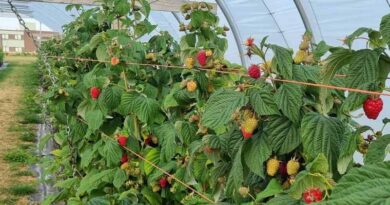
MIT’s own framing for the work points to two agricultural uses: weaving through orchards or berry fields to hand pollinate individual blossoms in regions where natural pollinator populations have declined due to habitat loss, and hovering near plants to monitor crop health or spot pests early without disturbing the crop. Both are presented as future possibilities rather than demonstrated capabilities today. The robot remains tethered to an external power source, so untethered, battery powered flight, a prerequisite for any outdoor agricultural use, has not yet been shown. Chen described the milestone as “the first demonstration of an aerial microrobot that is sensory and compute autonomous,” calling it “a really important milestone for the research community” rather than a field ready tool.
The research was funded by the US National Science Foundation, the US Office of Naval Research, the US Air Force Office of Scientific Research, MathWorks and a Zakhartchenko Fellowship.
Global Agriculture is an independent international media platform covering agri-business, policy, technology, and sustainability. For editorial collaborations, thought leadership, and strategic communications, write to pr@global-agriculture.com