Eyes In The Paddock: Detecting Fusarium Wilt Of Chickpea
22 September 2026, AU: Chickpea growers and agronomists have a critical role to play this spring in helping to safeguard the Australian grains industry by looking out for one of its high-priority exotic disease threats.
Spring is an important time for chickpea growers and agronomists to keep watch for unusual wilting, yellowing or plant collapse in paddocks.
The industry needs to be on alert for Fusarium wilt of chickpea, an exotic disease threat identified as a High Priority Pest (HPP) for Australia’s grains industry. It is not known to occur in Australia and early detection will be critical if it is ever found.
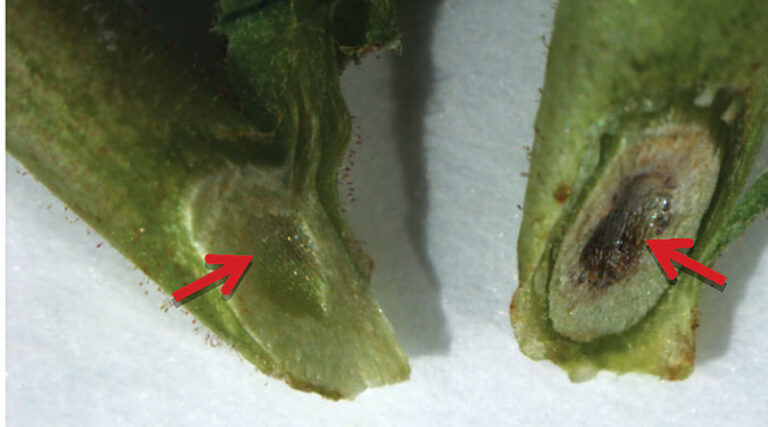
Figure 1/Header Image: Discolouration of vascular tissue on a chickpea plant infected with Fusarium oxysporum f. sp. ciceris (right) compared with a healthy chickpea plant (left)
What is Fusarium wilt of chickpea?
Fusarium wilt of chickpea is caused by Fusarium oxysporum f. sp. ciceris, commonly abbreviated as Foc, a soil-borne fungal pathogen that predominantly affects chickpeas. The disease is well established across Southern Asia, the Middle East, parts of Africa, Europe, Mexico and the US.
Foc earns its place on the HPP list for 2 main reasons.
First, it can cause significant economic damage where it establishes. Yield losses can range from 10 to 40% in affected regions and complete crop loss is possible under favourable conditions for the fungus.
Second, once Foc enters a paddock, it is extremely difficult to eradicate. This pathogen survives in soil as hardy resting spores for up to 6 years, even without chickpeas or other host crops present. There are no chemical or cultural practices capable of eradicating it from the ground once it is established, which makes prevention and early detection essential.
The primary pathway for Foc to enter Australia is through infected seed. Once on a property, it can spread through the movement of infected soil on machinery, boots, vehicles and equipment.
What to look for
Symptoms to watch for include:
- scattered wilting or yellowing that does not match patterns usually associated with waterlogging, soil variation or herbicide damage
- patches of collapsed plants with no obvious above-ground cause
- plants that wilt during the heat of the day but partially recover overnight (an early and easily overlooked sign of below-ground infection)
- sudden whole-plant yellowing and wilting at or after flowering.
Always check by pulling a suspect plant and making a clean cut through the stem at or just below the soil surface.
Reddish-brown to dark brown discolouration of the internal water-conducting vascular tissue (known as the xylem) is a strong indicator of Foc and must be followed up with diagnostic testing. Healthy chickpea stems are white or cream-coloured inside.
There can be other causes of root and stem wilting and rotting, including Phytophthora root rot, which is associated with wet soils, and general drought stress, which often affects plants uniformly across a paddock.
If you suspect Foc, contact your local plant pathologist or Grains Biosecurity Officer for assistance with identification before taking further action.
Biosecurity makes a difference
Good on-farm biosecurity practices reduce both the risk of Foc entering a property and help limit the chance of it spreading if something unusual is found. Practical steps include:
- use clean, traceable seed from accredited suppliers and avoid seed with unknown disease history
- know your paddock history and investigate unexplained wilting before sowing chickpeas again
- monitor crops frequently, particularly during September and October
- clean down machinery, vehicles, equipment and boots between properties and paddocks
- brief farm workers and contractors on what to look for
- keep records of seed source, paddock history, crop monitoring and machinery movement.
In biosecurity, the absence of a problem is rarely accidental. It reflects consistent, deliberate effort. The checks you do in the paddock this spring may be what keeps Fusarium wilt of chickpea out of your and other Australian paddocks.
If you see something, act early
If you see something unusual, take a picture and record the date and location. Mark the location with a peg or surveyor’s tape and avoid moving machinery, soil or plant material through the suspect area until you have received advice. Contact the Exotic Plant Pest Hotline at 1800 084 881 or your local plant pathologist to report it within 24 hours.
Also Read: India Approves Pioxaniliprole, First Insecticide Active Ingredient Discovered in India
Global Agriculture is an independent international media platform covering agri-business, policy, technology, and sustainability. For editorial collaborations, thought leadership, and strategic communications, write to pr@global-agriculture.com