22 June 2026, AU: Demonstration trials in southern New South Wales and northern Victoria show that crop diversity is a key part of an integrated disease management strategy for Fusarium crown rot.
Break crops provided the clearest benefit for reducing the risk of Fusarium crown rot (Fusarium pseudograminearum) to cereal crops in Riverine Plains demonstration trials.
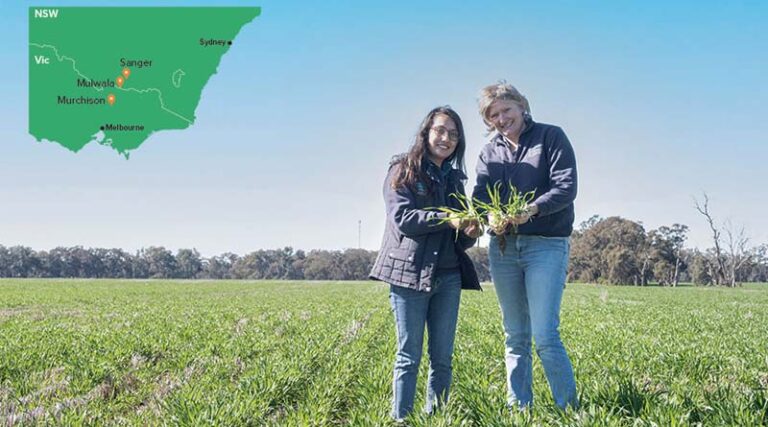
The demonstration trials, supported by GRDC investment, were run in paddocks with a confirmed high risk for Fusarium crown rot (FCR) infection near Mulwala and Sanger in New South Wales and Murchison in Victoria.
The results reinforce the value of using non-host break crops to interrupt the disease cycle and give infected cereal residues time to break down.
Crop choice
Long-term monitoring of a paddock near Murchison, Victoria (where acid subsurface soils had been ameliorated with lime and tillage), showed the value of a diverse rotation.
After wheat in 2022, the site was sown to faba beans in 2023 and canola in 2024. By 2025 and 2026, FCR levels were low or below detection in most treatments.
The results suggest crop rotation had a stronger influence on FCR levels than soil pH at this site.
In some paddocks, barley showed lower FCR inoculum levels than wheat, suggesting it may be a better option where a cereal crop is required.
Seed treatments
Various seed treatments were evaluated on paddocks near Murchison, Sanger and Mulwala in 2025. The results were variable across these unreplicated sites. Riverine Plains Project Manager Sabita Duwal observed no clear yield differences between strips on which seed dressings were applied and the control strips. She says the result may have been influenced by the unreplicated strip design and seasonal conditions.
Non-replicated strip treatments cannot reliably prove causation statistically because researchers cannot separate the treatment effect from normal paddock variability. Replication solves this problem by repeating each treatment multiple times across the paddock.
“Although 2025 was dry, the Riverine Plains region had a cool finish, which may have reduced crop stress during grain fill and limited FCR expression,” Ms Duwal says. “Accordingly, seed dressings should be considered only one part of an integrated disease management strategy, rather than a standalone tool.”
Testing encouraged
The work highlighted the importance of testing. PREDICTA® B can help identify low-risk paddocks before sowing, while post-harvest stubble testing shows the level of FCR that developed in the crop in that season.
Ms Duwal says the distinction is important because pathogen risk does not always translate directly into yield loss. Seasonal conditions, crop stress, crop type, variety, rotation and stubble management all influence FCR expression.
“Overall, our work showed that FCR management relies on a systems approach. Regular monitoring and testing, inter-row sowing, non-host break crops, cereal crop and variety choice, stubble management and seed treatment together help defend against grain yield losses caused by FCR.”
Global Agriculture is an independent international media platform covering agri-business, policy, technology, and sustainability. For editorial collaborations, thought leadership, and strategic communications, write to pr@global-agriculture.com