CCFL49 / Spirit Of Cooperation And Respect Sees Allergens, Multipack Formats And Emergency Labelling All Forwarded
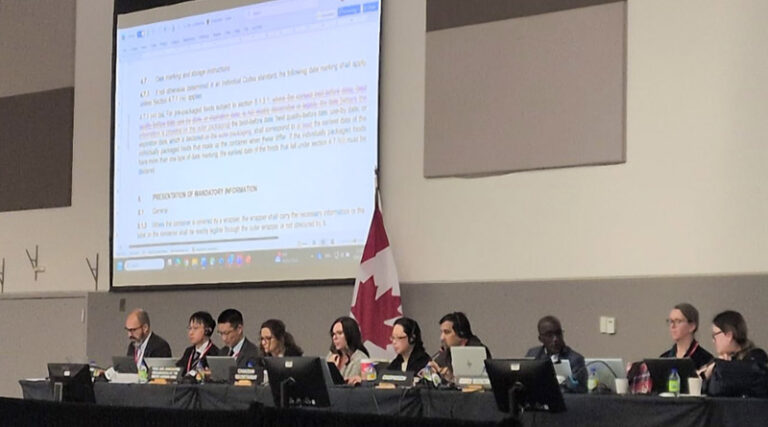
18 May 2026, Rome: A successful 49th session of the Codex Committee on Food Labelling has concluded in Ottawa, Canada. Upon adoption of the session report, Chairperson Parthiban Muthukumarasamy congratulated the delegates for the week’s achievements. “I would like to highlight what truly defines this committee,” he said. “The spirit and the cooperation throughout this week; we have seen open dialogue, respect for different perspectives, and the willingness to find common ground. This is not always easy and particularly when addressing issues that intersect with national priorities, public health considerations and trading interests. Time and again, you have demonstrated that consensus is possible when we work together in good faith.”
The Committee has completed work on three key agenda items and forwarded the agreed texts to the Codex Alimentarius Commission (CAC) for adoption. Two of those relate to the General standard for the labelling of pre-packaged foods (CXS 1-1985) and these include the guidelines on the use of precautionary allergen labelling (PAL), and provisions relevant to joint presentation and multipack formats, which have been forwarded for adoption at Step5/8.
CCFL49 was able to finalize the work on PAL following two FAO/WHO expert consultations in 2025 that clarified issues around qualitative risk assessment and the level of reference doses or concentrations for gluten or cereals containing gluten. However, delegates have been very clear that these guidelines need to be accompanied by training and capacity development, and requested FAO and WHO together with the Codex Secretariat to use the opportunity of the upcoming FAO/WHO coordinating committees to provide some training and capacity building activities.
Work relating to the third key agenda item that has been forwarded to CAC is the proposed guidelines on application of food labelling provisions in emergencies. This is a potentially sensitive area of food safety oversight, as testified by the consensus in the Committee. The guidelines are for use only by competent authorities within their own jurisdictions, and that other entities should be excluded from their use.
CCFL49 further agreed on a point where there have been diverging discussions on whether labelling of “country of harvest” should be an optional or mandatory provision in addition to the mandatory declaration of country of origin in the labelling of spices. The Committee discussed and agreed upon nine conclusions that emerged from electronic working group discussions on this topic. CCFL has recommended to CAC that these “conclusions” be used as guiding principles by the Codex Committee on Spices and Culinary Herbs (CCSCH) when determining origin-related labelling provisions for relevant commodities. Based on these conclusions, CCFL49 also made a proposal on the labelling of the outstanding provision on country of harvest in the standard for saffron.
This Session further agreed to endorse the labelling provisions of nine standards developed by six commodity and coordinating committees.
With these successesn CCFL then agreed to work on a strategic forward plan to identify and prioritize key future areas of work to include in the review of existing CCFL texts. CCFL49 discussed two new work proposals: the application of food labelling provisions to alcoholic beverages, and a guiding definition for a more uniform application of labelling provisions to “small packages” and their related exemptions. Discussions on both these topics concluded that they are not yet ready for development, and both will be retained in the CCFL inventory of future work.
Also Read: DCM Shriram Ltd. Reports ₹14,264 Crore Revenue and ₹856 Crore Profit for FY26
Global Agriculture is an independent international media platform covering agri-business, policy, technology, and sustainability. For editorial collaborations, thought leadership, and strategic communications, write