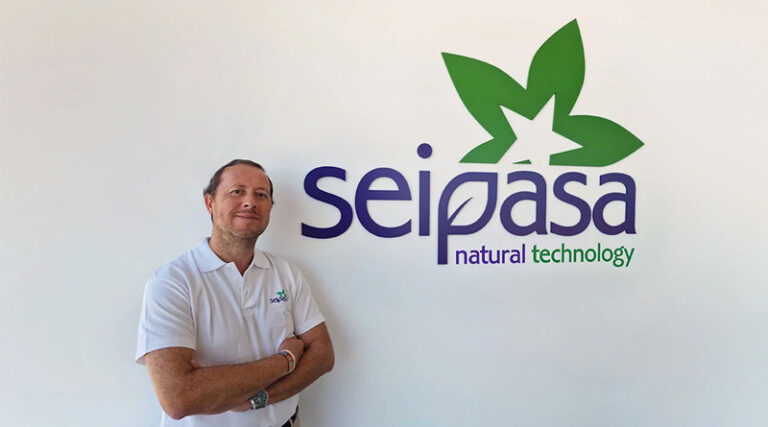
13 May 2026, Spain: We spoke with Pedro Sapata, Business Development Manager of Seipasa in Portugal, about the impact and technology behind this innovative herbicide of natural origin.
Portuguese agriculture is in a moment of profound transformation. With the gradual withdrawal of chemical synthesis active substances, uncertainty regarding the renewal of glyphosate in 2033, and a growing sensitivity toward soil health, the arrival of solutions like Seipasa’s Seithor herbicide marks a milestone in weed management.
1. Why is Seithor the answer the Portuguese countryside needed precisely now?
The Portuguese market is going through a moment of certain “anxiety” due to the gradual disappearance of numerous chemical synthesis products. Farmers urgently need viable alternatives for the future of our agriculture. There is a high demand for solutions with a lower environmental impact, especially regarding soil microorganisms.
The continuous use of traditional chemical herbicides directly affects soil life, and Seithor stands out precisely because it is not harmful to these microorganisms. Compared to solutions that damage edaphic biodiversity, Seithor drastically reduces that negative impact: it leaves no residues in the soil and contributes to preserving its fertility.
2. Is this product a real substitute, in terms of efficacy and handling, for the chemical herbicides that are disappearing?
Without a doubt. Seithor arrives in Portugal to meet a critical need in light of the shortage of alternatives. Currently, weed resistance to herbicides is a growing problem in Portugal, particularly in perennial crops such as vineyards due to intensive and continuous use. Therefore, contact herbicides like Seithor will be an alternative for more effective control of resistant weeds.
3. Regarding the mode of action, how does Seithor destroy weeds by contact without leaving residues in the soil?
The main advantage of Seithor is its high efficacy through a direct contact action on weeds. By acting exclusively by contact, its residue level is extremely low. It offers excellent agronomic action with an immediate effect, destroying plant tissues without leaving the soil residuality that other chemical synthesis molecules leave behind.
4. Let’s talk about objectives: Which key crops is this solution primarily aimed at?
Our current label covers strategic crops in Portugal such as grapes, apples, pears, and almonds. It is also fundamental in emerging crops that are gaining significant weight, such as hazelnuts, walnuts, pistachios, and quinces. Its label also includes application in non-cultivated areas, such as industrial areas, leisure zones, and others, such as communication routes.
5. What makes Seithor’s technology different from any other herbicide already on the market?
Seithor stands out for having a formulation with advanced encapsulation technology: the active ingredient -pelargonic acid- travels protected by a surfactant shield, remaining intact and ready to act at the moment of spraying; its stability guarantees an impeccable emulsion and homogeneity of application, which allows for working with lower doses.
Its mode of action is extremely fast and effective on both monocots and dicots. It is a broad-spectrum product that provides great security to the farmer, with visible results in a very short period of time after application.
6. For the farmer looking for results: At what stage of weed growth is the product effective?
The product provides good efficacy when applied in the earliest stages of the weeds. However, we have observed excellent results even in more advanced stages of development. In these cases, it is necessary to adjust the dose and ensure that the entire leaf surface is thoroughly wetted, given that, as a contact product, coverage is essential to guarantee optimal performance.
7. Seithor has already been on the market for a few weeks following its launch. How has the reception been?
The reception in Portugal has been excellent. It has sparked great interest for being a more concentrated product with a lower dose and, especially, due to the lack of alternatives in the market.
This year, after a very rainy winter in which traditional herbicides did not obtain the expected results, Seithor is the ideal alternative and tool to correct applications that had little success during the vegetative rest of the crops for which it is registered.
8. Following the DGAV registration, what is your market penetration goal in Portugal for this first year?
Portuguese producers are becoming increasingly receptive to solutions with lower environmental impact and high performance. In this first year, we are going to work to ensure that Seithor becomes a solution validated by farmers looking for alternatives to the use of conventional herbicides, but with the same guarantee of success. Seithor arrives to position itself as an alternative and to meet the needs of modern agriculture in Portugal.
Global Agriculture is an independent international media platform covering agri-business, policy, technology, and sustainability. For editorial collaborations, thought leadership, and strategic communications, write to pr@global-agriculture.com