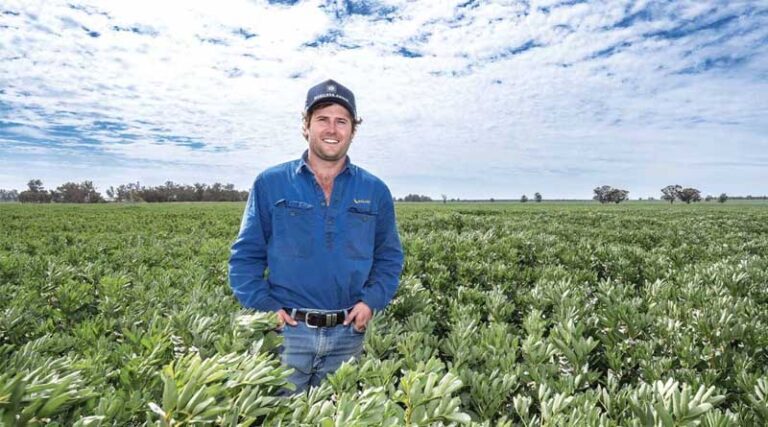
28 April 2026, AU: Lachie Moloney trialled faba beans for the first time 2 years ago to add resilience to his family’s property near Tullamore in central New South Wales.
The Diverse Farms demonstration trial on Lachie’s family farm is part of GRDC’s Southern NSW Farming Systems Project. The project is led by CSIRO with co-investment from the NSW Department of Primary Industries and Regional Development.
Diverse Farms aims to validate small-plot research by comparing a faba bean/canola/wheat/barley rotation with a canola/wheat/barley sequence. It also seeks to identify barriers to on-farm adoption.
Lachie’s adviser, Dan Sweeney from Baker Ag Advantage, says faba beans can fix 300 to 350 kg/ha of nitrogen, with 200 to 250 kg/ha removed in grain, leaving 50 to 100 kg/ha of legacy soil nitrogen.
Besides biological nitrogen fixation, Lachie hopes a faba bean/canola double break will help reduce crown rot pressure and enable better annual ryegrass management without compromising farm profit over 4 years.
Soil constraints
Initial soil tests showed no acid-soil constraints. Group F acid-tolerant rhizobia granules were applied at 1.5 times the label rate at sowing.
On 21 April 2024, Lachie sowed 135 kg/ha of PBA Samira faba beans with 60 kg/ha of monoammonium phosphate (MAP) into moisture on 30.48 cm (12-inch) rows. MAP was banded away from the seed. Barley was sown in an adjacent paddock.
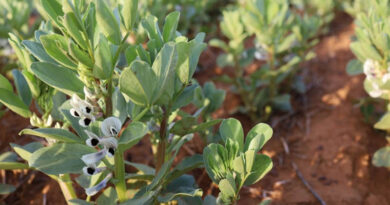
By 8 May, 17 plants/m2 of faba beans were established, but nodulation across most of the paddock was poor.
Follow-up soil tests showed some areas of the paddock had a pHCa of 4.5, but most of the paddock had a pHCa of 5.2 on average.
Surprisingly, faba beans sown into soils with a pHCa of 7 also nodulated poorly.
After running out of the granular inoculant, Lachie applied 1.5 times the rate of an acid-tolerant peat slurry inoculant (Group F). This achieved effective nodulation.
To protect yield potential, Lachie applied 150 kg/ha of urea (69 kg/ha of nitrogen) to the beans.
Early results
The faba beans yielded 2.8 t/ha from 392 mm of plant-available water, resulting in a gross margin of $558/ha. The barley yielded 6.4 t/ha and returned $1,298/ha.
Although less profitable than the barley, Lachie was happy with the faba bean yields. He says he is “trusting the process based on what detailed small-plot research has shown”. He will continue to evaluate the double-break farming system over the next 2 years.
In 2025, triazine-tolerant canola was sown into the faba bean and barley residue. Although nitrogen fixation was compromised in 2024, soil tests showed 42 kg/ha more soil nitrogen in the soil where the faba beans were planted.
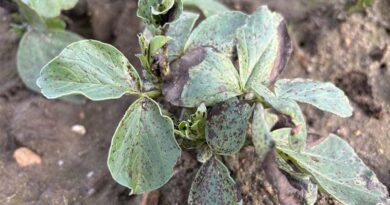
Mr Sweeney says that growing faba beans for the first time isn’t without challenges: “There’s grading seed by size to boost establishment, sourcing effective inoculant, setting up machinery, managing pests and disease, harvesting, storage and marketing.”
He says pulses can work in central NSW. “But matching inoculant to soil conditions, and addressing acidity early, are essential if we’re serious about reducing reliance on synthetic nitrogen.”
Global Agriculture is an independent international media platform covering agri-business, policy, technology, and sustainability. For editorial collaborations, thought leadership, and strategic communications, write to pr@global-agriculture.com