27 July 2026, AU: A report has been released by Grains Australia that equips the grains industry with the insights and data needed to address the costly issue of non-tariff trade barriers.
As trade tariffs fall, new regulatory complexities are taking their place. Called non-tariff measures (NTMs), they encompass policies such as quotas, import licensing, sanitary regulations and product standards.
To gain a technically sound understanding of the global NTM landscape, Grains Australia analysed and reported on their economic impacts, in collaboration with the Australian National University and with investment by GRDC.
The report highlights the growing importance of NTMs, estimated at about $4.6 billion annually. It also provides recommendations around practical opportunities for industry.
The Trade and Market Access Manager at Grains Australia is Lachlan Evans. He works collaboratively with industry stakeholders to navigate complex regulatory landscapes, including NTMs.
The Trade and Market Access team serves as a first point of contact for domestic and overseas governments on grain market access matters.
“We coordinate responses to emerging barriers to support the Australian grains industry and its international customers through strategic engagements,” Mr Evans says.
Understanding NTM impacts
Mr Evans explains that NTMs in grain export markets are often designed to address legitimate health, environmental and biosecurity objectives. However, they can also create compliance costs. In many cases, some of these measures reflect regulatory uncertainty about how the supply chain operates or what assurances already exist, rather than any deliberate intent to restrict trade.
“NTMs have overtaken tariffs as the most significant barrier to international market access for Australian grain exporters,” he says.
“We engaged with the Australian National University to move beyond simply counting the number of NTMs, which was the earlier approach, and instead measure their economic impact.
“The grain-specific analysis builds on the great work conducted by ABARES analysing the economic impact at a broader agricultural level.”
That phase of the project is now complete, with Grains Australia releasing a report entitled The economic impacts of non-tariff measures on Australian grain exports.
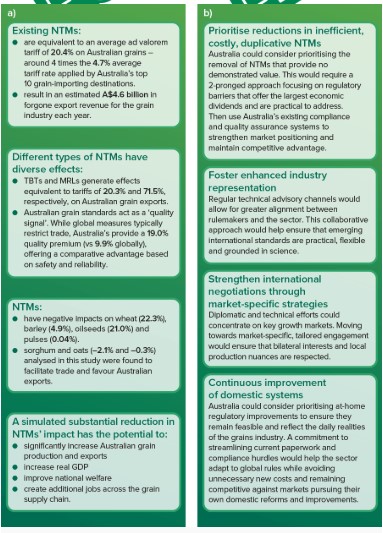
Figure 1: a) Key findings from Grains Australia’s report on impacts from non-tariff measures on Australian grain exports; b): Potential actions for industry and government consideration from Grains Australia’s report
The report
The report used more than 900,000 points of available data, identifying more than 200 individual NTM classifications globally.
For ease of analysis, these were grouped into 3 major categories:
technical barriers to trade (TBTs)
sanitary and phytosanitary (SPS) measures
maximum residue limits (MRLs).
These NTMs were found to result in an estimated $4.6 billion in forgone export revenue each year.
The report’s key findings are summarised in Figure 1a above.
Highlights
Of particular interest to the grains industry are 2 key findings.
First, many NTMs exist that merely add unnecessary cost to trading in grain, often due to factors such as duplication, redundancy and divergence from accepted scientific benchmarks and practices.
Second, where NTMs are practical, science-based and accommodating, these measures could become a competitive advantage. They allow importing markets to achieve their interests while the Australian industry is rewarded with a quality premium and improved market access over the competition.
“We found not all NTMs have the same effect,” Mr Evans says. “While some do add unnecessary costs, the analysis found that Australia’s existing practices and standards provided a quality premium. They serve as a seal approval for the safety and quality of Australian grain.”
The challenge is to distinguish between measures that provide that kind of reasonable assurance to customers’ interests and inefficient measures that add cost without delivering value to industry.
“A key part of Grains Australia’s role is to approach markets with respectful engagement and understanding of their interests,” Mr Evans says.
The way forward
The report highlights potential opportunities for Australia to consider when addressing NTMs that provide no demonstrated value.
Mr Evans says the approach Grains Australia takes is grounded in engagement and evidence: “By walking through the supply chain with trading and industry partners, practical solutions tend to emerge.
“It is an approach that treats NTMs as shared inefficiencies to be worked through together, rather than problems to be dropped at a partner’s door.”
Grains Australia takes a 2-pronged approach when working with trading partners:
Increased engagement – deeper technical engagement with trading partners and their governments to build a shared understanding of supply chain assurances and identify where requirements can be streamlined.
Strategic retention – retaining measures that recognise the quality and safety of Australian grain and farming practices to provide reasonable assurance to end-users in customer markets.
Potential actions for industry and government to consider are summarised in Figure 1b above.
Grains Australia is now moving into the project’s second phase where the analysis will operate at a more detailed, market-specific level to address challenges pragmatically.
“The aim is to identify where inefficiencies, duplications and costs without commensurate benefit present opportunities for practical reform that works for both sides,” Mr Evans says.
The research team
The analysis built on foundational research completed by the Australian Bureau of Agricultural and Resource Economics and Sciences (ABARES) in March 2025 entitled Non-tariff barriers: A multi-billion dollar burden.
The Grains Australia study used world-leading economic methods and brought together a research team that included agricultural economists, econometricians and trade specialists from Australia and around the world.
The research team was led by Professor Yu Sheng at the Australian National University. Professor Yu collaborated with experts at James Cook University, government agencies (such as ABARES), and global research organisations. Included are China University of Petroleum, the Chinese Academy of Social Sciences and the University of Maryland.
The report was authored by Professor Yu, Dr Sizhing Sun, Dr Qi Cui and Dr Shiji Zhao.
Grains Australia is an initiative of GRDC, generating value for the Australian grains industry by working collaboratively with industry and government.
Global Agriculture is an independent international media platform covering agri-business, policy, technology, and sustainability. For editorial collaborations, thought leadership, and strategic communications, write to pr@global-agriculture.com