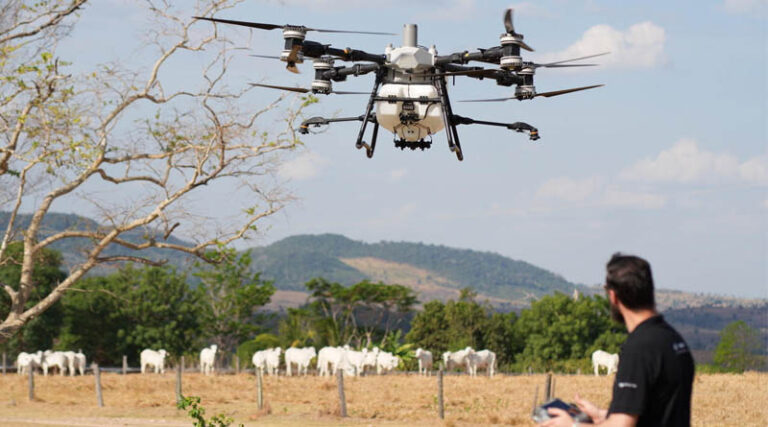
29 April 2026, Brazil: The use of drones in Brazilian agriculture has expanded dramatically, growing from approximately 3,000 units in operation in 2021 to 35,000 by 2025, according to data from Brazil’s Ministry of Agriculture and Livestock (MAPA). This rapid increase reflects how drone technology is moving from an emerging innovation to an established tool in modern farming systems, delivering performance comparable to traditional spraying methods while offering significant operational, economic, and environmental advantages.
The expansion has been driven by a combination of factors, including reduced use of agricultural inputs and water, improved operator and environmental safety, access to difficult terrain, and a longer operational window compared with conventional ground machinery. In regions where mechanization remains limited, drones are increasingly seen as a practical and efficient alternative that helps farmers maintain productivity while reducing constraints associated with traditional equipment.
Research from the Brazilian Agricultural Research Corporation (Embrapa), published in the study Use of Agricultural Drones in Brazil: From Research to Practice, highlights further technical benefits. Multiple studies cited in the report found that drone applications improve droplet penetration into crop canopies through rotor-generated airflow, allowing stronger deposition in the lower third of plants — an area typically difficult to reach with conventional sprayers. In some cases, deposition levels were reported to be up to 1.9 times higher than those achieved by ground-based methods.
The analysis also found that drones maintain spraying efficiency even when operating with significantly lower spray volumes. This increases operational autonomy and the area that can be covered in a working cycle. Another major advantage is the elimination of crop damage caused by machinery movement through fields. Such trampling losses in mechanized farming can reach up to 7 percent in soybean and 4.8 percent in rice, making drones an attractive solution for farmers seeking both yield protection and better field efficiency.
The rise of agricultural drones in Brazil mirrors a broader global trend led by technology providers such as DJI Agriculture, the farming-focused division of the Chinese drone manufacturer. The company reports that around 400,000 agricultural drones were operating worldwide by the end of 2024, representing a 33 percent increase over the previous year and 90 percent growth compared with 2020. These drones are being used across more than 300 crops in 100 countries, underlining the increasing importance of precision aerial technologies in global agriculture.
In Brazil, DJI Agriculture works through official importers and partners who provide technical support, quality assurance, and access to the latest products. One of the notable players in this ecosystem is DronePro, a company founded in 2016 after identifying the potential of drone technologies in Asian markets and introducing them to Brazil during the early stages of adoption.
As one of DJI Agriculture’s earliest official partners in the country, DronePro has built a distribution and technical support center in Marabá and has focused strongly on Brazil’s Northern region. The company has grown into one of the leading distributors of agricultural drone technology in the area, combining equipment sales with operator training, technical support, consulting services, and the development of a reseller network. This integrated approach has positioned DronePro as not only a supplier of machines, but also a major contributor to the growth and professionalization of Brazil’s agricultural drone market.
According to Marcus Lawder, Commercial Director at DronePro, drones are now being used across a wide range of Brazilian crops, reflecting the country’s diverse agricultural landscape. He noted that the technology has moved beyond the experimental phase and is now a consolidated part of farming operations, especially in regions where traditional mechanization faces structural challenges. He added that the evolution is visible not only in the equipment itself, but also in the wider ecosystem of services, knowledge, and field support surrounding drone adoption.
In the Northern region, DronePro has expanded drone use in crops such as pastures, grains, açaí, cocoa, pineapple, banana, citrus, and upland rice. Pasture management has emerged as a particularly strong use case because uneven terrain often creates recurring difficulties for tractors and ground sprayers. The region’s large and hard-to-access areas, combined with high rainfall and limited mechanization, create ideal conditions for precision aerial spraying systems that can perform accurate applications in irregular landscapes.
The equipment currently available in the market serves multiple farming needs, including liquid spraying, solid input distribution, and specialised operations such as cargo lifting. Models are designed with varying payload capacities and tank sizes, allowing producers to choose systems suited to different scales and production realities. Examples include the DJI Agras T25P, DJI Agras T70P, and DJI Agras T100.
DronePro has also strengthened its market position through rapid commercial growth. In 2024, the company ranked second in purchase volume from DJI, and by 2025 it had moved into first place. During that period, its market share increased from 16.3 percent to 21.1 percent, representing roughly one quarter of the Brazilian agricultural drone market.
Beyond sales performance, the company is also contributing to the technical development of the sector through field monitoring, practical trials with customers and partners, and collaborations with academic institutions such as Federal University of Pará, State University of Pará, State University of Tocantins, and State University of the South and Southeast of Pará. These partnerships are helping generate applied knowledge on drone performance across different crops and farming systems.
Industry stakeholders believe the next stage of market development will depend on deeper technical validation, stronger scientific foundations, and continuous field research. As equipment capabilities advance and applications widen across crop segments, drones are expected to play an increasingly important role in improving productivity, precision, and sustainability in Brazilian agriculture.
Global Agriculture is an independent international media platform covering agri-business, policy, technology, and sustainability. For editorial collaborations, thought leadership, and strategic communications, write to pr@global-agriculture.com