20 July 2026, AU: New research and improved varieties are building the case for lentils in Australia’s northern cropping region, although soil constraints, frost risk and harvest rainfall remain challenges.
While most lentil production in Australia is in South Australia and Victoria, there is potential for the crop to carve out a place in the northern cropping region. Strong market demand and the benefits of greater farming system diversity are boosting its appeal.
Speaking as part of a lentil discussion panel at the GRDC Grains Research Update in Goondiwindi earlier this year, Seednet Territory Sales Manager (north-eastern Australia) Jon Thelander said market demand for lentils in the northern region was strong, despite it being outside Australia’s traditional lentil-growing zone.
“I have been watching lentils very closely for the past 3 seasons, and the market potential is phenomenal,” said Mr Thelander.
“There are at least 4 Queensland-based marketers who are travelling to the south to purchase lentils. The market is strong, and these same marketers are asking northern growers if they would consider growing lentils locally.”
That said, lentils aren’t for the faint-hearted: “It’s important to get the soil type and paddock selection part of the equation right. If you can do that, the markets are absolutely there.”
Mr Thelander said that recent lentil variety releases were also helping improve the crop’s fit in northern farming systems. Three new varieties – PBA Kelpie, ALB Terrierand ALB Dane – offer differing maturity lengths, giving growers more flexibility around planting windows.
The quicker-maturing PBA Kelpieis better suited to later planting, while ALB Terrier and ALB Dane are longer-season options with stronger yield potential and disease resistance.
Lentils in high-temperature environments
Commercial lentil production in Australia’s northern cropping region remains limited, largely due to most growers being unfamiliar with growing the crop. There has been little research into how lentils perform in northern conditions, particularly in terms of the crop’s adaptability to different soil types and weather conditions.
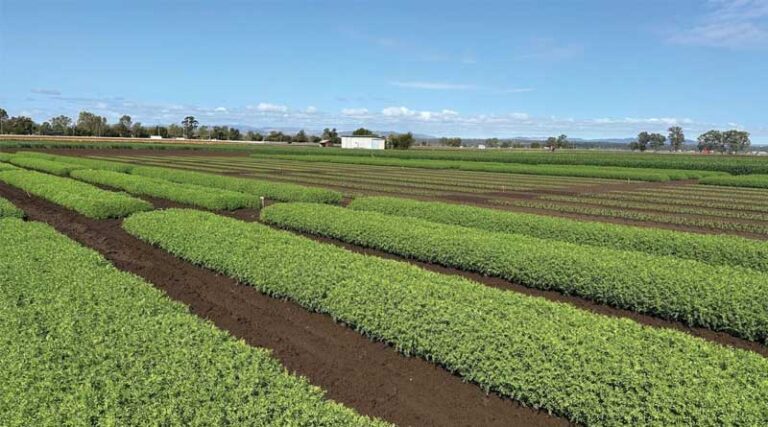
The pulse component of the GRDC-supported Frost and Heat Management Analytics project is helping to address this knowledge gap through a series of field trials run across the Darling Downs.
The work, which was led by CSIRO Crop Physiologist Dr Lia Olmedo Pico, ran from 2023 to 2025 and assessed how lentils performed under a range of environmental conditions.
Specifically, lentils were grown under different combinations of times of sowing (May, June or July), water supply (rain-fed or irrigated) and location (Gatton in 2023 and 2024, and Forest Hill in 2025), which resulted in 12 different environments. Locations were deliberately chosen to expose the crop to natural high temperature conditions.
In each season and for each combination of treatments, data was collected on phenology, biomass and partitioning, photosynthetically active radiation interception, and grain yield and components. Mean yield across the trials was 3.4 t/ha, ranging from 2.6 to 4.4 t/ha depending on the environment.
“In these environments, lentils experienced mean maximum temperatures of 27° C to 29° C during the reproductive period, and in most of these environments there were at least 9 days with heat events of 32° C or above,” said Dr Olmedo Pico.
“Our hypothesis was that plants were able to compensate for the abortion of flowers or pods under those heat events, thanks to the amount of water available in the soil.”
Frost in the north
Dr Olmedo Pico’s study was focused on the impact of both high and low temperature on lentil crops. In 2025, the trial also expanded to look at the effect of frost by including a site west of the Toowoomba range, at Wellcamp, which is regularly exposed to frost conditions.
At Wellcamp, 5 environments were set up, all rain-fed but each with a different time of sowing (TOS). TOS1 was 15 April 2025, and then every 15 days following for the remaining 4 environments.
The average yield across the 5 sowing dates of the frost-prone trial was 0.84 t/ha – significantly lower than the high-temperature environments.
“Overall, lower yields across all Wellcamp sowing times could be explained by the combination of lower temperatures plus higher plant water uptake early in the season, as the crops started with a full profile, which resulted in a dry finish and low harvest index,” said Dr Olmedo Pico.
At Wellcamp, frost events during the reproductive period affected the development of seeds in TOS1, onset podding in TOS2 and onset flowering in TOS3. TOS3 yielded higher than TOS1 and TOS2, suggesting that flowering might be a less sensitive phase to frost than podding.
“The information from the rain-fed frost-prone environment suggests there is potential to improve outcomes by adjusting sowing dates, but risks associated with planting date need to be further investigated before conclusions can be drawn around yield trade-offs.”
A ‘fussy’ crop
While the potential of lentils in the northern region looks promising, Grain Orana Alliance Chief Executive Officer Maurie Street said it was important for growers to carefully consider if the crop was a good choice for their system.
“Lentils have promising yield potential and have a pretty good gross margin too, but when it comes to sodicity, salinity, soil pH and waterlogging, they are pretty fussy,” he said.
As a general rule, you need chickpea-growing country or better to grow lentils. If you can’t grow chickpeas in your farming system, lentils are probably not going to be the crop for you.
Mr Street is based in Dubbo, and while lentil production in his area is limited, he has been involved in the NSW Pulse Agronomy Development and Extension Project for the past few seasons.
He said soil type was the biggest limitation to lentil production in the north.
“Because of lentils’ preference for high pH soils, our heavier clay soil types are probably better suited to lentil production. However, lentils don’t tolerate ‘wet feet’, so if you’ve got soils where waterlogging is an issue, that is going to be one problem.”
Rainfall timing adds another layer to the equation. More rainfall at harvest is a clear downside, while reduced in-crop rainfall pressure could work in favour of the crop to avoid waterlogging conditions in some northern environments.
There’s a bit of a trade-off there – as we move further north, rainfall patterns might favour growing lentils as we move towards a more even season or to a summer-dominant rainfall, where there is less rainfall during the cropping period. But rainfall at harvest is a major risk.
Once lentils reach maturity, they become highly vulnerable to rain, with lodging and pod shatter quickly reducing harvestability and downgrading lentil grain. This can reduce the attractiveness or suitability of lentils in many markets.
“Rain at harvest is a problem in any crop, but in lentils it’s particularly unforgiving,” said Mr Street.
Looking ahead, he said there was still a lot to learn about how lentils performed under northern conditions, particularly around variety fit, agronomy and sowing timing.
“There’s not a lot of regional validation on lentils – 3 or 4 varieties are being looked at in the NSW pulse project, but apart from that, there is no specific agronomy for lentils in northern areas.
“It’s a massive gap in our understanding and knowledge of this crop in the northern region, and there is a lot of opportunity to keep working on that and fill some of those gaps.”
Global Agriculture is an independent international media platform covering agri-business, policy, technology, and sustainability. For editorial collaborations, thought leadership, and strategic communications, write to pr@global-agriculture.com