Judy Thomas and Nedumaran Swamikannu (International Crops Research Institute for Semi-Arid Tropics)
27 June 2026, Africa: Strategic foresight research has long enabled policymakers to look ahead, examining how food systems might respond under different climate, economic, and policy scenarios, before those futures arrive. Tools such as IMPACT, GLOBIOM, and TOA-MD exemplify this approach, offering structured, scenario-based insights that have guided large-scale agricultural investments and policy decisions. However, they rely on periodically updated datasets, stylized behavioural assumptions, and fragmented knowledge systems features that increasingly limit their ability to keep pace with rapidly evolving food systems. As climate shocks, supply chain disruptions, and market volatility accelerate in speed and complexity, this disconnect between real-world dynamics and model responsiveness constrains timely and effective decision-making.
We propose augmented foresight — the systematic integration of Artificial Intelligence (AI) into strategic foresight systems to strengthen three core components: real-time data responsiveness, context-specific behavioural modelling, and cross-disciplinary knowledge synthesis. The goal is not to replace existing models but to make them more adaptive, integrative, and decision-oriented.
To operationalize this approach, we focus on three core domains where AI can directly strengthen existing foresight systems: data, behaviour, and knowledge integration.
1. Data: From Slow Integration to Real-Time Responsiveness
Data inputs shape foresight systems by defining both baseline conditions and signals of emerging change. Horizon scanning plays a critical role by identifying megatrends, disruptive technologies, early indicators of change (weak signals), and potential climate and geopolitical shocks that influence future food system trajectories.
Current approaches rely largely on harmonized historical datasets and standardized scenario frameworks that update only periodically. While this ensures consistency across studies, it prevents models from incorporating emerging signals such as climate anomalies, pest outbreaks, or sudden market disruptions in real time.
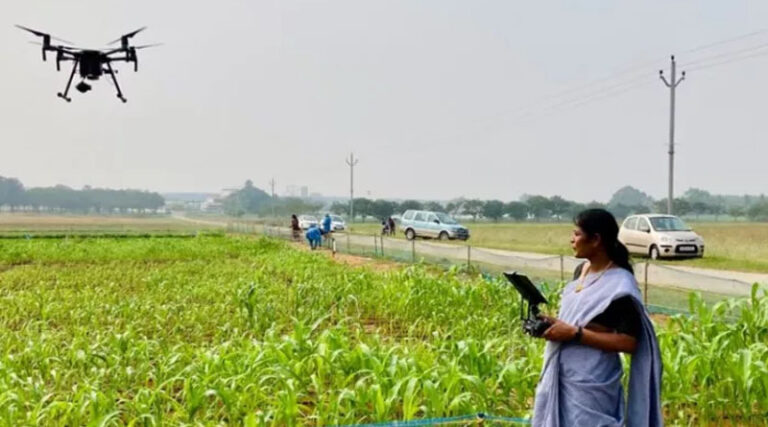
AI strengthens this layer by enabling continuous data integration, automated model workflows, and early signal detection. While machine learning techniques have long been used in forecasting and modelling, their integration into foresight processes is becoming increasingly sophisticated. The key shift lies in the level of automation: tasks that once required manual intervention—such as updating datasets, calibrating parameters, and running scenario simulations—can now be orchestrated through AI-driven pipelines. This enables modellers to run multiple simulations at sccale iteratively, significantly reducing the time and effort required for continuous model updating Applied to satellite data, climate observations, and market intelligence, these techniques detect patterns such as crop stress, land-use change, supply chain disruptions, and price volatility. It can also detect weak signals and emerging anomalies that may indicate deeper systemic changes, providing foresight practitioners with earlier insights into potential future developments.
Through data assimilation, models can integrate these insights between cycles and update baseline conditions iteratively. This shifts foresight from static scenario construction to dynamic, data-informed analysis.
2. Behaviour: From Stylized Assumptions to Contextual Decision-Making
Large-scale models typically assume simplified responses from farmers, consumers, and markets to risks, incentives, and policy changes. In reality, decision-making is highly heterogeneous, shaped by diverse socio-economic conditions, institutional contexts, and risk perceptions.
Agent-based models (ABMs), provide a complementary way to represent this diversity by simulating how individual actors such as farmers, traders, and consumers make decisions and interact under varying conditions. Unlike aggregate or average household decision models, where behaviour is embedded within generalized mathematical functions, ABMs make decision rules explicit and transparent, allowing them to be examined, refined, and validated using empirical evidence from surveys, experiments, and field observations. When researchers integrate these into hybrid modelling frameworks, global models generate macro-level scenarios that inform regional behavioural simulations. This enables analysis of how structural changes translate into local adaptation strategies.
For example, in ICRISAT’s work on pearl millet production domains across Asia and Africa and climate change impacts and adaptation strategies on groundnut in India, we combined multi-location trial data with crop and economic models to estimate research investment payoffs across geographies. An augmented foresight approach can extend this by layering agent-based simulations to model how farmers in different contexts adopt recommended varieties under varying credit access, market connectivity, and climate stress. This shifts the analysis from “where should we invest?” to “where will investment translate into adoption and impact?”
3. Knowledge Integration: From Fragmented Evidence to Synthesized Insight
Foresight research draws on diverse knowledge sources including climate science, economics, agronomy, nutrition, and stakeholder inputs, yet often struggles to integrate them effectively.
Participatory foresight processes generate valuable qualitative insights such as local risk perceptions, adaptation constraints, and lived experiences but researchers rarely incorporate these systematically into quantitative models. At the same time, the rapid expansion of scientific and policy literature makes comprehensive synthesis increasingly difficult.
AI, particularly through Natural Language Processing (NLP), strengthens knowledge integration by enabling large-scale evidence synthesis. By analyzing extensive corpora of scientific publications, policy reports, and development documents, AI tools identify emerging themes, map cross-disciplinary connections, and highlight knowledge gaps.
Ethical and Social Dimensions of Augmented Foresight
Integrating AI into foresight systems reshapes not only analytical capacity but also representation, interpretation, and decision authority.
First, greater reliance on digital and real-time data raises concerns about equity and representativeness. Data-rich regions and formal systems dominate these datasets, while smallholders and data-scarce contexts remain underrepresented.
Second, AI-enabled modelling introduces challenges around transparency and interpretability. As models grow more complex, stakeholders struggle to trace assumptions and uncertainty pathways, which weakens trust and limits policy uptake.
Third, AI-assisted knowledge synthesis can reinforce epistemic biases at scale. NLP tools draw predominantly from English-language scientific literature, structurally sidelining grey literature, practitioner knowledge, and non-digitised local evidence gaps that are far harder to detect and correct when synthesis operates automatically across millions of documents.
These interlinked challenges and opportunities cut across the three core domains of augmented foresight.
Table 1: Synthesizing AI Opportunities and Ethical Considerations Across Foresight Domains
Domain
AI Opportunity
Risk and Response
Data Systems
Reliance on static, periodically updated datasets → Continuous integration and early risk detection replace periodic updates
Risk of excluding data-poor regions and smallholders → Strengthen inclusive data collection and ensure transparent governance of data access and use
Opaque decision-making, lack of explainability, and reduced transparency in complex models → Maintain interpretability, communicate assumptions clearly, and retain human oversight
Knowledge synthesis
Fragmented scientific and participatory knowledge → Large-scale evidence synthesis across disciplines replaces fragmented review
Marginalization of local and experiential knowledge → Engage stakeholders throughout scenario and validation to counter epistemic bias
Toward Integrated and Decision-Oriented Foresight Systems
Addressing these challenges requires a shift from standalone foresight exercises to integrated, decision-oriented systems. Advances in AI now allow us to connect data, behaviour, and knowledge more dynamically but only when institutions design systems that embed strong participatory and governance mechanisms.
Future approaches will bring together:
Integrated modelling frameworks that link biophysical, economic, and institutional dynamics
AI-enabled analytics that support real-time data integration and evidence synthesis
Participatory processes that enable scenario co-design, validate assumptions, and interpret results in context
Within initiatives such as CGIAR’s Policy Innovation Hubs, augmented foresight can act as an upstream input—informing priority setting, guiding policy design, and feeding into policy labs, co-creation platforms, and AI-enabled advisory tools. Its value lies not in producing better reports, but in enabling more proactive, iterative, and future-aware policy processes.
What This Means Now
The building blocks already exist. Machine learning supports remote sensing and market intelligence. Agent-based modelling frameworks operate at scale. NLP tools increasingly enable rapid evidence synthesis.
What remains is deliberate integration, embedding these capabilities into established foresight systems while designing institutions and participatory safeguards that ensure inclusive and equitable outcomes.
This integration defines the next frontier. It will determine whether foresight research keeps pace with the complexity of the food systems it aims to inform.
Global Agriculture is an independent international media platform covering agri-business, policy, technology, and sustainability. For editorial collaborations, thought leadership, and strategic communications, write to pr@global-agriculture.com