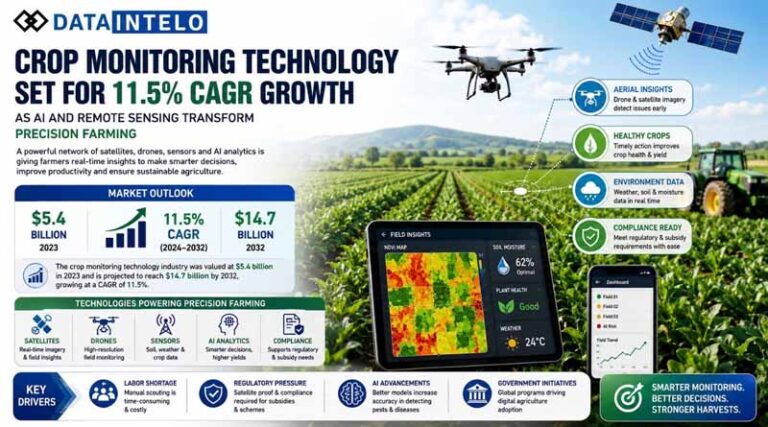
31 August 2026, London: The crop monitoring system a network of sensors, satellites, drones, and analytics, which enables the farmer or the agronomist to see what is really going on in the fields between the planting and harvesting has changed its status from an expensive extra to a must-have element in the farm technology budget. Based on the DataIntelo report about the crop monitoring technology market in precision farming, the industry was estimated at approximately $5.4 billion in 2023, with a forecast to increase to almost $14.7 billion by 2032, growing with a CAGR of 11.5% during the forecasted period.
To senior decision-makers within the agriculture business, providers of inputs, and equipment manufacturers, this evolution is less about another new tool and more about the convergence of three factors at once: severe labor shortage on farms making manual scouting unprofitable, programs in Europe and elsewhere requiring satellite proof of what the farmer actually planted and what chemicals used, and a new generation of AI models bringing accuracy of detecting diseases and pests in the field photos above the level when automatic notification becomes more reliable than manual weekly walk through the field.
Recent Developments
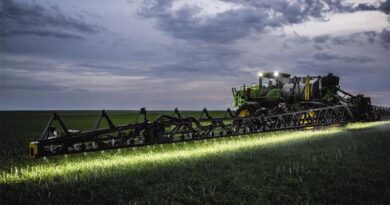
The clearest signal of where capital is actually flowing sits in John Deere’s own numbers. On its fiscal Q3 2026 earnings call, the company said its See & Spray weed-detection system — built on computer vision and machine learning from the 2017 Blue River Technology acquisition — is now specified on roughly a third of sprayers ordered in North America, nearly double last year’s adoption rate, while more than 40% of planters sold in the region already carry Deere’s ExactRate and FurrowVision precision seeding technology.
The company’s John Deere Operations Center, the software layer that ties monitoring data to machine execution, now covers more than 520 million engaged acres. This $20 billion manufacturing commitment over the next ten years in the U.S. related to scaling up the precision-ag software and hardware platform went alongside the significant increase in Deere’s R&D investment to $583 million. Deere’s 2026 acquisition of GUSS Automation, which produces autonomous orchard and vineyard sprayers operated with GPS and LiDAR, applies the same monitor-and-take-action approach to specialty crops where there is labor shortage seasonally.
Crop monitoring from satellites also received its share of institutional contracts in 2026. Planet Labs, which runs a satellite constellation with daily visits to provide remote sensing for agriculture, announced record first-quarter revenues of 2027 at $94.2 million (up 42% YoY) while its backlog increased 72% to more than $906 million. The first quarter brought Planet Labs’ agriculture contracts worth over seven figures for two years: a deal with the State Agricultural Intervention Fund of the Czech Republic to provide satellite images and AI-based analysis for around 25,000 farms; another deal with the Scottish government’s Agricultural and Rural Economy Directorate and an agreement with agtech company Nave Analytics to use Planet’s soil moisture and biomass layers to make irrigation decisions. These are government paying-agency contracts, not farmer subscriptions — a reminder that a large and growing share of crop monitoring demand is now driven by compliance verification rather than yield optimization alone.
That compliance dynamic is most visible in Europe. Copernicus’s Sentinel-1 and Sentinel-2 satellites now underpin the EU’s Area Monitoring System (AMS), which the European Court of Auditors has tracked since a 2020 special report and which, per 2026 guidance for EU member states, is fully operational across the bloc for the 2026 claim year as the primary control method for most Common Agricultural Policy payment schemes. The system classifies each monitored parcel as compliant, non-compliant, or requiring follow-up, and national paying agencies increasingly supplement satellite classification with geotagged farmer photo apps — France’s Telepac Géophotos among them — when cloud cover or small parcel size makes automated classification inconclusive.
Regulatory Developments
Regulation is reshaping both the demand side and the hardware side of crop monitoring simultaneously. In terms of demand, the EU’s AMS has turned every enrolled hectare into one which is continuously surveilled via satellites, while national-level initiatives elsewhere in the world are replicating the same strategy: India’s Digital Agriculture Mission has created AgriStack, a farmer identity and agricultural records data base, with farmer IDs being distributed in tens of millions, and an AI advisory layer being rolled out across various languages through the 2026 Union Budget.
As for hardware, the FAA’s much-anticipated Part 108 rulemaking — meant to legitimize beyond visual line of sight (BVLOS) drone flight without a waiver per flight — remains a proposed regulation as of mid-2026, with no final rule despite a Notice of Proposed Rulemaking issued in August 2025, after which over 700 pages of technicalities were proposed and comments closed in October 2025. If passed as it currently stands, the proposal will allow a single licensed operator to operate a fleet of drones, with up to 25 aircraft flying for agricultural missions, significantly lowering the cost-per-acre of scouting and spraying with drones.
In the meantime, the FAA had certified over 1,700 agricultural drone operators under existing Part 137 rules by September 2025, up 58% year-over-year — evidence that operators are scaling under the current waiver regime rather than waiting for Part 108. A parallel and less welcome regulatory development is the FCC’s Covered List restrictions on certain Chinese-made drone components, effective in stages from December 2025, which is pushing some U.S. ag-drone operators toward domestic or allied hardware suppliers and adding near-term cost uncertainty to fleet expansion plans.
Market Outlook by Region
Asia Pacific holds the largest share of crop monitoring technology spending, underpinned by farmland scale in India and China and by government programs India’s AgriStack chief among them that are building monitoring infrastructure as public goods rather than waiting for individual farmers to purchase it. The presence of many smallholder farmers has enabled this territory to become a test-bed for another adoption model: mobile phone and sensor-lite crop diagnostic apps, instead of the drones and sensor arrays prevalent in North American and Brazilian large farms.
In North America, however, the installed base is already the most advanced market, owing to its long-term use of GPS-enabled machinery and huge networks of dealerships belonging to Deere, Trimble, and AGCO. The story of further growth in North America now revolves around adding layers of sophisticated algorithms such as crop disease prediction, fertilizer recommendation, and automated spraying atop an existing platform.
Europe’s growth is regulation-led in a way no other region matches: with the Area Monitoring System now the default verification tool for CAP payments, satellite-based crop monitoring in the EU has shifted from a precision-farming option to a near-mandatory compliance input for any farmer receiving area-based support. Latin America and the Middle East and Africa are smaller in absolute terms but are adopting some of the newest tools first — AI-driven satellite and drone analytics arriving alongside export-market pressure for traceability, in some cases leapfrogging the GPS-only guidance systems that defined the previous generation of precision agriculture elsewhere.
Segment Insights
Remote sensing satellite imagery and drone-based multispectral scouting is the largest and one of the fastest-growing technology categories within crop monitoring, a position reinforced by the falling cost of high-frequency, moderate-resolution satellite data and by government paying-agency demand of the kind Planet Labs has been winning through 2026. Variable rate technology and GPS/GNSS-based guidance remain foundational, particularly on medium and large farms, but the growth frontier has clearly shifted toward software and services: cloud-based analytics platforms, subscription pricing, and increasingly what one 2026 industry analysis characterized as a move from predictive alerts toward agentic systems that close the loop between detection and action, exemplified by See & Spray’s real-time identify-and-treat cycle. Medium-sized farms, historically too small to justify the capital cost of a full monitoring stack but too large for pure mobile-app tools, are the fastest-growing farm-size segment as subscription pricing and equipment-leasing arrangements from manufacturers lower the entry barrier.
The Capital Behind the Growth
As with adjacent agtech categories, crop monitoring’s headline growth rate is not being funded primarily by early-stage venture capital. AgFunder’s Global AgriFoodTech Investment Report 2026 found overall agrifoodtech funding roughly flat at $16.2 billion for 2025, even as upstream farm and production technology drew $9 billion, up 7% year-over-year, and deal count fell double digits. The tracking of AgTech-specific venture rounds done by CropLife through 2026 indicates the same pattern, namely an average of about $1.5 billion and 182 transactions per quarter, which is described by investors and analysts as the stabilized baseline after 2021 rather than recovery.
AI-powered crop monitoring and disease prediction platforms are mentioned among those categories where the investor attention remains the highest. However, the investment is made on stricter conditions regarding the unit economics and revenue potential. At the same time, the debt financing has reached its highest proportion of agrifood funding in ten years. In case of crop monitoring, it means that further development will likely be mostly fueled by capital expenditures by corporations (for example, the promise of Deere to spend $20 billion on manufacturing or a growing government contract backlog of Planet Labs) and infrastructure investments by the public sector (AMS in Europe or AgriStack in India).
Case Studies
John Deere See & Spray, global. With its AI-driven weed-identification and spraying system, Deere has gone up from about 1 million hectares in its first year to 5 million hectares worldwide, claiming an average savings of 50-60% in herbicides per pass of sprayed area and saying that one in three orders for North American sprayers incorporates the technology.
EU Area Monitoring System, Czechia. Under Czechia’s AMS implementation, satellite monitoring from Sentinel-1 and Sentinel-2 combined with a geotagged-photo mobile app gives the paying agency a traffic-light compliance signal green, red, or yellow requiring follow-up for each parcel, reducing reliance on physical on-site inspections that previously covered only a sample of claims each year.
Planet Labs and Scotland’s Agricultural Reform Route Map. A one-year, seven-figure contract signed in mid-2026 supplies the Scottish Government’s Agricultural and Rural Economy Directorate with daily three-meter-resolution imagery and automated analytics, intended to inform future long-term satellite-based land management procurement across the broader UK an example of monitoring infrastructure being built at the government level ahead of individual farmer purchasing decisions.
Smallholder disease diagnosis, South Asia and Sub-Saharan Africa. Mobile-first crop monitoring services aimed at smallholders typically priced at a few dollars per month and often bundled with government extension programs are extending disease and pest diagnosis to farms too small to justify drone or sensor-network investment, though independent field research continues to find awareness of these tools sharply uneven across regions, suggesting distribution and farmer education remain as binding a constraint as technology cost.
Adoption Barriers
Data standardization is the most persistent structural obstacle. The hardware of companies like Deere, Trimble, AGCO, and independent sensor manufacturers uses proprietary data formats, and farmers who employ a combination of equipment find it difficult to merge the outputs of monitoring systems in one analytics dashboard through workarounds, something that has been achieved only slowly through standardization initiatives in the industry, partly because proprietary systems allow companies the opportunity to earn recurring software revenues.
The next challenge that farmers face in rural areas is connectivity; cloud-based monitoring platforms require consistent data connections, which have yet to be achieved in much of Sub-Saharan Africa, South Asia, and remote Latin America, which has contributed to the quick uptake of mobile-based advisory tools. Thirdly and lastly, there is the issue of cybersecurity and ownership of data: firms dealing with proprietary genetics or premium production data are increasingly hesitant about sharing their on-the-ground performance data with cloud companies, something that is influencing the way data contracts are drawn up by these companies as the sector evolves. Lastly, adoption is more linked to price cycles of commodities rather than technological readiness: farmers intensify their investments in monitoring when corn, wheat, and soybeans prices are high but drastically reduce investments when prices fall.
Outlook
The 11.5% CAGR to roughly $14.7 billion by 2032 reflects a market whose growth drivers have genuinely diversified since the first wave of GPS-guided tractors: acute agricultural labor shortages, regulatory programs that now treat satellite verification as the default rather than the exception, and AI models mature enough to shift crop monitoring from periodic human inspection toward continuous, largely automated surveillance. But the composition of who is paying for that growth has shifted alongside it equipment manufacturers funding vertical integration into software, satellite operators winning government paying-agency contracts rather than farmer subscriptions, and venture capital playing a smaller, more selective role than it did in the sector’s first growth cycle. For decision-makers evaluating where to invest or partner, the more useful question by 2032 may not be which sensor or algorithm wins, but which capital source corporate capex, public compliance infrastructure, or disciplined late-stage venture funding — is actually moving adoption in their specific market and farm-size segment.
Global Agriculture is an independent international media platform covering agri-business, policy, technology, and sustainability. For editorial collaborations, thought leadership, and strategic communications, write to pr@global-agriculture.com