Crop Monitoring Technology

Explore the latest news, research, technologies, applications, and innovations in Crop Monitoring Technology. Stay informed on satellite imagery, remote sensing, drones, artificial intelligence, crop health monitoring, precision agriculture, yield forecasting, pest and disease detection, irrigation management, and digital farming.

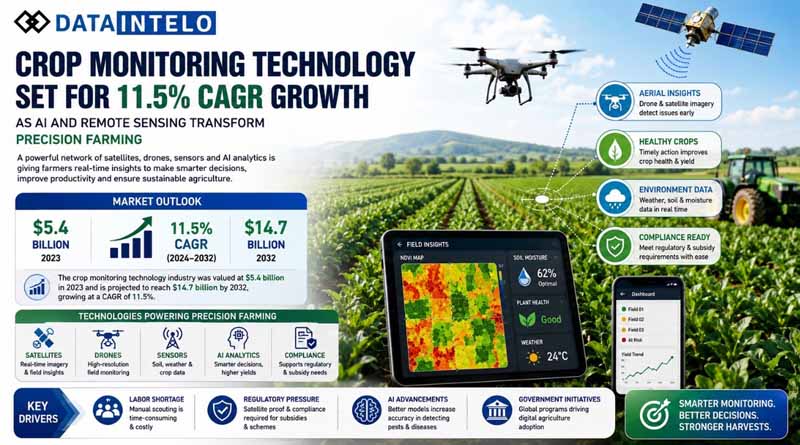
Crop Monitoring Technology uses satellites, drones, sensors, remote sensing, GIS, IoT, and artificial intelligence to monitor crop and field conditions and turn agricultural data into actionable insights. These technologies can help identify changes in crop health, soil moisture, nutrient status, pest and disease pressure, water stress, crop growth and yield potential. Recent research highlights the growing integration of multispectral, hyperspectral, thermal and other sensing technologies with machine learning for precision crop management.

Satellite-based monitoring is particularly valuable for covering large agricultural areas. In India, technologies such as FASAL use multispectral and Synthetic Aperture Radar (SAR) satellite data to generate pre-harvest production forecasts for major crops, while remote sensing and GIS are also used for drought, flood, soil-moisture and crop-condition assessment.

AI-powered crop monitoring is expanding the range of applications. Machine-learning systems can analyse imagery and sensor data to detect crop stress, classify crops, identify pest and disease symptoms, estimate yields and support more targeted irrigation, fertiliser and crop-protection decisions. India’s ICAR Network Program on Precision Agriculture (ICAR-NePPA) is developing technologies using ground, drone and satellite sensing, AI and ICTs for spatio-temporal monitoring of crop and soil health.

The technology is also becoming increasingly important for climate-smart agriculture and resource efficiency, enabling farmers and agricultural organisations to monitor fields more frequently and identify problems before they become widespread. However, challenges remain around data quality, cost, sensor limitations, interoperability, model accuracy, field validation and adoption, particularly among smaller and fragmented farms.

This category features crop monitoring technology, satellite crop monitoring, remote sensing, drone-based crop monitoring, AI in agriculture, NDVI and vegetation indices, crop health assessment, pest and disease detection, yield forecasting, soil and water monitoring, precision agriculture, digital farming, climate-smart agriculture, and agricultural technology developments.