Policy and Automation Are Key Solutions to Ag Labor Shortages
31 August 2026, North Carolina: Talk to farmers today, and they will tell you finding workers is often the greatest challenge they face.
Sure, pests and weather present never-ending headaches, and high production costs coupled with low commodity prices bring ongoing worries. But if farmers don’t have labor to help them produce their crops, they can’t stay afloat. For many, that means not only losing their major income source, but an asset that has been in the family for multiple generations and represents more than a business.
Labor is a top issue for farmers, large and small, says agricultural labor economist Alejandro Gutierrez-Li of NC State University. Gutierrez-Li believes that given the rising costs and political bottlenecks surrounding immigration and guest workers, further automation of routine, physically demanding tasks could be the answer for American farmers.
The challenges facing farmers in North Carolina and across the Southeast are unique due to the large number of fruits, vegetables and other specialty crops produced in this part of the country compared to the Midwest, which produces mostly corn and soybeans.
Other states with large labor-intensive operations, such as California, face different challenges given their geography, legal landscape and weather. In this context, a labor program focusing on the unique characteristics of agricultural production in the South is essential, Gutierrez-Li says.
“Our state is diverse in terms of agriculture. We grow many crops, and we have a substantial poultry and livestock industry. All require labor, and production of horticultural crops such as sweetpotatoes, apples, strawberries and blueberries hinges on a reliable supply of workers. North Carolina also has greenhouses that produce flowers and ornamentals that are sold across the globe,” says Gutierrez-Li, a faculty affiliate with the N.C. Plant Sciences Initiative, NC State Extension economist and assistant professor in NC State’s Department of Agricultural and Resource Economics.
“The state is a national leader in tobacco, poultry and Christmas tree production, and these sectors depend heavily on a reliable labor force as well,” he says. “No matter where you look, agriculture is a key industry in our state, and its impact goes beyond the economy. It’s part of North Carolina’s identity.”
Automation: A Long-Term Solution
Gutierrez-Li says that automation is the long-term solution, while immigration policy is the near-term solution to agriculture’s labor challenges. More mechanization and artificial intelligence are coming, but it will take time for technologies to be both efficient, affordable, socially accepted and widely available, he adds.
Many farmers say that if it weren’t for the H-2A program, they would be out of business.
“People think that mechanizing is easy — it’s not. It takes a lot of time, resources and constant learning,” Gutierrez-Li says. “Sometimes farmers don’t have the margins to invest in technology, so we will continue to rely on human hands for the foreseeable future.”
The federal H-2A program is important for the economy of North Carolina, where agriculture remains among the state’s top industries. The H-2A program enables U.S. farmers to bring foreign nationals to the United States for temporary or seasonal work when domestic workers aren’t available, he explains.
“Many farmers say that if it weren’t for the H-2A program, they would be out of business. Critically, the public doesn’t know much about this issue,” Gutierrez-Li says. “Oftentimes, when somebody in Raleigh or Charlotte goes to the supermarket, they are not aware of all the labor that is required to produce the food they are buying. Labor shortages impact not only farmers and farmworkers; they pose a major risk for food security at a time when people are talking day in and day out about affordability concerns.”
In the animal sector, the meat-packing industry faces critical labor issues that could be worsened by a recent Supreme Court decision concerning Temporary Protected Status (TPS), Gutierrez-Li adds. TPS is a humanitarian immigration program that allows foreign nationals from countries experiencing war, natural disasters or epidemics to legally live and work in the United States. In June, the court ruled that the executive branch has broad authority to terminate these country designations. In July, the executive branch ended designations for Haiti and Syria.
Oftentimes, when somebody in Raleigh or Charlotte goes to the supermarket, they are not aware of all the labor that is required to produce the food they are buying.
“While we do not have data on the prevalence of such workers on North Carolina farms, my guess is that we were employing some of them in our large packing plants,” Gutierrez-Li says, adding that at a time when meat prices “are through the roof,” loss of such workers could lead to price hikes, further reliance on imports and even meat shortages.
“Packing plants that are not capable of replacing their TPS workers may decide to close,” he told the global news organization Politico in July. “In rural areas with few employers, this could have broader negative impacts on the local economy.”
H-2A Wage Rate Fluctuations
Immigration and wage policies change with each presidential administration, so farmers need to be prepared and consider investing in automation to “protect their businesses from the political cycles happening every four years,” Gutierrez-Li says.
In October 2025, President Donald Trump’s administration made changes to the way H-2A wages are calculated. Effective pay rates were lowered, which led to an increase in the demand for H-2A workers on farms. Then on Aug. 25, a federal court held that the change was unlawful, sending it back to the U.S. Department of Labor to produce a new method of calculating wages.
“New leadership in the White House could decide to reverse the change a couple of years from now, and we might find ourselves back to where we were with volatile wages. We have seen this movie before,” he says. “Reversals like this make a strong case for automation as a long-term solution. … Not only that, the H-2A program is also expensive and bureaucratic for farmers and we’ve had federal crackdowns on illegal immigration. Even though most people don’t like to talk about it, the reality is that we likely have many undocumented immigrants working in the state and in agriculture.”
Gutierrez-Li sees the N.C. PSI as a bridge that will help bring improved automation and artificial intelligence to the farm to meet long-term labor challenges. The collaborative nature, interdisciplinary research and expertise of NC State scientists and engineers working though the N.C. PSI are bringing solutions to North Carolina.
“The beauty of the PSI is its interdisciplinarity, meaning that problems are addressed in a holistic way, drawing from knowledge that transcends intellectual boundaries. The initiative works closely with stakeholders, which guarantees that research remains relevant to the communities in North Carolina that we serve,” he says. “The (initiative) was created with the support of the farm community, and that shows in every interaction we have with producers around the state who are eager to engage with the university. Importantly, the network of Extension agents working with the PSI serve as the bridge that connects challenges on the ground with expertise from academia, a key aspect of our land-grant mission.”
Automation, AI as Fixes
North Carolina farm leaders agree with Gutierrez-Li that automation is the long-term answer to ag labor challenges.
Shawn Harding, president of the North Carolina Farm Bureau, says farm labor will always be needed, but automation and artificial intelligence is the long-term solution.
“Our great universities must help us with mechanization, and they have been ever since they’ve been around,” Harding says. “I’ve seen in my lifetime the changes in tobacco, the mechanization of that crop, and I am fully confident that we will continue to do that. But that’s expensive, and it’s a long-term solution.”
Harding, who is an alumnus of the Agricultural Institute, housed within NC State’s College of Agriculture and Life Sciences, thinks that large farms will benefit from automation first, but as automation costs come down, smaller farms will benefit as well. Until that happens, farmers will still need labor and the H-2A program.
The H-2A program has been a great ag worker program. Many Farm Bureau members have been participating in this thing for 20, 25 and 30 years. Those workers choose to come back every year.
“The H-2A program has been a great ag worker program. Many Farm Bureau members have been participating in this thing for 20, 25 and 30 years,” he says. “Those workers choose to come back every year. They love it. They love to come here, make more money than they can make in their home country.”
Harding says the H-2A program fills a void because it is well established that Americans aren’t willing to do many of these hard manual labor farm jobs.
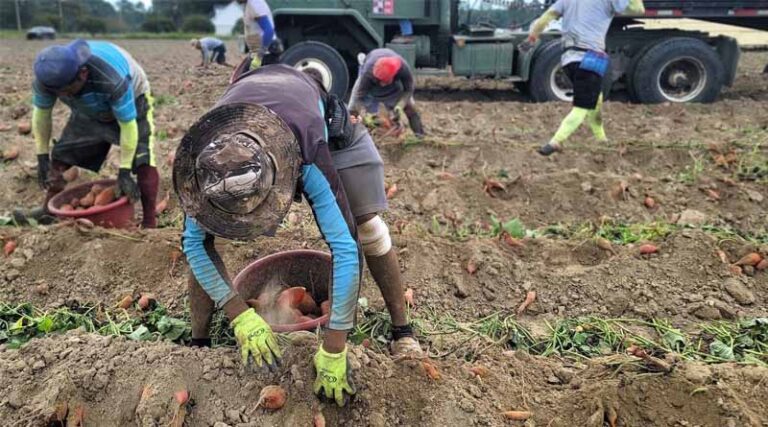
“I often ask people, ‘Are you sending your kids to college to harvest sweetpotatoes or pick blueberries?’ The answer is ‘no,’ so we need guest workers to harvest our sweetpotatoes and pick our blueberries or strawberries. If we are going to keep growing our own food here, we need immigrants to do these jobs.”
Also Read: Glyphosate Use in Caldor Fire Restoration Draws Strong Opposition at Lake Tahoe Meeting
Global Agriculture is an independent international media platform covering agri-business, policy, technology, and sustainability. For editorial collaborations, thought leadership, and strategic communications, write to pr@global-agriculture.com