06 October 2026, New Delhi:Can AI replace plant breeders?
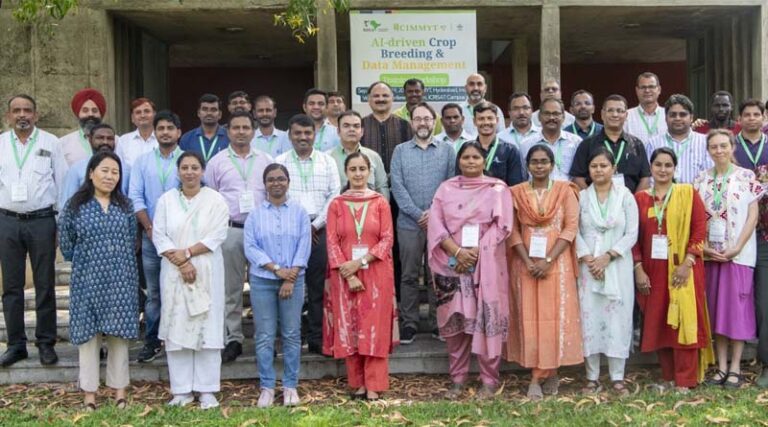
This hypothetical question, posed at the Training Workshop on AI-driven Crop Breeding and Data Management organized by CIMMYT-BISA in Hyderabad, gave 33 wheat and maize breeders from the National Agricultural Research System in India, including ICAR institutions and State Agricultural Universities, besides CIMMYT and BISA, reason to pause and reflect.
After few responses from participants, BM Prasanna, workshop convener and CIMMYT Distinguished Scientist and Regional Director Asia & Managing Director of Borlaug Institute for South Asia, offered his thoughts: “No. It will, however, transform crop breeding in the near future. AI’s value is in augmenting breeders’ expertise and helping them make faster, and more informed decisions using complex multimodal data. And that is what this training, a first of its kind in India, is aiming to achieve.”
Christian Werner, Quantitative Geneticist at CIMMYT, who presented CIMMYT’s perspective on the use of AI in crop breeding, put the challenge more sharply: “Breeders who adapt and learn to work with emerging technologies will be better equipped for the future.”
Behind the remark was an important distinction. The future of crop breeding is not simply about whether artificial intelligence can perform tasks once carried out by people. It is about whether today’s breeders have the knowledge, data systems and skills to use emerging technologies effectively as the science evolves.
For crop breeding programs, this is becoming increasingly important. Climate and production environments are changing rapidly, while breeders are working with growing volumes of genomic, phenotypic, environmental and management data. The challenge, therefore, is no longer simply generating data, but turning that data into better breeding decisions.
Plant breeding is always required to keep in view the needs of farming communities today and tomorrow. “Breeders must increasingly understand the complex interactions among the genotypes, environments and management, alongside socioeconomic factors,” observed P.H. Zaidi, CIMMYT maize breeder for Asia.
From drones and digital phenotyping to genomic tools, new technologies allow breeders to collect and analyse information at a scale and precision previously difficult to achieve.
Access to technology, however, is not the same as having the capability to use it effectively. “The real capability lies in knowing how to use them, when to use them and when not to use them,” Werner told participants.
Rather than treating AI as a stand-alone technology, the training placed it within the breeding cycle, connecting experimental design, field data collection and phenotyping with data management, analysis, genomics and ultimately breeding decisions.
One lesson ran through almost every stage of the training: AI is only as useful as the data and scientific judgement behind it. Sophisticated models cannot compensate for poorly designed experiments, incomplete observations or unreliable information.
The workshop, therefore, returned repeatedly to the fundamentals of experimental design, standardized information, data quality and validation before moving into more advanced applications. Sessions led by CIMMYT’s Data Science team, including Keith Gardner, Kate Dreher and Angela Pacheco, took participants through this progression, from digital field-data collection and phenotyping to centralized data management and AI-assisted analysis.
Participants worked with various platforms and tools including the Enterprise Breeding System, E-Agrology, Fairgrounds and Field Book, while demonstrations of drone-based data collection in the research fields, alongside platforms such as Hiphen and Cloverfield showed how image-based approaches can expand what breeders are able to observe and measure.
From more data to better decisions
The purpose of building these capabilities is not just to create breeders who simply use a disruptive innovation like AI, but to help them make better breeding decisions. As CIMMYT Data Science Lead Keith Gardner emphasized, “this requires not only high-quality data, but systems that allow breeding information to be standardized, securely managed and transformed into knowledge.”
Through Bioflow, participants explored analytical approaches ranging from trial analysis to parental selection, while other sessions introduced applications of AI in bioinformatics, genomics and gene network modification, through specific use cases presented by Huihui Li, Professor and Director at the Chinese Academy of Agricultural Sciences.
Together, these approaches point towards a breeding environment in which researchers can integrate complex datasets, test possibilities faster and identify promising breeding material with greater precision.
As analytical tasks become more automated, scientific judgement becomes more important, not less. Breeders still need to determine whether data are fit for purpose, whether results make biological sense and when an apparently convincing output should be challenged.
Building capability for tomorrow
For Prasanna, that investment needs to extend beyond individual breeders to breeding programs and institutions. He described the CIMMYT-BISA training in India as a primer, with an ambition to extend the learning through future training programs, additional hands-on sessions and further demonstrations of practical use cases.
“Strengthening one breeder’s capabilities can strengthen a breeding team. Building those capabilities across institutions can help strengthen the national breeding system,” he said.
Participants were already considering how they could apply and extend the learning within their own institutions. H.B. Mahesh from the University of Agricultural Sciences, Bangalore, for example, plans to revisit the workshop lessons with his students and share what he learned with young researchers at his campus, taking the learning beyond those in the room.
Reena Saharan from the ICAR-Indian Institute of Wheat and Barley Research (ICAR-IIWBR) described the training as particularly relevant in a rapidly changing crop-breeding environment. Several of the AI, machine-learning and data-management approaches introduced during the workshop could be directly applicable to her research, she said, while calling for future training to include even more hands-on practice.
The larger opportunity, however, extends beyond learning to use AI tools. “We need to reorient our breeding strategy,” said Prasanna stressed in his opening remarks on day one of the workshop. India, he noted, does not lack breeding infrastructure, genetic diversity or scientific talent. The opportunity is to integrate these strengths into faster, more predictive, AI- and data-driven breeding pipelines that deliver higher genetic gains and greater impact for farmers.
Seen in that context, the opening question begins to look different. The more consequential question is not simply whether AI can replace plant breeders, but whether today’s breeders are being equipped with the skills and systems they will need to lead tomorrow’s crop research and development.
The tools will continue to change, and the breeder’s role will evolve with them. But the responsibility for asking the right questions, interpreting the evidence and making sound breeding decisions remains fundamentally human.
Global Agriculture is an independent international media platform covering agri-business, policy, technology, and sustainability. For editorial collaborations, thought leadership, and strategic communications, write to pr@global-agriculture.com