Invisible Pollutants: How Microplastics Are Transforming Soil Ecosystem
Rohit Kumar, PhD Scholar, Department of Soil Science, Chaudhary Charan Singh Haryana Agricultural University (CCSHAU), Hisar, India
08 July 2026, New Delhi: Microplastics (<5 mm) have emerged as pervasive environmental pollutants, with terrestrial soils potentially acting as larger reservoirs than marine environments. This article synthesizes recent research on the sources, behavior and multifaceted ecological impacts of microplastics on soil health. Key entry pathways include agricultural practices (e.g., plastic mulching, sewage sludge application), atmospheric deposition and mismanaged waste. Once introduced, microplastics persist for decades, altering soil physical properties by decreasing bulk density and disrupting water-holding capacity. Chemically, they interfere with nutrient cycling and soil pH while acting as vectors for heavy metals and organic pollutants. These changes exert selective pressure on microbial communities, forming unique “plastispheres” and impairing enzymatic activities. Furthermore, ingestion by soil fauna like earthworms causes physical damage and reproductive issues, while plant uptake (particularly of nanoplastics) threatens crop productivity and food safety. Despite challenges in standardized detection, understanding these “invisible” pollutants is critical. Future research must prioritize long-term field studies and sustainable mitigation strategies, such as bioremediation and biodegradable alternatives, to safeguard global food security and environmental sustainability.
Microplastics are the plastic particles smaller than 5 mm, have emerged as one of the most pervasive and persistent pollutants of the modern era. While early research primarily focused on marine environments, recent studies have revealed that terrestrial ecosystems, particularly soils, may act as even larger reservoirs of microplastics. Soil environments remain comparatively understudied despite accumulating significant quantities of microplastics from various anthropogenic activities. This growing body of research highlights an urgent need to understand how these invisible pollutants are reshaping soil ecosystems, influencing their physical structure, biological diversity and ecological functions. The concept of soil health has also evolved in recent years. Traditionally associated with crop productivity, it now encompasses broader aspects such as microbial diversity, ecosystem services and human health protection. Microplastic contamination poses a significant
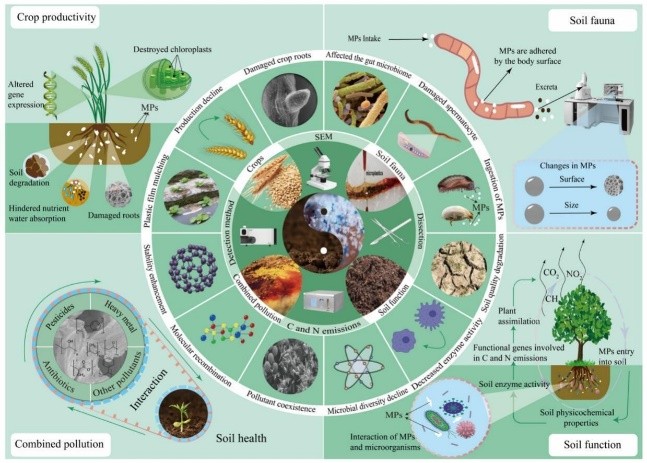
threat to all these components, making it a critical global environmental concern.
Sources and Pathways of Microplastics in Soil
Microplastics enter soil systems through a wide range of pathways, most of which are directly linked to human activities. Agricultural practices are among the primary contributors. The use of plastic mulching films, greenhouse coverings and irrigation systems leads to the gradual breakdown of larger plastics into microplastics over time. These fragments accumulate in soil and persist for decades due to their resistance to degradation. Another major source is the application of sewage sludge and organic fertilizers. Wastewater treatment plants capture up to 90 percent of microplastics present in sewage, which are then concentrated in sludge. When this sludge is applied to agricultural fields, it introduces large quantities of microplastics into the soil. Similarly, compost derived from urban waste can also contain plastic residues. Atmospheric deposition is an often overlooked but significant pathway. Microplastic fibers from synthetic textiles and industrial emissions can travel long distances through the air before settling on soil surfaces. Additionally, road runoff, tire wear and landfill leachates contribute to soil contamination. In developing countries, improper disposal of plastic waste exacerbates the problem. India, as a major producer of plastic waste, faces significant challenges with microplastic contamination in agricultural soils,
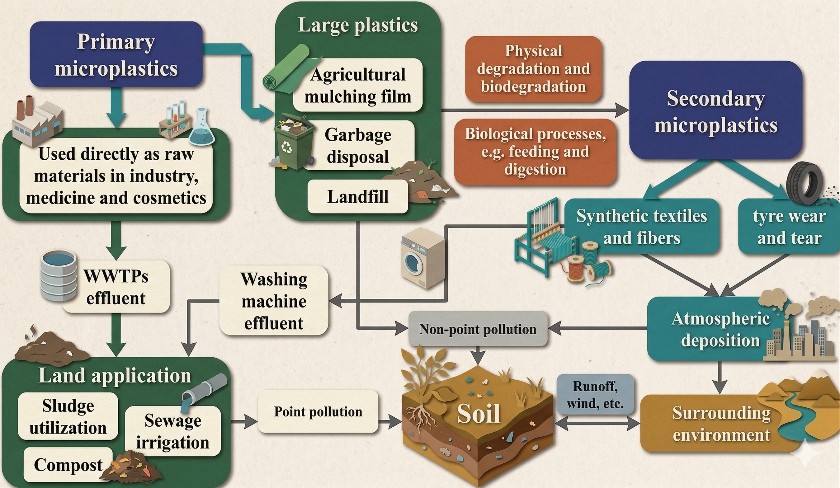
particularly in regions with intensive farming practices.
Distribution and Fate in Soil Environments
Once introduced into the soil, microplastics exhibit complex distribution patterns. Soil as a “reservoir” of microplastics, with their distribution showing significant spatial heterogeneity. Factors such as soil type, land use and agricultural practices influence their accumulation and movement. Microplastics can migrate both vertically and horizontally within the soil profile. Vertical movement is often facilitated by bioturbation, the activity of soil organisms such as earthworms, as well as root growth and water infiltration. Horizontal movement occurs through surface runoff and wind erosion, potentially transporting microplastics to adjacent ecosystems. Degradation of microplastics in soil is extremely slow compared to aquatic environments. Limited sunlight and oxygen in soil reduce the rate of photodegradation and oxidation, allowing microplastics to persist for decades. Over time, they may fragment further into nanoplastics, which pose even greater risks due to their small size and high reactivity.
Impact on Soil Physical Properties
Microplastics significantly alter the physical structure of soil. One of the most notable effects is the change in soil bulk density and porosity. Microplastics can decrease bulk density while increasing soil aeration, which may initially appear beneficial but often leads to unstable soil structure. Water dynamics in soil are also affected. Microplastics can disrupt water infiltration and retention, leading to reduced water-holding capacity or increased evaporation. These changes can have serious implications for plant growth, particularly in arid and semi-arid regions. Experimental studies further demonstrate these effects. Microplastic contamination alters key engineering properties of soil, including shear strength and permeability. This indicates that increasing concentrations of microplastics reduce soil strength and stability, which can affect both agricultural productivity and infrastructure development.
Influence on Soil Chemistry and Nutrient Cycling
Microplastics also interfere with the chemical processes that regulate soil fertility. They can alter soil pH and electrical conductivity, affecting nutrient availability for plants. More importantly, microplastics disrupt nutrient cycling by influencing microbial activity and enzyme functions. Soil enzymes such as urease and phosphatase play critical roles in nitrogen and phosphorus cycles. Microplastics can either inhibit or enhance enzyme activity, depending on their type and concentration. These disruptions can lead to imbalances in nutrient availability, ultimately affecting plant growth. Another critical aspect is the ability of microplastics to adsorb pollutants. Due to their large surface area and hydrophobic nature, microplastics can bind heavy metals, antibiotics and organic pollutants. This not only increases the persistence of these contaminants in soil but also enhances their mobility and bioavailability, posing additional risks to ecosystems.
Effects on Soil Microorganisms
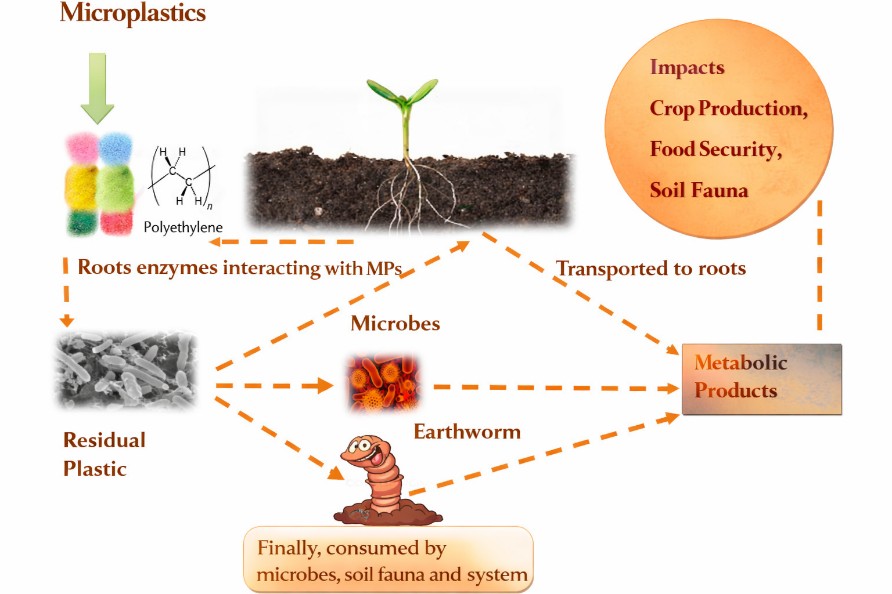
Soil microorganisms are essential for maintaining ecosystem functions such as decomposition and nutrient cycling. Microplastics can significantly alter microbial communities, leading to changes in diversity, composition, and activity. Microplastics exert selective pressure on microbial populations, favoring certain species while suppressing others. This can disrupt ecological balance and reduce the efficiency of key soil processes. Additionally, microplastics provide surfaces for microbial colonization, forming what is known as the “plastisphere”, is a unique microbial habitat that differs from the surrounding soil environment. These changes can have cascading effects on soil health. Reduced microbial diversity and altered enzymatic activity can impair nutrient cycling and organic matter decomposition, ultimately affecting plant productivity.
Impact on Soil Fauna
Microplastics also pose significant risks to soil fauna, including earthworms, nematodes and arthropods. These organisms play crucial roles in soil structure formation and nutrient cycling. Ingestion of microplastics can cause physical damage, oxidative stress and reproductive issues in soil organisms. Earthworms, in particular, are highly affected due to their feeding habits. They ingest microplastics along with soil, which can accumulate in their digestive systems and reduce their growth and survival rates. Microplastics can hinder the survival and reproduction of soil fauna, leading to population declines. This has serious implications for soil health, as these organisms are essential for maintaining soil structure and fertility.
Effects on Plants and Crop Productivity
The interaction between microplastics and plants is an emerging area of research. Studies indicate that microplastics can affect plant growth, development and productivity in several ways. One of the primary concerns is the uptake of microplastics by plant roots. Microplastics, particularly nanoplastics, can enter plant tissues and potentially accumulate in edible parts. This raises serious concerns about food safety and human health. Microplastics can also inhibit seed germination and reduce plant biomass. Exposure to microplastics can lead to reduced root and shoot growth, lower chlorophyll content and impaired photosynthesis. These effects ultimately resulted in decreased crop yields. Additionally, microplastics can interfere with nutrient and water uptake by blocking root pores or altering soil properties. These disruptions can significantly affect crop productivity, particularly in intensively farmed regions.
Trophic Transfer and Human Health Risks
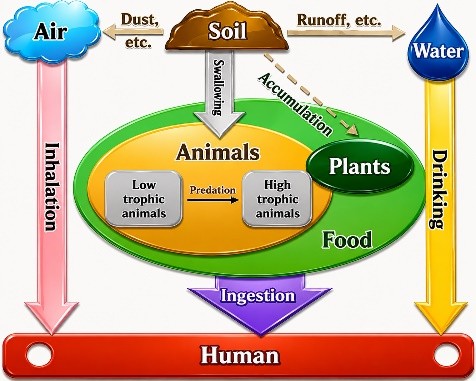
Microplastics in soil do not remain confined to terrestrial ecosystems; they can enter the food chain through trophic transfer. Soil organisms that ingest microplastics can pass them on to higher-level predators, eventually reaching humans. Also note that microplastics can move from soil organisms to animals such as chickens. This raises concerns about the accumulation of microplastics in food products. Furthermore, microplastics can act as carriers of toxic substances. Their ability to adsorb pollutants increases the risk of exposure to harmful chemicals. When these contaminated particles enter the food chain, they may pose serious health risks, including inflammation and oxidative stress.
Challenges in Detection and Analysis
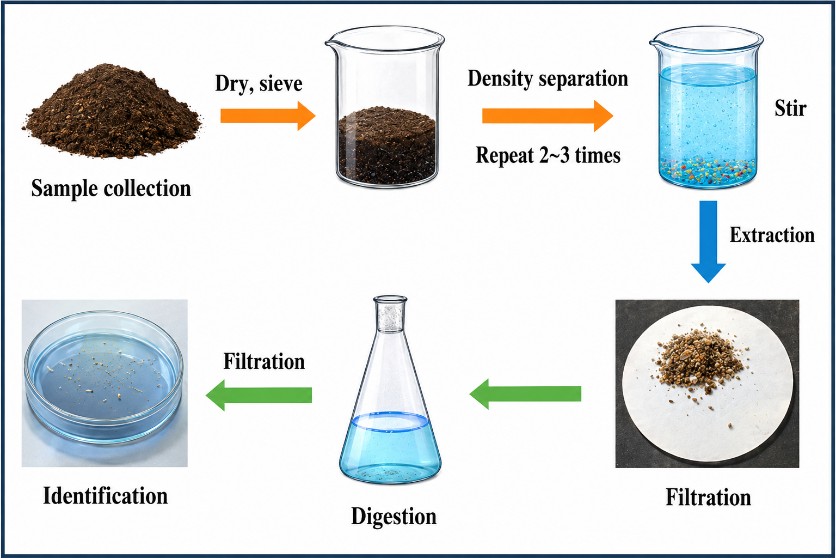
One of the major challenges in studying soil microplastics is the lack of standardized analytical methods. Soil is a complex matrix, making it difficult to isolate and identify microplastic particles. Common analytical techniques, including density separation, chemical oxidation and spectroscopic methods such as FTIR and Raman spectroscopy. However, the absence of standardized protocols limits the comparability of results across studies. There is a need for improved detection methods, particularly for nanoplastics, which are more difficult to identify but potentially more harmful.
Future Research Directions
Despite significant progress, many knowledge gaps remain in our understanding of soil microplastics. There is a need for more research on the long-term ecological effects of microplastics, particularly under field conditions. There should be interdisciplinary approaches to study the complex interactions between microplastics and soil ecosystems. This includes research on combined pollution effects, as microplastics often interact with other contaminants. There is also a need to develop effective mitigation strategies, such as biodegradable plastics and bioremediation techniques using plastic-degrading microorganisms.
Summary
Microplastics represent a hidden but pervasive threat to soil ecosystems. From altering physical structure and chemical properties to disrupting biological communities, their impacts are far-reaching and complex. As research continues to uncover the extent of this pollution, it is clear that soil microplastics pose significant risks to environmental sustainability, food security, and human health. Addressing this issue requires a comprehensive approach that includes improved waste management, sustainable agricultural practices, and advanced research. By understanding and mitigating the effects of microplastics, we can protect soil ecosystems and ensure the long-term health of our planet.
Also Read: Crystal Crop Protection and Corteva Sign Collaboration Agreement
Global Agriculture is an independent international media platform covering agri-business, policy, technology, and sustainability. For editorial collaborations, thought leadership, and strategic communications, write to pr@global-agriculture.com