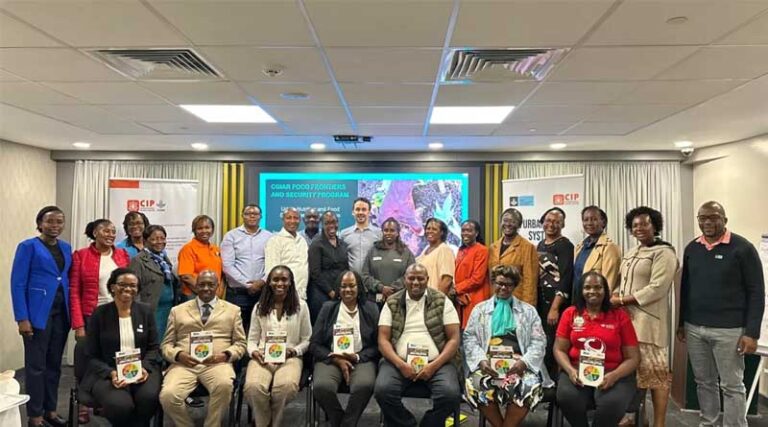
06 July 2026, Kenya: On 19 June 2026, the International Potato Centre (CIP), under the CGIAR Food Frontiers and Security Science Program, convened an Inception and Co-creation Workshop on Urban Nutrition and Food Environment Interventions in Nairobi, Kenya. The workshop served a dual purpose: to introduce and deliberate CGIAR Food Frontiers and Security Program proposed urban nutrition and food environment package of delivery to county government stakeholders and to co-create a shared, multi-sectoral implementation plan within the available programme window of June to November 2026.
Nairobi is one of the fastest-growing cities in sub-Saharan Africa. As urbanization accelerates, the city faces mounting challenges related to food security, dietary quality and sustainable livelihoods. Nationally, data from the 2022 Kenya Demographic and Health Survey (KDHS) indicate that nearly half of urban women of reproductive age are overweight or obese, a trend that has risen progressively over the recent past. Overweight among adolescents is also higher among girls in urban areas compared to rural areas. At the same time, only half of children aged 6 to 23 months in urban Kenya meet the minimum dietary diversity and the proportion consuming vitamin A-rich foods stands at 38 percent. Micronutrient deficiencies, non-communicable diseases and the coexistence of under- and over-nutrition (double burden of malnutrition) are increasingly prevalent in Nairobi’s urban communities.
These trends are closely linked to the food environment that urban residents navigate daily. The proliferation of ultra-processed and convenience foods, aggressive marketing of nutrient-poor products, limited access to diverse and affordable nutritious foods, and the constraints of urban livelihoods including long commutes, time poverty and income volatility combine to create conditions that are inimical to healthy dietary choices. Addressing these challenges requires aligning with Nairobi City County Government (NCCG) priorities and fostering a coordinated collaborative multi-sectoral approach that links agriculture, health, markets and social systems to contribute to improved diets and nutrition outcomes among urban populations.
This inception and co-creation workshop was convened to strengthen partnerships with NCCG, map out county-level priorities, introduce the proposed intervention design and co-develop a feasible implementation plan aligned with county government priorities and capacities. A central finding of the workshop was the convergence of evidence on the drivers of poor dietary quality in Nairobi’s urban population. Stakeholders identified high costs and limited availability of nutritious foods, heavy marketing of ultra-processed foods, time constraints associated with urban livelihoods, limited nutrition knowledge among caregivers and consumers, weak food safety systems along the value chain and socio-cultural preferences that favor convenience and processed foods as the key barriers to healthy diets. Children aged 6 to 23 months, pregnant and lactating women, low-income households, adolescents, and informal sector workers were identified as the most nutritionally vulnerable population groups.
The research team presented its proposed intervention package, which comprises four complementary approaches: (i) integration of the Healthy Baby Toolkit into existing community health structures through social and behavior change communication to promote improved dietary practices (ii) promotion of nutritious crops, (iii) capacity building across all sectors and (iv) market assessment to establish baseline food environment data for nutritious roots and tuber crops in target markets. The intervention targets households with children under two years and pregnant and lactating women in Westlands and Dagoretti North sub-counties.
The workshop concluded with a multi-sectoral work-planning session during which representatives from health, agriculture and markets sectors proposed specific timelines, locations and role assignments for key activities. An agreed implementation schedule was developed. County Government counterparts affirmed their institutional commitment to the collaboration. The workshop brought together 30 participants from three sectors of the Nairobi City County Government – Health; Food, Agriculture and Natural Resources; Trade and Markets alongside CIP – CGIAR Food Frontiers research team. The event was officially opened by Ms. Gladwell Cheruiyot, County Chief Officer for Food, Agriculture and Natural Resources, and was facilitated by CIP’s Urban Food Systems Research Team. The discussions were structured around four thematic group-work sessions and complementary plenary presentations.
Global Agriculture is an independent international media platform covering agri-business, policy, technology, and sustainability. For editorial collaborations, thought leadership, and strategic communications, write to pr@global-agriculture.com