Why Governance Is Essential for Managing Invasive Species
18 August 2026, New Delhi: Invasive species are accelerating land degradation across the world, undermining biodiversity, livelihoods, and climate resilience. As delegates gather for the UNCCD COP, one example from India illustrates a broader truth: technical approaches alone cannot solve invasive species problems. Governance is essential.
Take Lantana camara — the sweet-smelling ornamental shrub that has become one of the world’s ten worst invasive plants. Introduced to India 200 years ago, it now threatens over 40% of the country’s forests, forming dense, thorny thickets that smother native vegetation and reduce forage for livestock and wild herbivores. While its spread in tiger reserves has drawn attention, lantana also invades agricultural land and village commons that are central to rural livelihoods.
Removing lantana requires uprooting it and planting native or locally appropriate vegetation—a difficult and expensive process. It’s not enough to do it on one plot of land—it has to be done over whole landscapes to be effective. And it’s not a one-shot deal—it requires continued monitoring and removal of new lantana plants for at least three years.
Invasive Species Management Is a Governance Problem
This is where governance comes in: the set of formal and informal ways that society organizes to make and implement decisions. Governance is necessary to address these challenges:
- Mobilize resources for labor-intensive removal and replanting, considering who receives benefits and has incentives to contribute.
- Coordinate action across entire landscapes, as the problem spans individual farms, village commons, reserve forests, and wildlife areas managed by government departments.
- Sustain monitoring and management over time to prevent reinvasion.
Successful governance of invasive species can’t just be by government—it requires a combination of individual and collective action as well.
Benefits Are Real — But Distributed Across Different Actors
A study around the Kanha Tiger Reserve by the Foundation for Ecological Security shows that lantana removal delivers substantial economic and ecological benefits. But these benefits accrue at different levels:
- Individuals gain improved fodder, fuelwood, and access to wild foods.
- Communities benefit from more non-timber forest products, better nutrient cycling, stronger pollination services, less time to collect products, and fewer dangerous wildlife encounters.
- National and global stakeholders gain public goods including wildlife habitat, genetic diversity, and other ecosystem services.
The total benefits for any one of those groups may not be enough to cover lantana removal. It is the combination of benefits that is key. In addition, the costs of removal and replacement are front loaded, while benefits appear more slowly over time.
This distribution of benefits creates a multi-layer governance dilemma: each group benefits, but none benefits enough on its own to sustain action. There are incentives for individuals in each group to take advantage of other’s actions.
Why Individual Action Isn’t Enough
Farmers may see short-term gains from clearing lantana on their own fields. But unless removal is coordinated across the landscape, lantana simply spreads back. Provisioning services like food and fodder are visible; regulating services like nutrient cycling and pollination are not.
Communities may struggle to mobilize collective labor for benefits that are medium-term or intangible. And the collective action can’t be a one-off event; it needs to be sustained over time.
Public goods benefits — habitat, biodiversity, fire risk reduction — are long-term and easiest to overlook. Forest departments may recognize them, but cannot act effectively without community participation and cross-sector coordination.
The question is whether these different actors can work together to mobilize the resources to not only restore the landscape once, but maintain it over time.
A Landscape That Shows What’s Possible
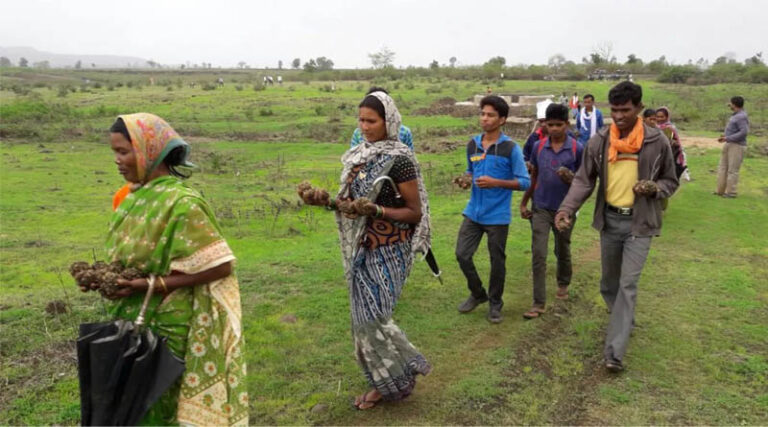
Mandla District in Madhya Pradesh, home of the Kanha National Park, offers a hopeful example. By 2020, 111 villages had collectively restored over 6,000 hectares of lantana-infested commons and agricultural uplands through coordinated removal and sustained post-restoration management. Community institutions identified lantana-infested areas, mobilized labor, developed and enforced rules, regulated access, monitored restored sites, and coordinated with local government and other agencies. The Forest department contributed resources and planting materials, recognizing their role as custodians of public goods.
Communities reported additional gains such as easier mobility, reduced labor burdens after initial clearing, and lower risks of fire and wildlife conflict. In villages where collective action remained strong, communities periodically removed lantana regrowth and maintained the restored areas. Where such collective management was weak, lantana re-established itself.
What This Means for UNCCD COP Delegates
Invasive species management is a microcosm of the broader land governance challenges the UNCCD seeks to address. The lessons from lantana apply globally:
- Technology is necessary but insufficient.
- Landscape-scale coordination is essential.
- Governance must align incentives across individuals, communities, and public agencies.
- Long-term monitoring and reinvasion prevention require sustained financing and building of institutions.
- Public goods must be valued and invested in even when benefits are diffuse.
For COP delegates, this means designing policies and financing mechanisms that:
- Support community-led restoration
- Incentivize collective action and strengthen community stewardship
- Strengthen cross-sector coordination
- Ensure long-term vigilance
- Recognize and reward public goods benefits
Invasive species will not wait. Governance must catch up.
The Path Forward
The world needs governance models that can outpace invasive species.
As countries negotiate commitments and implementation pathways, lantana offers a clear message: restoration succeeds when governance works across scales, sectors, and time horizons.
Also Read: Paraquat and the Future of Pesticide Regulation in India
Global Agriculture is an independent international media platform covering agri-business, policy, technology, and sustainability. For editorial collaborations, thought leadership, and strategic communications, write to pr@global-agriculture.com