Milling Oats Option Reduces Frost Risk
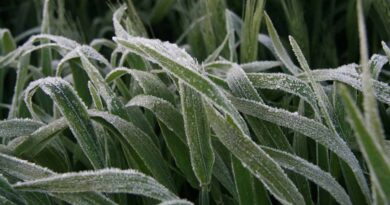
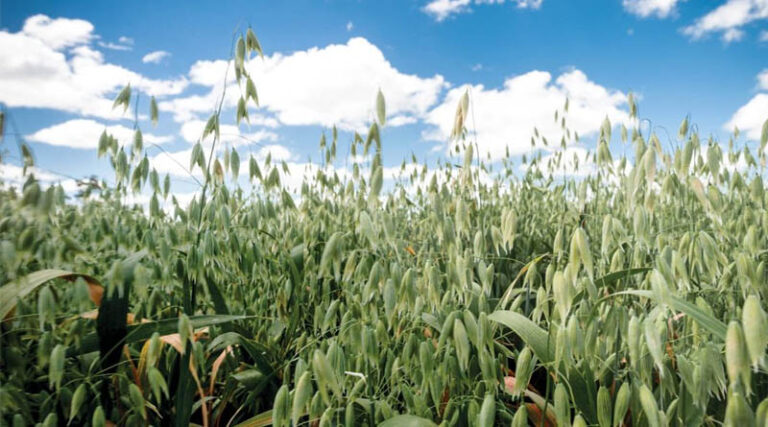
19 November 2026, AU: Ongoing research continues to highlight the agronomic value of milling oats, especially in mitigating frost risk.
ConsultAg Research Agronomist Trent Butcher says milling oat crops are strong performers at mitigating frost risks compared with other cereal crops.
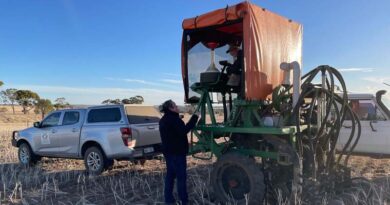
The Western Australian researcher says a grower-scale trial in WA’s Lakes region in 2016 explored the response of oat and barley varieties to frost. The trial was seeded outside the optimal window on 15 April 2016.
Researchers recorded 18 below-zero frosts from 20 August to 20 October, with some days as low as minus 4° C.
Mr Butcher says results showed Yitpi wheat was severely frosted, yielding less than 100 kg/ha. The Hindmarsh barley, by contrast, yielded 300 kg/ha.
“In the same trial, Bannister oats yielded just more than 4 t/ha, with no reduction in hectolitre weight. Oats were way ahead in frosty conditions.”
Oats issues
Nonetheless, Mr Butcher concedes a few challenges remain with oats, particularly around weed control.
“There are limited weed control options for brome grass, barley grass, wild oats and annual ryegrass,” Mr Butcher says.
“But with tyne and press-wheel seeding systems, there are increasing options for pre-emergence herbicides for grass weed control, provided plant-back periods are observed.
“The recently registered early post-emergence application of Boxer Gold® (800 g/L prosulfocarb + 120 g/L s-metolachlor) is a step change in annual ryegrass control options.”
He says planting oats after an Intervix® (33 g/L imazamox + 15 g/L imazapyr) application carries a minimum plant-back period of 10 months, while planting oats after Sakura® (850 g/kg pyroxasulfone) requires 21 months.
“Sowing oats too soon after imidazolinone (Group 2) or pyroxasulfone (Group 15) has been applied may cause severe stunting, yellowing, bleaching, root-pruning and potential crop failure. These plant-back periods need to be considered in how you approach your weed control more broadly.”
Early sowing
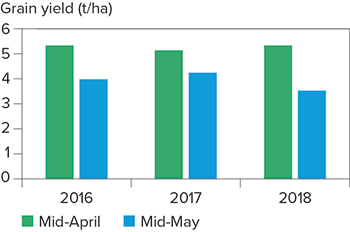
When considering April versus May sowing, Mr Butcher points to the Western Australian Department of Primary Industries and Regional Development (WA DPIRD) data from 2016 to 2018. This work showed April-planted oats yielded more grain than May-planted oats (Figure 1).
WA DPIRD research also showed that earlier-sown oat crops had lower screenings, which improved their suitability for delivery as premium milling oats (OAT1 grade).
He says Bannister oats have a very strong photoperiod hold, which is triggered by day length (light). But some newer varieties have different photoperiod holds. Check optimal sowing dates before seeding.
Moisture seeker
When it comes to moisture seeking, Mr Butcher says oats are unique. He points to CSIRO research examining the emergence ratio of planted seeds at depths of 10 to 11 cm versus 3 to 4 cm.
“The research showed more than 80% of Goldie oats sown deep emerged. This compared well to the long-coleoptile wheats, of which more than 75% emerged, whereas only 50% of commonly grown wheat and barley varieties emerged when sown deep.”
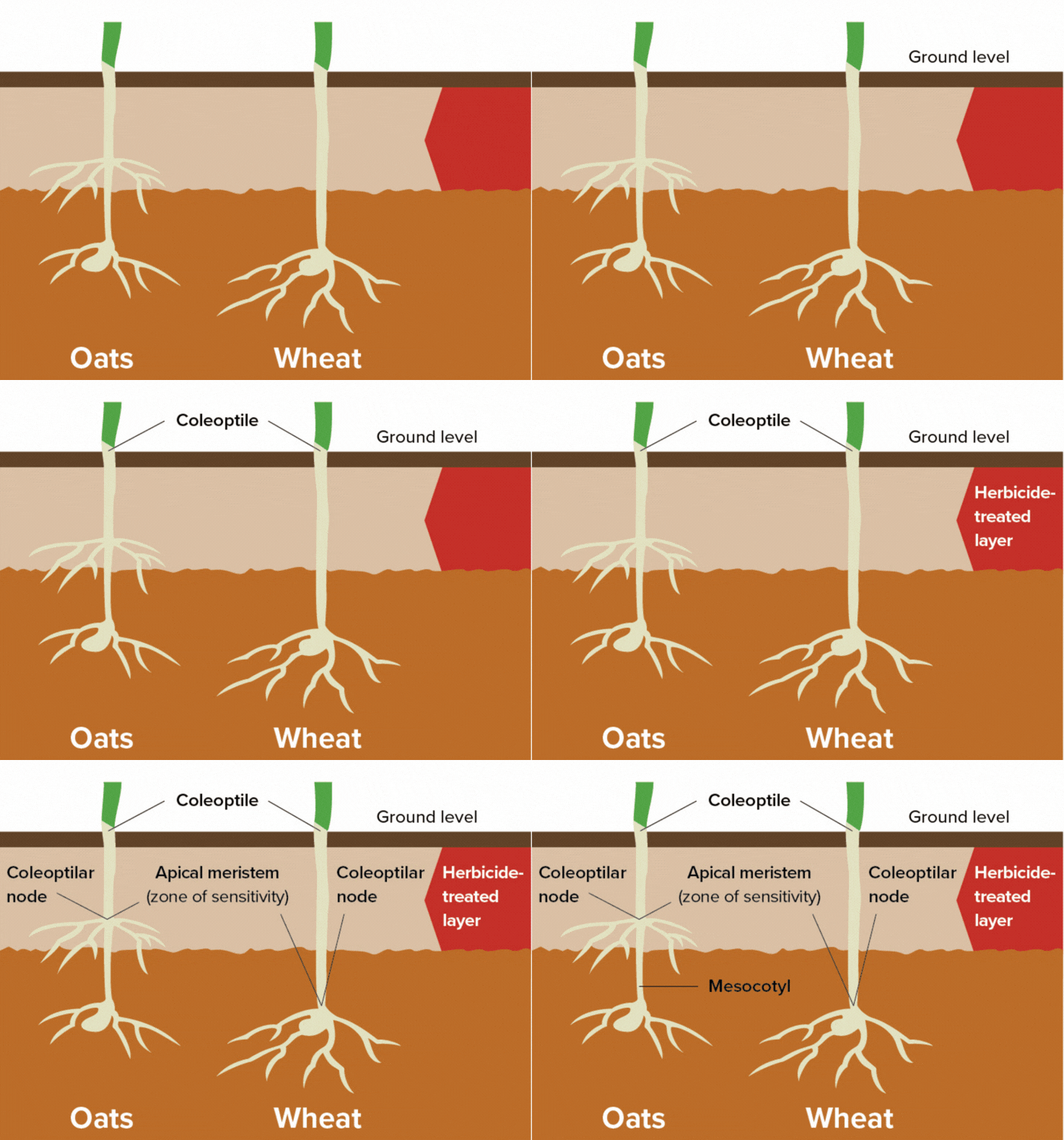
He says the reason for oats’ superior emergence when sown deep is related to their combined mesocotyl and coleoptile length (Figure 2).
“A wheat plant emerges from the coleoptilar node, which is the most sensitive root part to pre-emergence herbicides. Oats can emerge more effectively than wheat and barley from deeper soil layers because they extend through the mesocotyl (Figure 2).”
He says the downside of extending through the mesocotyl is that it pushes the apical meristem (the zone of sensitivity) higher in the profile, closer to where pre-emergence herbicides are located.
“Sowing oats shallow can be dangerous from a herbicide perspective, so we need to maintain a good seeding depth.”
Mr Butcher says his trials have shown 80% oat establishment when seed was sown 80 mm deep. He considers this a success.
“The problem with sowing oats deeper is more soil throw and herbicide damage. This can be overcome, to some degree, by sowing at a slower speed. Separation of the seed from herbicide is essential to maintain crop safety. Given the challenges, deep sowing should only be done if sowing into moisture is required.”
Nitrogen and oats
Mr Butcher says oats show a plateau in grain yield response to nitrogen, which is not commonly seen in wheat or barley.
“Also, adding more nitrogen to some oat varieties increases the risk of brackling. This is like lodging except the stem snaps, causing the oat head to lean over or droop. It can lead to increased screenings and reduced hectolitre weights.”
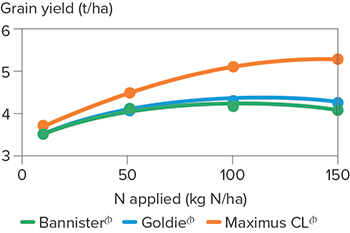
He says more nitrogen does not necessarily equal more profit from oats. By way of example, he points to trial work by Blakely Paynter from WA DPIRD comparing the nitrogen needs of oats and barley (Figure 3).
“What you expect to see is the orange curve at the top, which is the nitrogen response curve for Maximus CL barley.
It shows increased yield with increased nitrogen applications, whereas Bannister and Goldie oats plateau at a low nitrogen rate.”
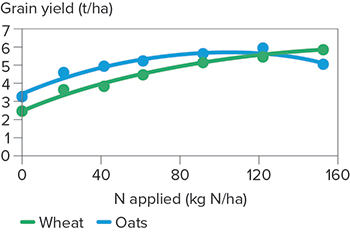
Mr Butcher says the nitrogen response curve of wheat is similar to barley, but different to oats (Figure 4).
“What is worth noticing are the starting points, where the wheat without nitrogen yielded 2.5 t/ha, and the oats without nitrogen yielded 3.25 t/ha. Both the oats and the wheat used 35 kg/ha of nitrogen after accounting for the grain nitrogen content.”
He says the same amount of nitrogen was available, but the oats converted more of it into grain. He notes that the upper end of yield potential for oats and wheat in the same trial was almost 6 t. But oats achieved that yield with a lower nitrogen rate.
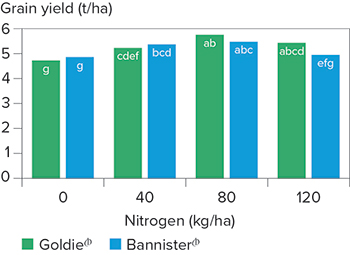
Two years ago, Mr Butcher explored the plateauing effect in oats and whether it could be managed by examining 2 oat varieties: Goldie and Bannister (Figure 5).
“We wanted to better understand the tipping point with nitrogen. The trial showed a similar plateau in grain yield response to nitrogen, with Bannister oats showing a more distinct drop at higher nitrogen rates.”
Regarding grain quality, he says hectolitre weight showed a similar response. However, with screenings, the tipping point is reached much earlier, resulting in a significant blowout at higher nitrogen rates.
Mr Butcher says he gathered some oat plants (harvest index cuts) and made some measurements. His finding was that the more nitrogen is applied, the more biomass is produced. But more precisely, the more nitrogen is applied, the more panicles (sites for grain production) are produced.
“As soon as you apply more nitrogen, the average grain weight in that plant starts to decline. While there are more sites for potentially more grains, they do not grow as large, leading to higher screenings and lower yields.”
Too much bulk
Accordingly, Mr Butcher says he wanted to find out if too much biomass grew at the expense of grain fill. To explore this, he set up a trial at Lake Grace, sowing on 6 April, with investment from the GRDC National Grower Network (NGN).
Biomass imagery of the site was collected using a drone on 4 September 2025.
Mr Butcher says most people would look at the blue-green appearance of the Goldie oats given 105 kg/ha of nitrogen and say that the nitrogen rate is ideal. But the grain yield results told a different story.
“The results showed a grain yield increase up to 35 kg/ha of nitrogen but a plateau at higher nitrogen rates. The same trend was seen at Highbury.”
Regarding the economics, he says a flat response will have a significant negative impact on the gross margin if the crop does not convert additional nitrogen into grain.
“If oats are growing in a very high rainfall environment, where they have lots of time and sunlight to turn water and energy into grain, you’ll likely see plump grain,” Mr Butcher says.
“But if your environment during spring is cut off by dry and hot conditions, there’s less chance to turn those resources into grain. The impact is low hectolitre weights and higher screenings.”
Mr Butcher says preliminary data suggest that 5.14 t/ha is the tipping point for oats.
“From the NGN trials in 2025, environments with an estimated yield potential below about 5.14 t/ha appeared to carry a greater risk that extra biomass would be partitioned inefficiently into grain, as reflected by a lower harvest index.”
Another point to consider is maintaining green leaf area by minimising leaf diseases.
For Septoria avenae blotch in oats (found in WA), he suggests a 2-spray approach: a demethylation inhibitor (DMI) fungicide applied early, followed by a succinate dehydrogenase inhibitor (SDHI) fungicide from flag-leaf emergence to mid-booting.
Harvest management
Mr Butcher says another consideration is how oats are harvested. “Harvesting at night poses a high risk to grain quality, which restricts the harvesting window compared to wheat and barley.”
He says to harvest in the heat of the day to achieve the highest quality oats. “Avoid pushing harvesting too late into the evening. As moisture increases, separating the grain becomes more difficult and hectolitre weight typically declines.”
He says screenings thrown out the back of a harvester indicate you have potentially overdone your nitrogen for the season. It is also forgone grain yield.
Retrospective assessment
Mr Butcher encourages a retrospective assessment of oats for grain in view of the environmental conditions (rainfall, temperature and sunlight). He suggests reflecting on the following and revising your nitrogen strategy where needed:
- When did the oats emerge?
- What were the rainfall, temperature and sunshine levels?
- How successfully did the oats fill grain after head emergence?
- What were your nitrogen rates and timings?
- Did you see brackling and lodging?
- Did the crop look good, yet didn’t yield?
- What were your screenings and hectolitre weights?
More information:
Also Read: Mahindra Launches 50 HP Compact Harvester Harvest Yuva for Small Farms
Global Agriculture is an independent international media platform covering agri-business, policy, technology, and sustainability. For editorial collaborations, thought leadership, and strategic communications, write to pr@global-agriculture.com