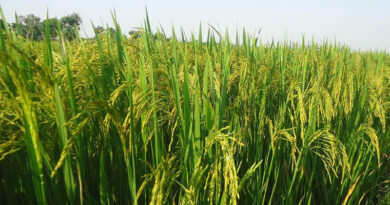
19 November 2026, Beijing, CN: Researchers at the Chinese Academy of Agricultural Sciences (CAAS) and Germany’s Leibniz Institute of Plant Genetics and Crop Plant Research (IPK Gatersleben) have pinned down a combination of two genes that lets barley mature early enough for double-season cropping without the yield penalty that usually comes with faster-flowering varieties. The findings, led by Dr. Ping Yang of CAAS’s Institute of Crop Science with first author G. Gao and IPK co-authors Dr. Martin Mascher and Dr. Nils Stein, were published in the journal Nature on November 5.
Double cropping, growing two harvests from the same field in one year, is one of the main ways farmers in parts of China raise land productivity, but it depends on each crop maturing quickly enough to leave time for the next planting. Breeders have long known that pushing flowering time earlier tends to cut yield, because the plant has less time to build grain-filling capacity. What the CAAS and IPK team found is that this trade-off is not fixed. It depends on which version of a second gene the early-flowering mutation is paired with.
The gene at the center of the discovery is PHYTOCHROME C, or PhyC, which helps plants sense day length and time their transition to flowering. The researchers identified a single amino acid change in PhyC that speeds up ear emergence and overall maturity in barley. On its own, that change behaves the way breeders would expect: faster flowering, smaller plants, lower yield. But when the team paired the early-PhyC variant with a winter-type version of VERNALIZATION 1 (VRN1), a gene that controls the plant’s requirement for a period of cold before it will flower, the yield penalty disappeared. Barley carrying both the early-PhyC change and the winter-VRN1 background matured earlier and still produced a full yield in field trials. Pair the same early-PhyC variant with a spring-type VRN1 instead, and the yield loss returns.
To confirm that PhyC itself, rather than some other nearby gene, was responsible for the effect, the team used base editing, a genome-editing method that rewrites a single DNA letter without cutting the double helix the way older CRISPR tools do. Editing the gene directly and reproducing the early-maturity, no-yield-loss phenotype in a controlled genetic background gave the researchers direct proof of cause and effect, rather than just a statistical association found in field data.
The second half of the study looked backward rather than forward. The team examined breeding records and genetic data from 505 Chinese barley varieties and 27 reference lines spanning roughly 80 years of breeding history. They found the early-PhyC and winter-VRN1 combination present in more than 60 percent of modern Chinese autumn-sown barley varieties released since the 1990s. In other words, Chinese breeders had already been selecting for this exact genetic combination for decades, without knowing the specific mechanism behind it. Varieties carrying the pairing by chance performed well and were kept in breeding programs; varieties without it were more likely to be discarded along the way.
The researchers also tested whether the same PhyC change behaves consistently across species. In rice, a short-day plant with a different flowering biology than barley and wheat, the identical PhyC change delayed flowering instead of speeding it up. That result tells the team the underlying flowering-time machinery involving PhyC is conserved across cereal crops, but its practical effect depends heavily on the genetic and environmental context it operates in. The team also tested the mechanism in wheat, where early signs point to a similar pattern to barley, though the wheat results were described as preliminary compared with the barley findings.
For plant breeders, the practical value of the discovery is that it turns a trait combination they were selecting for blindly into a genetic marker they can screen for directly. Instead of running years of field trials to find early-maturing lines that do not sacrifice yield, breeding programs could use a genetic test for the PhyC and VRN1 combination to identify promising candidates far earlier in the breeding pipeline. That has particular relevance for regions expanding double-cropping systems under pressure to grow more food on the same land, including large parts of China’s wheat and barley belt, where autumn-sown cereals are often followed by a second summer crop.
Global Agriculture is an independent international media platform covering agri-business, policy, technology, and sustainability. For editorial collaborations, thought leadership, and strategic communications, write to pr@global-agriculture.com