US Cotton Disease Loss Report 2025: Yield Loss Drops to Historic Low of 4.8%
20 March 2026, Illinois: Cotton diseases can reduce annual yields in the United States. Diseases of importance vary from year to year, and those that affect yield depend on many factors, including environmental conditions, crop production practices, and variety susceptibility to disease.
Plant pathologists representing 17 U.S. cotton-producing states estimated the percent yield losses from cotton diseases for each participating state. These states accounted for a total production of 13.9 million bales (one bale = 480 lbs.) of cotton lint in the United States in 2025 (Figure 1). The yield loss estimates include diseases that impact cotton and are grouped into categories that include root rots, stem diseases, seedling blights, foliar diseases, boll rots, and nematodes. For this summary, cotton diseases were divided into two categories: foliar and boll, or root and stem diseases.

This publication documents the impact of major diseases on cotton production in Alabama, Arizona, Arkansas, California, Florida, Georgia, Kansas, Louisiana, Mississippi, Missouri, New Mexico, North Carolina, Oklahoma, South Carolina, Tennessee, Texas, and Virginia in 2025. University Extension specialists with cotton pathology responsibilities in these states estimate disease loss data annually. Data collection began in 1952 for the entire U.S., and for individual states in 1965. It is important to note that methods for estimating disease loss may vary by state and/or over time. The estimates may be based on feedback from university Extension and personal experience with disease losses.
Values for cotton disease losses are based on yield beforeestimated losses occurred for each state and are determined using the formula (harvested bales/[{100 – percent estimated disease loss}/100]). Next, the formula ([percent loss/100] x yield before estimated loss) is used to determine the number of bales lost for each participating state.
This publication quantifies yield losses caused only by cotton diseases. It does not account for additional costs associated with disease management, including crop scouting, fungicide/nematicide applications, and product costs, research to improve cotton varieties, or implementation of other management strategies.
2025 Conditions and Production
The United States produced 13.9 million bales of cotton on 9.3 million acres in 2025. Approximately 2.4 million fewer acres were planted to cotton in 2025 compared to the annual average acreage planted from 2020 to 2024. The number of bales harvested in 2025 was 697.7 thousand, less than the average annual number harvested from 2020 to 2024.
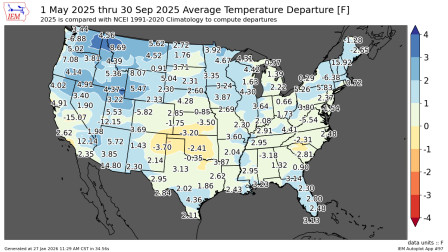
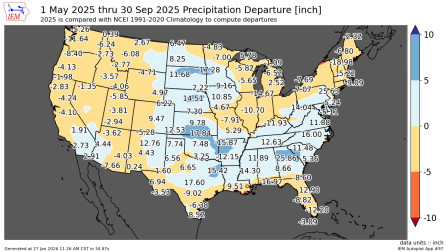
In general, temperatures across many cotton-growing states were slightly above normal from May 1 through September 30, 2025 (Figure 2). Portions of Kansas, Oklahoma, New Mexico, South Carolina, and Texas were below normal. Precipitation was well above normal across multiple cotton-growing states, including Alabama, Arkansas, Georgia, Kansas, North Carolina, Oklahoma, South Carolina, Tennessee, and Virginia (Figure 3). Precipitation was below normal in Florida and across southern Alabama, Georgia, Louisiana, New Mexico, and Texas, as well as in portions of Arizona and California. Much of Missouri was also drier than normal; however, most of the cotton is produced in the Missouri Bootheel.
2025 National Disease Loss
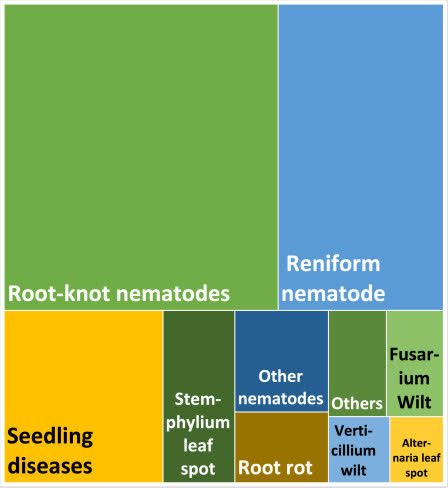
In 2025, disease reduced cotton yield by an estimated 4.8 percent, or 702,244 bales. Across the U.S., the percent yield reduction in 2025 was the lowest ever recorded, since data collection for individual states began in 1965. The average percent loss from 1964 through 2024 was 11.6 percent. Fewer bales were estimated to have been lost due to disease in 2025 than in any other year except 1983. The top yield-reducing disease or disease group in 2025 across U.S. cotton-producing states was root-knot nematode, followed by reniform nematode, seedling diseases, Stemphylium leaf spot, and other nematodes, respectively (Table 1 and Figure 4). Compared to the top five yield-reducing diseases or disease groups, other diseases had much lower yield impacts, although they are still important yield-limiting cotton diseases.
Table 1. Estimated cotton yield losses (number of bales) due to diseases in 17 U.S. cotton-producing states in the 2025 growing season.
| Disease | Total losses (480 lb. bales) | |
|---|---|---|
| Foliar and boll | ||
| Stemphylium leaf spot | Stemphylium solani | 41,393 |
| Alternaria leaf spot | Alternaria macrospora | 11,806 |
| Boll rots | Rhizopus and others | 6,250 |
| Bacterial blight | Xanthomonas citri pv. malvacearum | 5,596 |
| Target spot | Corynespora cassiicola | 2,941 |
| Areolate mildew | Ramulariopsis gossypii and R. pseudoglycines | 2,173 |
| Ascochyta blight | Nothophoma gossypiicola | 1,757 |
| Cercospora leaf spot | Cercospora gossypina | 1,516 |
| Viruses | CLRDV and others | 56 |
| Root and stem | ||
| Root-knot nematodes1 | Meloidogyne spp. | 280,269 |
| Reniform nematode | Rotylenchulus reniformis | 169,080 |
| Seedling diseases | Rhizoctonia and others | 91,476 |
| Other nematodes2 | Belonolaimus and Hoplolaimus | 31,746 |
| Root rot | Phymatotrichopsis omnivora | 22,088 |
| Fusarium wilt | Fusarium oxysporum f.sp. vasinfectum | 20,212 |
| Verticillium wilt | Verticillium dahliae | 13,563 |
| Other diseases3 | — | 321 |
Diseases in the Southwestern United States
The states reporting data from the southwestern cotton-growing region accounted for 46.4 percent of U.S. cotton production. Root-knot nematodes caused the greatest yield reduction in the southwestern U.S. in 2025, with 95,801 bales lost (Table 2). Reniform nematode caused the second greatest yield losses, followed by seedling diseases, root rot, and Fusarium wilt(Figure 5). As in the previous three years, all five of the most significant diseases in this region were root and stem diseases. Overall, the yield reduction caused by disease in this region was 3.6 percent.
Table 2. Estimated cotton yield losses due to the five most significant diseases in the southwestern U.S. states1 in 2025.
| Rank | Disease | Total losses (bales) | |
|---|---|---|---|
| Southwestern Region | Nation | ||
| 1 | 1 | Root-knot nematodes | 95,801 |
| 2 | 2 | Reniform nematode | 54,856 |
| 3 | 3 | Seedling diseases | 22,230 |
| 4 | 6 | Root rot | 22,088 |
| 5 | 7 | Fusarium wilt | 16,727 |
Diseases in the Southeastern United States
The states reporting data from the southeastern cotton-growing region accounted for 53.6 percent of U.S. cotton production. Root-knot nematodes were the greatest cause of yield reduction, followed by reniform nematode, seedling diseases, Stemphylium leaf spot, and other nematodes (Table 3). Due to the climate of southeastern U.S. states, foliar diseases are generally more likely to pose problems than in drier southwestern states. Diseases reduced yield by an estimated 5.8 percent in the southeastern states.
Table 3. Estimated cotton yield losses due to the five most significant diseases in the southeastern U.S. states1 in 2025.
| Rank | Disease | Total losses (bales) | |
|---|---|---|---|
| Southeastern | Nation | ||
| 1 | 1 | Root-knot nematodes | 184,469 |
| 2 | 2 | Reniform nematode | 114,224 |
| 3 | 3 | Seedling diseases | 69,246 |
| 4 | 4 | Stemphylium leaf spot | 41,393 |
| 5 | 5 | Other nematodes | 30,274 |
Summary
Estimated percent losses in 2025 (4.8%) were much lower than the 60-year average from 1965 through 2024 (11.6%). Estimated bales lost to disease were also much lower in 2025 (702,244) than the 60-year average (1,952,398). This does not mean that losses in individual fields were negligible, as disease risk varies across fields, regions, and production conditions.
The development of cotton disease depends on the presence of a susceptible host, the right environment, and the disease-causing organism. One of the best ways to reduce disease risk is to plant cotton cultivars that are less susceptible to diseases. A guide that compiles a list of commercially available cotton cultivars with documented resistance or tolerance to root-knot and reniform nematodes (the two greatest causes of cotton yield reduction) is available at Selecting Cotton Cultivars with Nematode Resistance and Tolerance. There are now cotton cultivars with resistance to the southern root-knot nematode and reniform nematode. However, some cultivars are resistant to only one nematode species. This guide should help select the right resistant cultivar for specific nematode species in the field.
Disclaimer
The disease loss estimates in this publication were provided by University Extension with cotton pathology responsibilities. This information is only a guide. The values in this publication are not intended to be exact values of cotton yield losses due to diseases. Participants used the means they considered best to estimate disease losses and assume no liability for them.
Values reported in this document were accurate as of the publication date and do not reflect corrections or updates occurring since that time. For the most up-to-date values and additional information on yield and economic losses due to diseases, see the Field Crop Disease and Insect Loss Calculator.
Sponsors
This project was supported by Cotton, Inc. and the United States Department of Agriculture – National Institute of Food and Agriculture.
Also Read: India Issues Draft Rules for Amendment to Its Insecticides Rules, 1971
Global Agriculture is an independent international media platform covering agri-business, policy, technology, and sustainability. For editorial collaborations, thought leadership, and strategic communications, write to pr@global-agriculture.com