Biochar Made From Herbal Medicine Waste Cuts Cadmium Uptake in Crops
19 November 2026, Foshan, CN: Researchers in China have shown that biochar produced from the leftover plant material of traditional Chinese medicine processing can meaningfully reduce how much cadmium moves from contaminated soil into food crops, offering a low cost option for farmland where heavy metal pollution limits what can safely be grown. The work, led by scientists at the Kunpeng Institute of Modern Agriculture at Foshan together with City University of Hong Kong and Guangxi University, was published in the journal Carbon Research on September 8, with the institutions issuing a joint public announcement on November 9.
Cadmium contamination is a persistent problem in parts of China’s farmland, often linked to industrial activity, mining and the long term use of certain fertilizers and irrigation water. The metal is readily taken up by many crops, particularly in acidic soils, and can accumulate in edible plant tissue at levels that raise food safety concerns. Biochar, a charcoal like material made by heating organic matter in low oxygen conditions, has been studied for years as a soil amendment that can bind heavy metals and make them less available for plant uptake. What has been less clear is which feedstocks and production conditions make the biggest difference, and traditional Chinese medicine processing residue, a large waste stream that is otherwise often discarded, had not been systematically tested for this purpose.
The team, whose corresponding authors include Carol Sze Ki Lin, Ziting Wang and Chong Li, with Xiaochen Zhu as first author, began with a meta-analysis pulling together previously published research. They screened 3,339 articles published between 2001 and 2024 and narrowed that pool to 134 studies covering 640 separate experimental comparisons of biochar’s effect on cadmium in soil and plants. Across that body of evidence, biochar use was associated with an average 37.9 percent decrease in the cadmium available for plant uptake in soil, and a 41.1 percent decrease in the amount of cadmium that ended up in plant tissue.
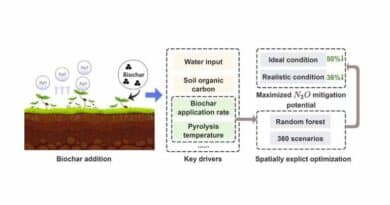
Having established that the broad approach works, the researchers then tested their own tailored biochar made specifically from Houttuynia cordata, a herb commonly used in Chinese medicine and left over in large quantities after processing. They varied the pyrolysis conditions, the temperature and duration of the low oxygen heating process used to turn the plant material into biochar, to find a version that performed particularly well. Their best performing formulation, produced by heating the residue at 450 degrees Celsius for three and a half hours and applied to soil at a 2 percent rate, was tested in pot experiments using lettuce and dandelion grown in acidic, cadmium spiked soil alongside adsorption kinetics tests that measured how strongly the biochar bound cadmium.
In the lettuce trials, this tailored biochar cut cadmium accumulation in the plant by 52.3 percent and reduced the amount of available cadmium left in the soil by 17.6 percent, compared with untreated contaminated soil. In the dandelion trials, plant cadmium accumulation fell by between 42.9 and 68.6 percent depending on the specific test conditions. The researchers also included Lanzhou lily, a crop grown for both food and ornamental use, in their pot trial design, though the publicly released figures for that species were not distinct enough from the dandelion results to be reported here with confidence, and are better treated as preliminary pending the full paper.
A waste stream turned into a soil treatment
The practical appeal of the approach is that it converts an existing waste problem into a soil treatment input. China’s traditional medicine industry generates large volumes of plant residue after herbs are processed for their active compounds, and that residue is frequently burned, landfilled or left to decompose without further use. Turning it into biochar for contaminated farmland gives processors a disposal pathway with agricultural value, while giving farmers in cadmium affected regions a treatment option that does not require removing or replacing topsoil, a far more expensive remediation method.
The adsorption kinetics data suggest the cadmium reduction works primarily through the biochar’s physical and chemical capacity to bind cadmium ions, pulling them out of the soil solution that plant roots draw from, rather than through any biological activity in the soil. That mechanism is consistent with how biochar is understood to behave with other heavy metals, and the research team’s meta-analysis indicates the general approach holds up across a wide range of prior studies using different feedstocks, not just their own herbal waste formulation.
Also Read: Mahindra Launches 50 HP Compact Harvester Harvest Yuva for Small Farms
Global Agriculture is an independent international media platform covering agri-business, policy, technology, and sustainability. For editorial collaborations, thought leadership, and strategic communications, write to pr@global-agriculture.com