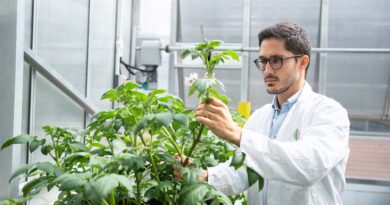
18 November 2026, Harpenden, UK: The UK government has published regulatory notices confirming two new gene-edited tomato lines developed by Phytoform, a precision-breeding company based at the Lawes Open Innovation Hub in Harpenden, Hertfordshire. One line has a compact, dwarf growth habit suited to high-density vertical farming. The other produces fruit that stays attached to the plant instead of dropping off, a trait aimed at mechanized and cluster harvesting. Both notices were published by the UK Department for Environment, Food and Rural Affairs (Defra) on November 3, 2026.
The two lines were filed under the Genetic Technology (Precision Breeding) Regulations 2025, the UK’s post-Brexit regulatory pathway for gene-edited crops that do not carry foreign DNA. The route is separate from, and lighter-touch than, the rules governing genetically modified (GM) organisms, because the edits only alter a plant’s own genes rather than inserting genetic material from another species. For both Phytoform filings, Defra’s two required confirmations, that the line meets the legal definition of “precision bred” and that it will not be marketed before that status is confirmed, are both marked as satisfied.
The underlying technique, described in the filings, starts with tomato protoplasts, individual plant cells with their outer wall removed so that editing tools can enter more easily. Researchers used a site-directed nuclease, an enzyme that cuts DNA at a chosen location, paired with a synthetic guide molecule that steers the cut to a specific gene. For the compact-growth line (filing reference PBR/26/013), the edit deleted both copies of a gene controlling stem elongation and branching, shortening the distance between leaf nodes and reducing side-branching. For the non-dropping fruit line (PBR/26/011), the edit removed both copies of a gene responsible for forming the fruit’s abscission zone, the small weakened layer of cells at the stem-to-fruit joint that normally lets ripe fruit separate from the plant. In both cases, the cell repaired the cut on its own through a natural process called non-homologous end joining, which closes the break but often disables the gene in the process. No new DNA was inserted at any point.
Why Growers Would Want Each Trait
A shorter, less branching tomato plant uses less vertical space and can be packed more densely under lights or in multi-tier growing systems, which is the main selling point for controlled-environment and vertical farm operators who are trying to raise output per square meter of expensive indoor floor space. Phytoform has worked on this trait before: in 2024 the company reported a separate compact tomato line that produced up to four times more fruit per unit of growing area in trial vertical-farm conditions, which gives some indication of what commercial-scale compact architecture can be worth to that style of production, though that earlier figure comes from a different, older line and should not be read across directly to the new filing.
The non-dropping fruit trait addresses a different cost line. Tomatoes grown for processing or for cluster sale can lose yield when ripe fruit detaches and falls before or during harvest, and growers using mechanical harvesters in particular contend with fruit loss at the point of detachment. A plant that holds its fruit until it is deliberately removed reduces that pre-harvest and harvest-time loss, and Rothamsted Research, the UK’s largest agricultural research institute, assisted Phytoform with glasshouse work on this line.
Phytoform’s pipeline now includes gene-edited traits in both potato, where the company secured a separate Defra notice for a bruise-resistant line on October 30, 2026, and tomato, suggesting the business is building a portfolio of precision-bred horticultural traits rather than a single product. Neither new tomato notice discloses a commercial launch date, and Defra’s publication of a release notice is a regulatory milestone rather than a market approval; a precision-bred line still needs that separate marketing confirmation before Phytoform can sell seed or plants commercially.
Global Agriculture is an independent international media platform covering agri-business, policy, technology, and sustainability. For editorial collaborations, thought leadership, and strategic communications, write to pr@global-agriculture.com