18 November 2026, AU: Antibiotic use in the world’s farms and food systems could climb by 29.5% from 2019 levels to about 142,481 tonnes a year by 2040 unless countries change course, according to the updated global action plan on antimicrobial resistance that frames this year’s World AMR Awareness Week, which opens today. The week runs from 18 to 24 November under the theme “One Health, one action: Prevent AMR now”, jointly promoted by the Food and Agriculture Organization of the United Nations (FAO), the World Health Organization (WHO), the UN Environment Programme (UNEP) and the World Organisation for Animal Health (WOAH).
Antimicrobial resistance, or AMR, happens when bacteria, viruses, fungi and parasites evolve to survive the medicines designed to kill them, making infections in people, animals and plants harder or impossible to treat. Overuse and misuse of antibiotics and other antimicrobials, in hospitals and on farms alike, speeds up that process. The four agencies, known together as the Quadripartite, argue that because resistant microbes move between people, livestock, crops, food and the environment, the response has to cover all of them at once, an approach known as One Health.
FAO’s campaign material puts the human toll of bacterial AMR at more than 4.7 million associated deaths each year. Without urgent action, the agency says, AMR could cause up to 39 million deaths by 2050 and cost the global economy more than US$3.4 trillion annually. The plan text submitted to the World Health Assembly breaks down the human burden further: in 2021, bacterial AMR directly caused an estimated 1.14 million deaths and was associated with 4.7 million.
What the plan asks of farms and food producers
The Global Action Plan on Antimicrobial Resistance 2026-2036 was adopted by WOAH members at their 93rd General Session on 21 May and by the World Health Assembly in Geneva two days later. WOAH said in July that FAO and UNEP were taking the plan through their own approval processes. The plan’s theory of change sets three goals for 2030: a 10% reduction in human deaths associated with bacterial AMR, a reduction in global antimicrobial use in agrifood systems, and minimal environmental pollution from resistant microbes and antimicrobial residues. Only the deaths goal carries a number. The agrifood target has no fixed percentage.
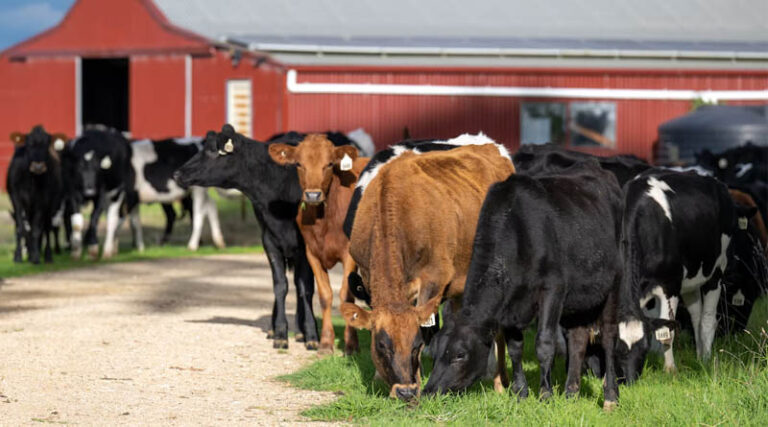
The livestock sector starts from a mixed baseline. Between 2020 and 2022, antimicrobial use in animals fell by 5% globally, according to the plan, with reporting covering 71% of the world’s animal biomass, the combined weight of farmed animals. A total of 157 countries contributed data to WOAH’s ANIMUSE database on animal antimicrobial use, and 71% of countries said in 2022 that they no longer used antimicrobials as growth promoters, the practice of giving low doses of antibiotics to make animals gain weight faster.
The plan calls for countries to phase out growth promotion, beginning with antimicrobials that WHO classifies as medically important for human medicine, although it sets no deadline. It also asks for prophylactic use, meaning treatment given to prevent disease rather than cure it, to be prudent and consistent with Codex Alimentarius food standards. Farm-level priorities include better biosecurity, improved animal husbandry, wider use of vaccination and alternatives to antimicrobials. The plan explicitly covers aquaculture and points to WOAH guidance on vaccines and to lists of essential veterinary medicines for food-producing animals.
Data collection is set to become more detailed. The plan asks for antimicrobial use in agrifood systems to be broken down by species, production stage and type of production system, guided by FAO, Codex and WOAH standards. WOAH is developing a veterinary counterpart to WHO’s AWaRe system, which groups human antibiotics into Access, Watch and Reserve categories according to how carefully they should be used.
Crops, money and the economic case
Plant agriculture gets its own attention. The plan says soil health, biodiversity and integrated pest management, which combines biological, cultural and chemical controls to limit pesticide use, can reduce inappropriate antimicrobial use, especially in crop production. It also flags persistent gaps in plant production and protection, in fungicide use and in antifungal resistance, an issue that links crop spraying to drug-resistant fungal infections in people. Countries are encouraged to set up take-back schemes for unused human and veterinary medicines so that they do not end up in soil and water.
The economic argument is aimed squarely at agriculture ministries. The plan says losses to livestock-sector GDP from AMR could reach US$575 billion by 2050, while a 30% cut in antimicrobial use in livestock within five years could add US$120 billion to global GDP. Funding remains the weak link: only 10% of countries reported dedicated domestic funding for their national AMR action plans in 2024.
Global Agriculture is an independent international media platform covering agri-business, policy, technology, and sustainability. For editorial collaborations, thought leadership, and strategic communications, write to pr@global-agriculture.com