Why Statistical Modelling Matters For Ethiopia’s Food Security Future
12 June 2026, Ethiopia: In Ethiopia, where agriculture remains the key to livelihoods and national economic security, future food security not only depends on improved seed, irrigation or mechanization, but on something less visible things: the ability to transform raw data into actionable scientific evidence. Throughout many of the universities and agricultural research stations in developing countries large data sets are collected every season. Yet much of this information remains underutilized because researchers often lack advanced analytical tools and practical statistical modelling skills needed to convert data into solutions that can guide policy, strengthen resilience, and improve productivity.
In this context, CIMMYT and Ambo university recently have joined hands to strengthen the analytical and research capacity of Ethiopian scientists in applied research using statistical modeling with R software environment.
Building evidence-based agricultural research
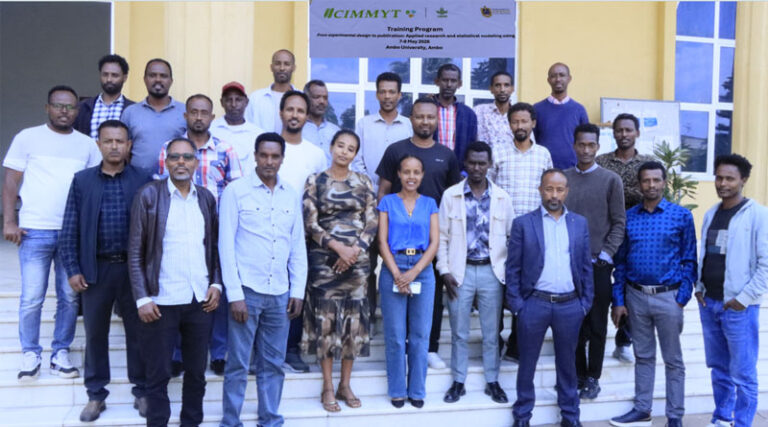
A three-day training (7-9 May, 2026) brought together University lecturers, researchers and junior scientists on the theme: “From Experimental Design to Publication: Applied Research and Statistical Modelling using R.”. Led by CIMMYT Systems Agronomist Dr. Tesfaye Shiferaw Sida, the training focused on the importance of designing a robust experiment and analyzing data in high standard research.
Given increased climate variability, land degradation and food security issues in Ethiopia, equipping participants with skills and tools to analyse complex agricultural datasets is a vital step towards improving best practices. By providing an opportunity to explore the application of statistical modelling approaches that relate to the knowledge and interests of agriculture researchers such as crop responses, soil quality, resource applications and climate change, the training contributed to actual decision making systems to improve practices in local farming systems. The training was not just theoretical in nature as it also motivated participants to bring their own research datasets so the skills gained could be used to address real on-farm problems.
Dr. Challa Hailu, Lecturer at Ambo University, highlighted the value of this approach:
“One of the most valuable aspects of the training was the opportunity to use our own research data during the practical sessions rather than random datasets. This made the learning highly relevant to our work and strengthened our ability to analyze, interpret, and present research findings effectively for high-quality scientific publications.”
Why statistical modelling matters
Contemporary agricultural research relies on high-level statistical tools, which can analyze complex, multi-faceted, big data. Software such as R equips scientists with the capability to analyze in greater depth, simulate different interventions, and produce evidence-based solutions. This data can support innovation and adaptation to climate change in Ethiopian agriculture. The strengthening of resilient food systems in Ethiopia under increasingly variable climatic conditions depends on new research and analytical abilities of researchers. The combination of growing familiarity with new statistical tools and already existing analytical skills make Ethiopian researchers a smart investment for agricultural development. The training addressed one institutional priority for the future: providing experienced and young Ethiopian researchers with the skills they need to utilize high level statistical tools.
For Meskerem Gulma, Lecturer at Ambo University, the inclusive nature of the training was particularly impactful:
“Mainly, we learned two important lessons from this training. First, it served as a capacity-building opportunity for colleagues already familiar with the R software and system. Second, for those taking the training for the first time, it provided an excellent introduction to the tool. The training significantly strengthened our capacity to produce high-quality research outputs suitable for renowned international journals.”
Strengthening Ethiopia’s scientific capacity
Beyond technical skill development, the initiative reflects a broader investment in Ethiopia’s scientific self-reliance and research excellence. Strong analytical capacity not only improves the quality of scientific publications but also strengthens the credibility of locally generated evidence that can inform agricultural policy and development planning. By producing more robust and globally competitive research, Ethiopian scientists will also expand Ethiopia’s influence in the global debate on climate resilience, food security, and sustainable agriculture.
Prof. Bizunesh Mideksa Borena, Vice President of Ambo University, emphasized the broader significance of the partnership:
“By mastering these practical analytical skills, our researchers are better equipped to produce high-impact, credible science that drives agricultural innovation and informed decision-making.”
Investing in the future of food security
The CIMMYT – Ambo University partnership exemplifies how replication of analytical capacity can translate into agricultural change. In a world dominated by information, the capacity to generate, interpret, and utilize scientific data is rapidly becoming as vital as the technologies being tested on farm. With climate stresses increasing and consequent implications for all elements of the food system, money invested into statistical modelling and applied research will be key to ensuring Ethiopia’s agricultural future remains strong, sustainable and just. Through equipping researchers with modern analytical tools, this effort is helping to turn data into knowledge—and knowledge into solutions that endure for food security.
Also Read: UPL Recognized as Top Innovator in AgriBusiness at Clarivate South Asia Innovation Awards 2026
Global Agriculture is an independent international media platform covering agri-business, policy, technology, and sustainability. For editorial collaborations, thought leadership, and strategic communications, write to pr@global-agriculture.com