Looming Beef Market Access Issues Create Uncertainty
23 May 2026, AU: Looming beef market access issues may threaten to affect the bright demand outlook for Australian beef over the next few months.
While some of these are almost seen as a fait of accompli, others are speculative, making the overall impact uncertain.
Looming beef market access issues may threaten to affect the bright demand outlook for Australian beef over the next few months. While some of these are almost seen as a fait of accompli, others are speculative, making the overall impact uncertain. Let’s go through them individually:
1. China has renewed the export licenses of 425 US beef plants which it let lapse in May 2025. Australian exporters have virtually replaced US beef in China which has been a key driver of the strength of our local prices in 2025 and so far in 2026. While Australia may be affected by increased US competition from US grainfed beef over the next few months, the biggest concern for Australian exporters is our lack of quota in China. The charts below show US and Australian beef exports to China since 2024.
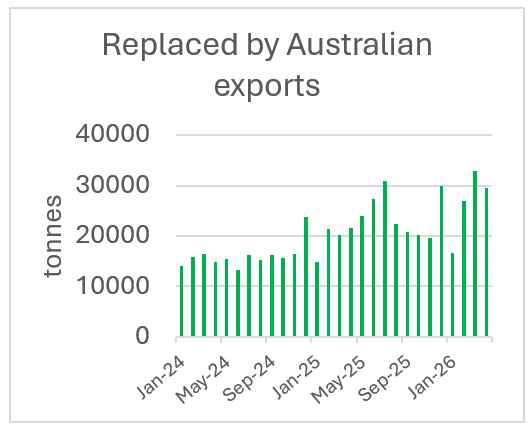
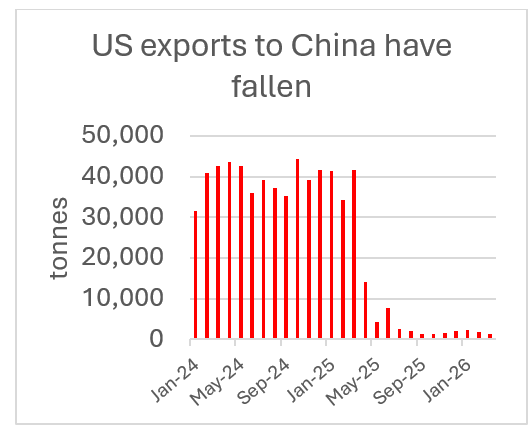
2. China’s Ministry of Commerce (MOFCOM) has announced Australian beef imports have reached 80 per cent of China’s 2026 safeguard quota (206,000 tonnes above, which our beef exports are levied at a prohibitive tariff of 55 per cent). Up to 30,000 tonnes per month (21 per cent of all exports) of Australian beef previously destined for China will need to be diverted to other markets (possibly at lower values) in H2 2026.
3. Brazil has already filled half its annual 1.1 million-tonne tariff-protected beef quota to China, and is on pace to exhaust the limit around mid-2026, after which 400,000 to 600,000 tonnes of Brazilian beef will need to be redirected from China to other destinations in H2 2026.
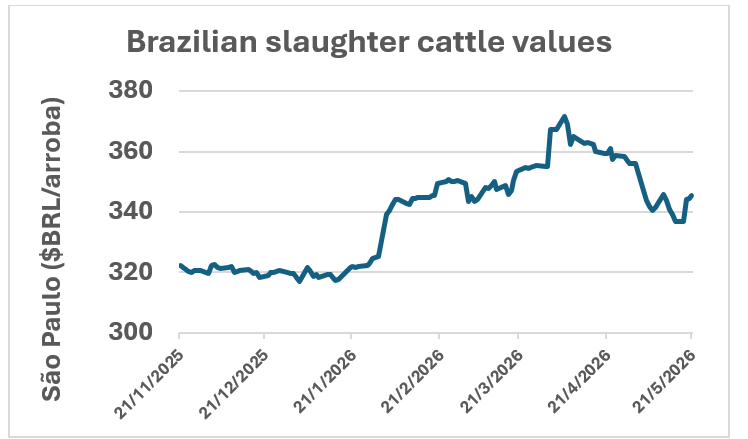
Live-cattle futures in São Paulo have already begun to ease as ranchers price in the coming domestic-market overhang. It is likely that some of this product will find its way to the US, intensifying competition against the Australian product.
4. Trade Ministers from both Brazil and Australia are in China this week asking Beijing to allow them to send more meat to China as both nations come close to exhausting their 2026 beef quotas. Many Chinese beef businesses have been less profitable in recent years, with Brazilian beef competing directly with local products. Australia’s Trade Minister Don Farrell will be asking China to exempt bones and chilled meat from the quota as it doesn’t compete as directly with Chinese domestic product. The Australian offal market in China is of vital importance, paying much higher prices than alternative markets.
5. Australia will likely trigger our Korean safeguard in late July, well ahead of the 12 September date on which this happened in 2025 (our above-quota tariff jumps to 24 per cent). Previously this has been managed by placing product in bond, to be used against the following year’s quota. It is uncertain if Korean importers will be willing to carry bonded product for up to five months this year. Last month, Australiaexported 21,000 tonnes to Korea (16 per cent of all exports).
6. Trump is considering suspending the TRQ (Tariff Rate Quota) on imported beef into the US which would allow Brazilian beef tariff-free access to the US market (currently the Brazilian out of quota tariff is 26.4 per cent). It is possible that Trump may act and impose a temporary additional tariff-free quota, like what he has done with Argentina, with a bunch of trade-offs to the domestic cattle industry. Brazil has been lobbying hard and with the US recently regaining access to China, the chances of this happening have strengthened. Trump needs a win on cost-of-living pressures before the November mid-terms. Given tight supplies of lean beef in the US, prices should hold relatively firm, however the reduction in the tariff on Brazilian beef may affect Australia’s competitive positioning in the US compared to the Brazilian product.
7. This issue is far from settled. Apparently, the USDA Secretary Brooke Rollins pushed back strongly against National Economic Council Director Kevin Hassett and Deputy Chief of Staff Stephen Miller who were demanding executive action to lower beef prices by removing tariffs on Brazilian beef. Rollins’ rationale was that it would create a huge amount of anger from American ranchers. The jury is still well and truly out on this one.
8. Brazil has reacted strongly to the EU’s decision to temporarily remove Brazil from the list of countries allowed to export. The dispute comes at a sensitive moment for relations between the EU and Mercosur, as the trade agreement between the two blocs entered into force only weeks ago. In 2025, Brazil exported 130,000 tonnes to EU countries and was hoping to increase exports under the new EU-Mercosur trade agreement to partly offset its loss of access to the Chinese market.
Also Read: China’s Fertilizer Trade Sees Strong Export Growth in Jan–April 2026, Potash Imports Remain Critical
Global Agriculture is an independent international media platform covering agri-business, policy, technology, and sustainability. For editorial collaborations, thought leadership, and strategic communications, write