How Somalia’s Diaspora is Strengthening Climate and Conflict Resilience
22 May 2026, Africa: For decades, political instability, climate shocks and clan-based violence have pushed Somalis from their homes. The civil war of the 1990s (PDF) scattered millions across the region and the world, creating one of the largest and most far-reaching diasporas in Africa.
Today roughly two million Somalis live abroad. Yet many remain closely tied to home, returning seasonally or permanently and maintaining strong economic and social ties to their communities.
As climate shocks intensify and conflict persists, those connections are taking on new importance. Can diaspora returnees help strengthen resilience to climate and conflict in Somalia?
This article examines that question through the experiences of nomadic pastoralist communities in Somalia’s Mudug region, drawing on interviews conducted in February 2025.
Remittances as Social Capital
In Somalia’s Mudug region, recurring drought has steadily eroded pastoralist livelihoods. As water and pasture disappear, livestock die, stripping families of their primary source of income and security. In this fragile environment, the Somali diaspora has become a critical source of support. Through remittances, relatives abroad send money that enables households to absorb drought shocks and help avert sudden destitution.
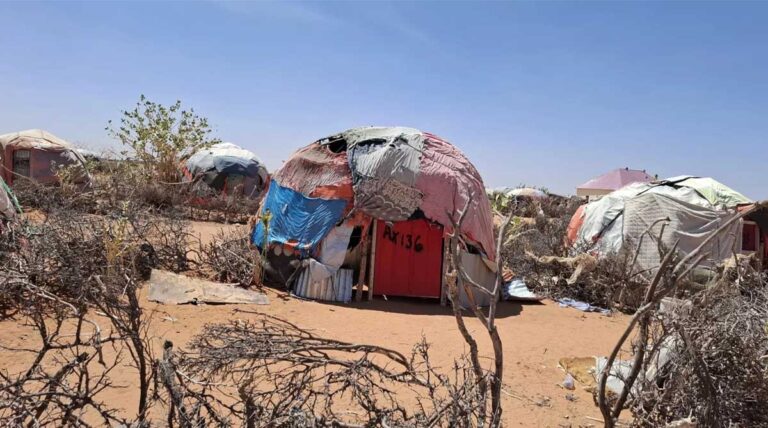
For households that lose their livestock, which is their primary source of livelihood, distress migration to urban areas as internally displaced persons (IDPs) becomes inevitable. Yet households with diaspora family members demonstrate comparatively greater resilience: regular remittance flows from the diaspora cover their basic needs during displacement, offering short-term financial security.
Therefore, remittances from the Somali diaspora, which is estimated to be between $1.3 and $2 billion per year, serve as a major lifeline for those who live in the country. Somalia’s remittance trend aligns with a continental one. In 2024 alone, the African continent received more than $95 billion in remittances, often surpassing foreign direct investment and export revenues. This highlights the African diaspora’s potential to contribute to the resilience of their home countries against various stresses and shocks.
Diaspora-Led Improvement in Milk Supply Chains
Nomadic pastoralism remains the backbone of livelihoods in Somalia’s Mudug region, with households earning income primarily through the sale of milk and heads of livestock (for meat). However, recurrent droughts are increasingly devastating herds, leading to food insecurity.
Against this backdrop, diaspora returnees have improved the camel-milk industry by introducing a new camel-milk production and distribution model. They began purchasing and keeping lactating she-camels near towns, allowing milk to be sold reliably in urban markets several times daily. This approach contrasts with traditional systems, in which nomads remain in distant pastoral areas, limiting their ability to access urban markets multiple times daily.
The model has since spread beyond diaspora-run enterprises. Groups of pastoralist families now pool their lactating camels and move them temporarily to peri-urban areas. Labor and management responsibilities are shared according to herd size. Using motorcycles for milk collection and delivery, this system has turned camel milk into a reliable source of income for often drought-hit nomadic pastoralists. The collective arrangement also enabled even nomadic households with a small number of lactating camels to have market access and sell their camel-milk cost-effectively.
Previously, nomadic pastoralists could sell only limited quantities of milk, which they transported on foot (sometimes using camels) to nearby towns, yielding minimal earnings. These dynamics demonstrate that diaspora returnees play a critical role in community capacity building, leveraging best practices and innovative approaches acquired abroad.
Introducing Crop Farming in Mudug’s Arid Climate
In Mudug, farming was historically rare and confined to small pockets in the coastal areas. It was widely believed that crops could not grow in the region due to its arid climate conditions, in contrast to other regions in southern and northwestern Somalia. However, diaspora returnees have challenged this assumption by successfully farming in the region, demonstrating the viability of crop production. As a result, crop farming is now spreading across the Mudug region, gradually reshaping local livelihoods and land-use patterns.
Diaspora Engagement in Peacebuilding
In Mudug, drought does more than destroy livelihoods. As water and pasture shrink, competition over scarce resources intensifies, often triggering clashes between clans.
Diaspora returnees frequently step into these disputes as mediators.
Because many have greater financial resources and higher levels of education than local residents, they often carry social and political influence. In some cases, they organize collectively to pressure local and state authorities to intervene in emerging conflicts.
They also fundraise along clan lines to support peace efforts. Moreover, diaspora returnees participate in cross-clan outreach efforts, working in close collaboration with clan elders and governmental authorities to facilitate peaceful dialogue and de-escalation. From this angle, they contribute to community cohesion. However, it is important to point out that some diaspora returnees also play a destabilizing role. They fuel inter-clan fighting by siding with their own clans and mobilizing resources in their support.
Overall, these contributions demonstrate that diaspora returnees constitute a strategic constituency, bringing critical skills, financial resources, and transnational networks that can be leveraged for climate resilience and peacebuilding.
Based on these insights, the following recommendations can be implemented to maximize their contributions.
Policy Recommendations:
- Diaspora returnees should be formally recognized as strategic partners in climate resilience and peacebuilding through structured engagement at both federal and state levels.
- Proven diaspora-led innovations should be documented and supported for wider replication.
- Better information on diaspora members and their activities should be collected to engage them more effectively and increase their contribution to climate resilience and peacebuilding.
- Finally, remittance costs should be lowered through regulatory reform. Fees to Sub-Saharan Africa remain high, averaging 7.9 percent, far above the SDG target of 3 percent by 2030. Reducing costs would increase disposable income and improve communities’ capacity to withstand climate and conflict shocks.
Authors: Joyce Takaindisa & Said Abdullahi
This work was carried out with support of the CGIAR Climate Action, and Food Frontiers and Security Science Programs. We would like to thank all funders who supported this research through their contributions to the CGIAR Trust Fund (https://www.cgiar.org/funders/)
Also Read: China’s Fertilizer Trade Sees Strong Export Growth in Jan–April 2026, Potash Imports Remain Critical
Global Agriculture is an independent international media platform covering agri-business, policy, technology, and sustainability. For editorial collaborations, thought leadership, and strategic communications, write