Testing, Trust, And Scale: How Partnerships Strengthen Farmer-led Change
22 May 2026, Zambia: From a small plot embedded in a hilly terrain, a farmer’s lived experience can reveal whether an idea works beyond a project document. In Kanyanja camp in Chipata District, Eastern Zambia, that test plays out every season under harsh conditions: worn soils, floods in some years, dry spells in others, and farms that must feed families from limited land. That is why the EU-funded Sustainable Intensification of Farming Systems in Zambia (SIFAZ) matters: it is not simply introducing technologies but building evidence, trust, and a practical path to adoption.
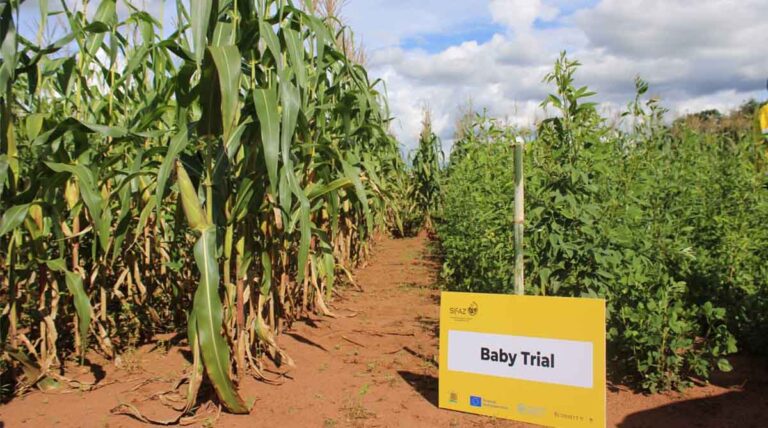
Known for maize-based smallholder farming, Kanyanja has become a valuable learning ground for how climate-smart sustainable intensification can move from research into real farmer decision-making. Seven years into implementation, the value of the SIFAZ partnership is increasingly clear, not just in the design of the trial fields, but in the confidence of farmers who can now compare options, test them on their own land and judge what is worth carrying forward. That progress is built on a simple but effective model, with seven technology (mother) trials and 175 outscaling (baby) trials working together. These trials are more than just demonstration plots and have created a practical pathway for farmers to test, compare, adapt, and gradually adopt better agronomic practices that fit their realities.
From a small plot embedded in a hilly terrain, a farmer’s lived experience can reveal whether an idea works beyond a project document. In Kanyanja camp in Chipata District, Eastern Zambia, that test plays out every season under harsh conditions: worn soils, floods in some years, dry spells in others, and farms that must feed families from limited land. That is why the EU-funded Sustainable Intensification of Farming Systems in Zambia (SIFAZ) matters: it is not simply introducing technologies but building evidence, trust, and a practical path to adoption.
Known for maize-based smallholder farming, Kanyanja has become a valuable learning ground for how climate-smart sustainable intensification can move from research into real farmer decision-making. Seven years into implementation, the value of the SIFAZ partnership is increasingly clear, not just in the design of the trial fields, but in the confidence of farmers who can now compare options, test them on their own land and judge what is worth carrying forward. That progress is built on a simple but effective model, with seven technology (mother) trials and 175 outscaling (baby) trials working together. These trials are more than just demonstration plots and have created a practical pathway for farmers to test, compare, adapt, and gradually adopt better agronomic practices that fit their realities.
At the core of the ongoing work is an impactful idea: farmers are more likely to trust what they can see and to sustain what they have tried themselves. The learning starts with the mother trials, which bring together 10 treatment plots side by side, allowing farmers to observe how different practices perform under the same local conditions. In Kanyanja, the treatments range from conventional ploughing, which reflects common farmer practice, to more intensive systems based on conservation agriculture with crop rotation, intercropping, and soil-improving trees such as Gliricidia sepium, a fast-growing leguminous tree known for restoring soil fertility.
The value of that process is visible in the experience of farmers like Annah Phiri, a mother trial implementer who manages the work together with her husband. On their site, farmers can observe a clear progression from conventional maize production to systems that add pigeon pea, crop rotation, and Gliricidia. This step-by-step design is key as it shows not only what works, but why it works. Under conventional tillage, farmers may still harvest a crop, but the system weakens over time. Repeated ploughing breaks down soil structure and depletes organic matter. In good rainfall seasons, that decline may go unnoticed. But when dry spells hit, the weakness becomes harder to ignore. The soil holds less moisture, the crop struggles, and the field has less capacity to recover.
The intensified plots tell a different story as the soil is protected, fertility is built up, and the farm produces more than one benefit at a time. Rotations help break pest and disease cycles. Pigeon pea adds value through food, income, and nitrogen fixation. Residue retention improves soil structure, while Gliricidia adds nutrients through its leaves and helps restore soil fertility over time. But intensification is not instant and requires good management and patience to finally realise good results. In the first and second years, results with Gliricidia were not immediate, but the difference became clearer from the third year onwards.
Connecting the dots between mother and baby trials
Farmers are not only interested in what works, but also want to know how long it takes, how much labour it requires and whether the results justify the effort. This is where the link between mother and baby trials becomes especially important. If the mother trial is the classroom building the evidence, the baby trial is the test of confidence in what holds. Baby trials take that learning one step further, allowing farmers to adopt one or two promising options from the mother trial and try them on a small portion of their own land, year in year out. That small size is deliberate, as it lowers risk, keeps labour and input demands manageable, and shifts the focus to learning what a technology can do.
Phanuel Banda is one of the baby trial implementers who took the leap and began with the simplest option of maize in rotation with groundnut. Over time, he moved to a more advanced option that includes rotating with pigeon pea and groundnut, taking ownership and pride in the outcome. That progression matters as it shows that farmers are not just replicating what they are told but making informed decisions that diversify their food basket. Farmers are comparing options, weighing labour needs, watching soil performance, and selecting practices that make sense for their households.
Not every practice spreads at the same pace. Strip cropping, for example, has been taken up more quickly because its benefits become visible early. Other options, especially those involving trees such as Gliricidia, take longer to show their full benefit, but do not make them less important. This simply means adoption tends to follow different timelines depending on the practice. This is where the partnership behind SIFAZ has been critical. CIMMYT brings the agronomic backbone. Through the mother trials, it generates evidence on which combinations of practices perform best under local conditions and which ones farmers respond to most positively.
As Christian Thierfelder, Principal Cropping Systems Agronomist at CIMMYT, puts it, “Agronomy is at the heart of this work as farmers need options that perform under their conditions, not just in theory. Mother trials help us compare those options clearly, while baby trials allow farmers to test them in their own fields and build confidence over time. That link is what turns research into adoption and impact.”
But research alone is not enough. Good agronomy is about identifying the combinations of practices that are workable, resilient, and relevant to farmers. For practices to spread, they also need trusted systems of promotion, farmer engagement and local support. Through promotional camps and extension structures, FAO and the Ministry of Agriculture help translate lessons from the trial plots into farmer action.
“What makes this model strong is the connection between evidence and outreach. CIMMYT generates strong agronomic lessons through trials, while FAO, working with the Ministry of Agriculture, helps translate that knowledge into promotional camps and farmer networks where practices can spread. This is how promising technologies move from research plots into farmers’ fields at scale,” states Mtendere Mphatso, Chief Technical Advisor for the SIFAZ project.
The Ministry of Agriculture plays an important role, as lasting adoption depends on the continuity of such innovations within the local systems beyond the project life. When ministry staff, camp officers, and local promoters are part of the process from the beginning, the learning does not leave with the project but stays in the community.
Kanyanja, therefore, offers more than a story of field trials; it provides evidence of a system that can continue to grow with the right support. Farmers like Annah Phiri are not only managing trials but becoming local proof points for what sustainable intensification can achieve when knowledge, patience, and partnership come together. The SIFAZ project has built a solid base of learning, farmer trust, and practical experience. It has been shown that intensification is not about pushing inputs. It is about solving a real problem and identifying ways to help farming families produce more, protect their soils, and stay resilient in a changing climate. The opportunity now is to build on that momentum.
Also Read: China’s Fertilizer Trade Sees Strong Export Growth in Jan–April 2026, Potash Imports Remain Critical
Global Agriculture is an independent international media platform covering agri-business, policy, technology, and sustainability. For editorial collaborations, thought leadership, and strategic communications, write