Biological Diversity Day 2026: TERI Launches New GEF-SGP India OP7 Publication on Community-Led Coastal Biodiversity Restoration
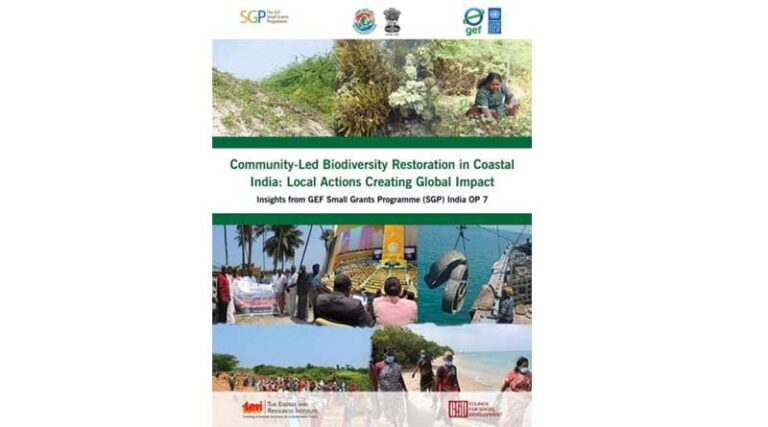
23 May 2026, New Delhi: On the International Day for Biological Diversity 2026, the Global Environment Facility Small Grants Programme (GEF-SGP) India Operational Phase-7 (OP7) launched a new publication titled, Community-Led Biodiversity Restoration in Coastal India: Local Actions Creating Global Impact. The publication has been prepared under the GEF-SGP India OP7, executed by the Ministry of Environment, Forest and Climate Change (MoEF&CC), Government of India, implemented by the United Nations Development Programme (UNDP), and coordinated by The Energy and Resources Institute (TERI), which serves as the National Host Institution. The booklet has been developed by TERI in collaboration with the Council for Social Development (CSD), Knowledge Partner for SGP-India OP7.
As the world faces accelerating biodiversity loss, ecosystem degradation, pollution, and climate-related risks, there is growing recognition that global biodiversity goals cannot be achieved through top-down approaches alone. Coastal and marine ecosystems such as coral reefs, sand dunes, wetlands, seagrass beds, and traditional agro-ecosystems are increasingly under pressure, directly affecting livelihoods, food security, and ecological resilience. The theme of this year’s International Day for Biological Diversity, “Acting Locally for Global Impact” highlights the critical role of local communities, women, indigenous knowledge systems, and grassroots institutions in restoring ecosystems and advancing sustainable development.
TERI’s publication documents eight community-led biodiversity restoration initiatives across Tamil Nadu and Maharashtra supported under GEF-SGP India OP7. The case studies cover diverse restoration pathways including artificial reef restoration, ghost gear management, sand dune restoration, women-led seaweed cultivation, sacred grove conservation, agro-biodiversity restoration, watershed restoration, and conservation of indigenous crops and food systems. Together, these experiences demonstrate how community participation, local ecological knowledge, and sustainable livelihood approaches can contribute to biodiversity conservation, climate resilience, pollution reduction, and ecosystem restoration.
The initiatives highlighted in the booklet showcase how local communities are emerging as key actors in biodiversity restoration and environmental stewardship. Fishing communities in Ramanathapuram are restoring marine habitats through artificial reefs and reducing marine pollution caused by ghost fishing gear. Coastal communities in Rameswaram are restoring fragile sand dune ecosystems to strengthen climate resilience and shoreline protection. Women-led seaweed cultivation initiatives are simultaneously improving livelihoods and supporting marine ecosystem restoration. Sacred grove restoration efforts are reviving ecologically and culturally important landscapes, while agro-biodiversity and indigenous crop conservation initiatives are strengthening sustainable farming systems and food resilience.
What makes the publication particularly significant is its effort to connect local restoration experiences with the Kunming–Montreal Global Biodiversity Framework (KMGBF), adopted under the Convention on Biological Diversity (CBD) in 2022. The booklet demonstrates how community-led initiatives contribute directly to global biodiversity targets related to ecosystem restoration, pollution reduction, sustainable use, gender inclusion, and participatory governance. By linking grassroots experiences with global policy frameworks, the publication highlights that local communities are not merely beneficiaries of conservation programmes, but active drivers of ecological restoration and resilient futures.
Dr Vibha Dhawan, Director General, TERI, said, “Behind every restored ecosystem is a community choosing hope over degradation. This booklet captures how local stewardship, women’s leadership, and grassroots action across coastal India are restoring biodiversity, strengthening resilience, and advancing global biodiversity goals under the Kunming–Montreal Global Biodiversity Framework. These stories remind us that local action truly creates global impact.”
Dr Dipankar Saharia, Senior Director, TERI, highlighted, “The publication demonstrates that biodiversity restoration is not only an ecological process, but also a social, institutional, and livelihood process driven by communities themselves. These case studies provide important evidence on how community-led approaches can operationalize global biodiversity goals on the ground while strengthening resilience, women’s participation, and sustainable livelihoods.”
The booklet is intended for policymakers, government agencies, researchers, civil society organizations, development practitioners, academic institutions, and community organizations working on biodiversity conservation, climate resilience, coastal ecosystem restoration, and sustainable development.
The publication titled, Community-Led Biodiversity Restoration in Coastal India: Local Actions Creating Global Impact was released on International Day for Biological Diversity 2026 and will be available through GEF-SGP India, TERI, and partner institutional platforms. The report can be accessed here.
Also Read: China’s Fertilizer Trade Sees Strong Export Growth in Jan–April 2026, Potash Imports Remain Critical
Global Agriculture is an independent international media platform covering agri-business, policy, technology, and sustainability. For editorial collaborations, thought leadership, and strategic communications, write